PRESS RELEASE
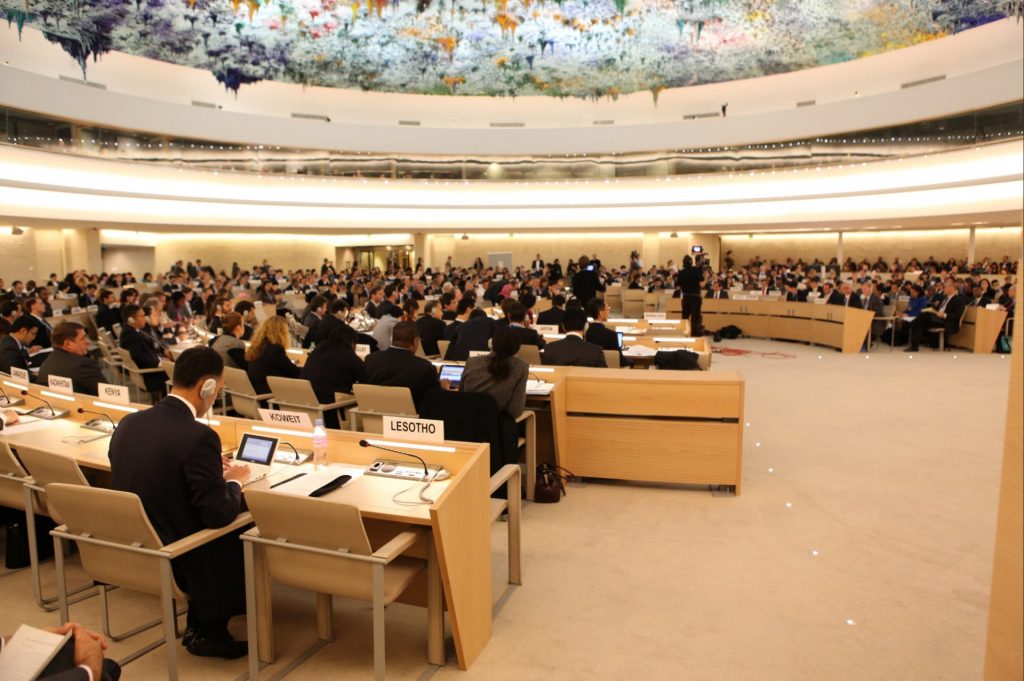
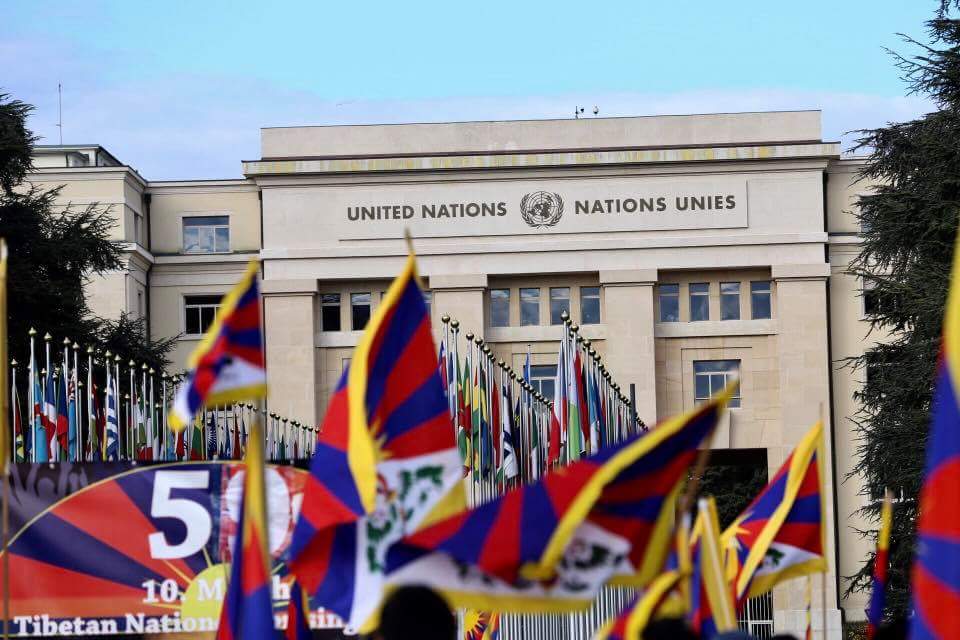
Date: 3 March 2025
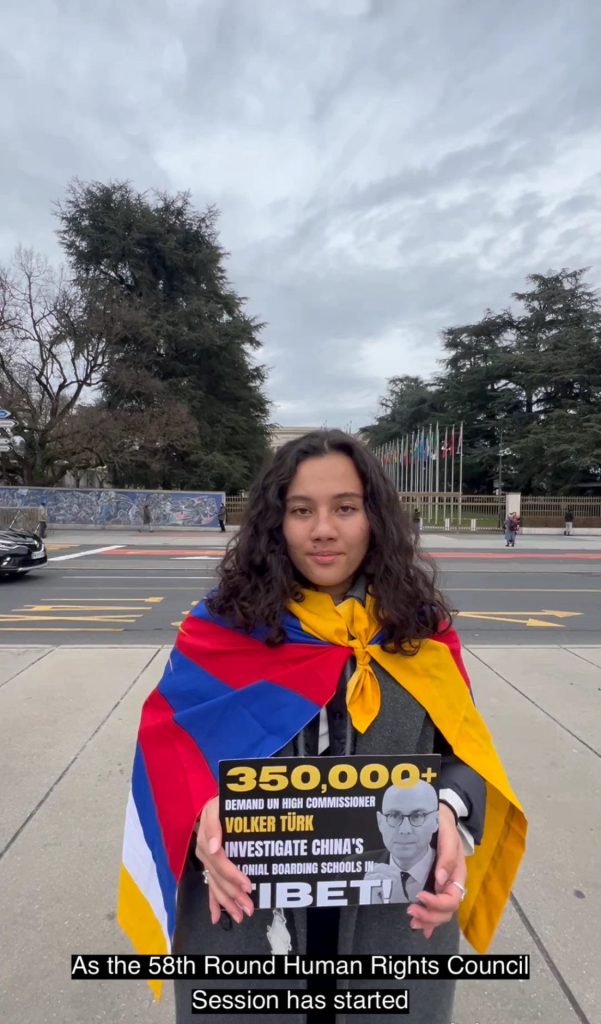
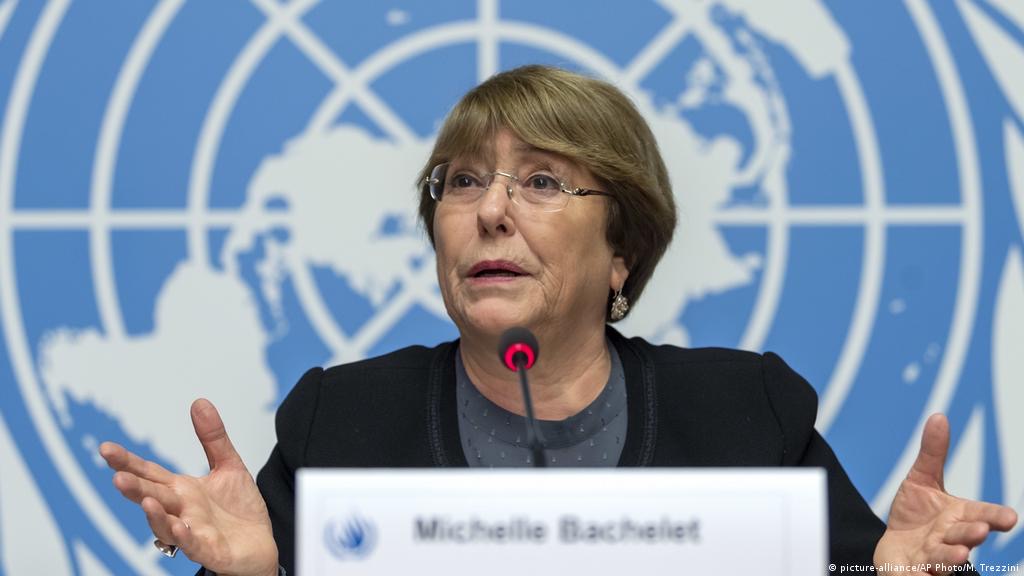
[Geneva] Tibetan activists and supporters welcome the UN High Commissioner for Human Rights, Volker Türk’s, acknowledgement of the worsening human rights situation in Tibet in his global update at the Human Rights Council today. For the first time since he became the highest-ranking human rights official, Türk expressed concern over “education policies and restrictions on freedom of expression and freedom of religion and belief in the Tibet Autonomous Region.” [1] Until now, Tibet has largely been absent from his oral updates. Today’s statement marks an important step forward – but it is not enough given the scale and severity of repression in Tibet. [2] Notably, Volker Türk’s remarks referred only to the Tibetan Autonomous Region (TAR), ignoring the fact that China’s coercive boarding school system is imposed across all of historic Tibet, including in what China calls Sichuan, Qinghai, Gansu and Yunnan provinces [3]. By limiting reference to the TAR, Türk overlooked the majority of Tibetans affected by these policies.
Tibet Advocacy Coalition [4] insists that the High Commissioner must go further. To effect real human rights improvements, he must explicitly name China’s boarding school system as a key driver of the forced assimilation of Tibetan children and demand its immediate abolition.
Pema Doma, Executive Director, Students for a Free Tibet said: “Tibetan activists and our global allies will not stop until these colonial boarding schools are abolished. The High Commissioner’s statement today was progress, but he must take more urgent, concrete action to hold China accountable. Every day that he hesitates, more Tibetan children are forcibly assimilated.”
Lhadon Tethong, Executive Director, Tibet Action Institute said: “The High Commissioner had a crucial opportunity to take a stand against China’s forced assimilation policies, yet he shied away from directly condemning the residential boarding schools. If the UN is serious about defending human rights, it must be willing to call out China’s blatant violations without hesitation. We urge Türk to make this a priority in his direct engagement with Beijing and in every international human rights forum.”
“We cannot afford diplomatic caution when an entire generation of Tibetan children is being systematically cut off from their language, culture, and families,” said Gloria Montgomery, UN Advocacy Director, Tibet Justice Center. “While we welcome the High Commissioner’s statement as progress, his failure to explicitly name China’s colonial boarding schools is a missed opportunity. The Chinese government will interpret broad statements as a sign that it can continue these assimilationist policies unchecked.”
Mandie McKeown, Executive Director, International Tibet Network, added: “This is a step forward, but not the decisive action that Tibetans desperately need. The High Commissioner must directly name and condemn these colonial boarding schools in Tibet, just as UN human rights experts have already done. Anything less lets Beijing off the hook.”
Karma Gahler, Co-President, Tibetan Youth Association in Europe: “We welcome the High Commissioner’s recognition of the human rights crisis in Tibet, but his statement falls short of what is needed. After months of advocacy and over 350,000 people calling on him to break his silence, he still failed to directly name China’s residential boarding school system. These coercive schools are the single greatest threat to Tibetan identity today, and if the High Commissioner truly wants to see human rights progress, he must call them out explicitly and demand their closure.”
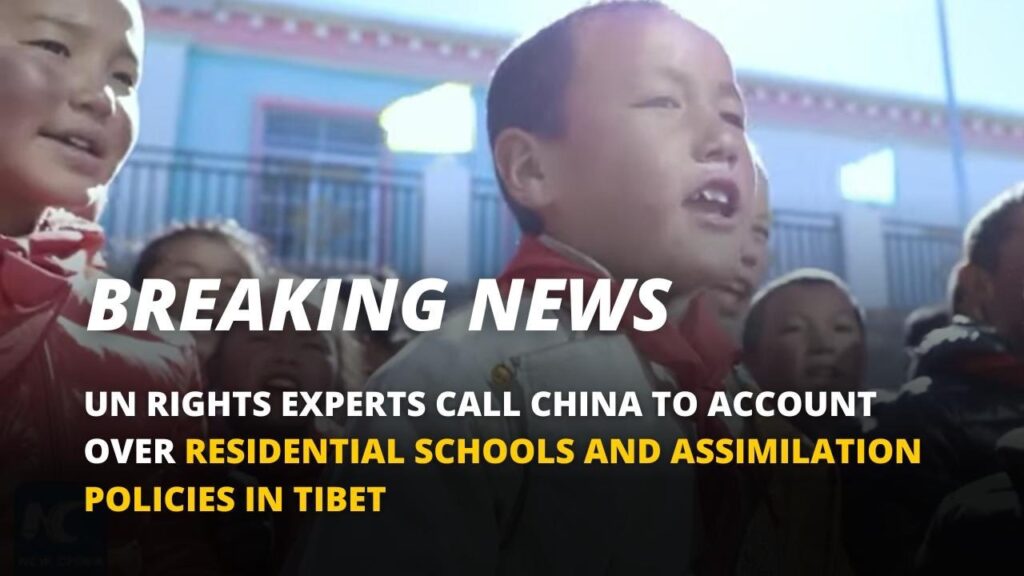
Over 350,000 people and 140 organisations worldwide urged the High Commissioner to explicitly condemn China’s vast network of residential boarding schools in Tibet [5], where at least one million Tibetan children are systematically separated from their families subjected to political indoctrination and alienated from their culture, including the Tibetan language [6]. Yet, despite the growing global alarm, Türk failed to directly call out this policy—one of the most egregious tools of forced assimilation in Tibet today. This omission is a missed opportunity for meaningful pressure on the Chinese government to abolish these coercive institutions and uphold Tibetan children’s fundamental rights.
UN human rights experts have already expressed alarm about these schools, including unequivocally calling on China to abolish them [7]. The gravity of this crisis [ demands more than careful wording by the UN High Commissioner – it requires clear condemnation and urgent action.
Former Special Rapporteur on Minority Issues, Fernand de Varennes, raised serious concern about the one million children in China’s forced boarding schools stating that “they are torn from their environment, their family, they are put in schools and villages far away from their home, their language, culture and religion….I don’t think so many children have ever been kept away from their community, their people before.” [8]
Tibet Advocacy Coalition urges the UN High Commissioner to build on today’s statement by making Tibet—and the boarding school crisis—a priority in all his global updates and during all his bilateral discussions with Chinese authorities. If the world’s leading human rights official does not take a clear stand, Beijing will only accelerate its systematic attempt to erase Tibetan identity.
— End-
Lhadon Tethong, Tibet Action Institute: +1 (917) 418 4181, lhadon@tibetaction.net
Gloria Montgomery, Tibet Advocacy Coalition: +44 (0) 7541 362001, gloria@tibetnetwork.org
Pema Doma, Students for a Free Tibet: +1 (617) 792-3606, pemadoma@studentsforafreetibet.org
Mandie McKeown, International Tibet Network: +44 (0) 7748 158618, mandie@tibetnetwork.org
—-
Notes to Editors:
[2] Freedom House, Freedom in the World 2025: The Uphill Battle to Safeguard Rights: https://freedomhouse.org/report/freedom-world/2025/uphill-battle-to-safeguard-rights
[3] GEOGRAPHICAL NOTE: ‘Tibet’ refers to the three Tibetan provinces of Amdo, Kham and U-Tsang. In the 1960s, the Chinese government split Tibet into new administrative divisions: the Tibetan Autonomous Region (TAR), and Tibetan Autonomous Prefectures within Qinghai, Gansu, Sichuan and Yunnan Provinces. When the Chinese government references Tibet, it is referring to the TAR.
[4] Tibet Advocacy Coalition is a project established in 2013 by International Tibet Network, Tibet Justice Center and Students for a Free Tibet to develop coordinated strategies, monitoring tools, and reports to highlight the situation in Tibet at the United Nations Human Rights Council. The Coalition core members are Tibet Justice Center, International Tibet Network Secretariat, Students for a Free Tibet, Tibetan Youth Association Europe, Tibet Action Institute and Tibet Initiative Deutschland.
[5] https://actions.tibetnetwork.org/un-protect-tibets-children; https://secure.avaaz.org/campaign/en/china_indoctrination_schools_loc/ and https://tibetnetwork.org/joint-letter-un-high-commissioner-for-human-rights/
[6] Tibet Action Institute, “Separated From Their Families, Hidden From the World: China’s Vast System of Colonial Boarding Schools Inside Tibet,” 2021, pg. 24, available at: https://tibetaction.net/wp-content/uploads/2022/12/2021_TAI_ColonialBoardingSchoolReport_Digital.pdf
[7] UN Communication by Mandates of the Special Rapporteur on minority issues; the Special Rapporteur in the field of cultural rights; the Special Rapporteur on the right to education and the Special Rapporteur on freedom of religion or belief, Ref.: AL CHN 6/2022, 11 November 2022: https://spcommreports.ohchr.org/TMResultsBase/DownLoadPublicCommunicationFile?gId=27444 and OHCH); “China: UN experts alarmed by separation of 1 million Tibetan children from families and forced assimilation at residential schools”, 6 February 2023, available at: https://www.ohchr.org/en/press-releases/2023/02/china-un-experts-alarmed-separation-1-million-tibetan-children-families-and;Committee on Economic, Social and Cultural Rights, Concluding Observations, 6 March 2023: https://tbinternet.ohchr.org/_layouts/15/treatybodyexternal/Download.aspx?symbolno=E%2FC.12%2FCHN%2FCO%2F3&Lang=en; Committee on Elimination of Discrimination Against Women, Concluding Observations, 30 May 2023: https://tbinternet.ohchr.org/_layouts/15/treatybodyexternal/Download.aspx?symbolno=CEDAW%2FC%2FCHN%2FCO%2F9&Lang=en
PRESS RELEASE
Date: 27 February 2025
FOR IMMEDIATE RELEASE
[Geneva] – With the UN High Commissioner for Human Rights set to deliver his global update on 3 March, all eyes are on Volker Türk and whether he will break his silence on Tibet’s deepening human rights crisis.
Among the most pressing concerns is China’s colonial boarding school system in Tibet, which houses at least one million Tibetan children [1], prompting a coalition of over 140 global Tibet groups and more than 350,000 concerned individuals [2] to call on him to break his silence on the issue and publicly condemn China’s policies targeting Tibetan identity, language, and heritage.
In a joint letter [3] submitted to the UN High Commissioner on 14 February, the coalition denounces these schools as “nothing short of cultural genocide targeting Tibet’s youngest and most vulnerable.” The letter calls on Türk to amplify the growing international alarm, echoing calls from UN human rights experts for the immediate abolition of these coercive institutions. [4]
The urgency of this appeal is underscored by the recent Freedom House report [5], which ranks Tibet with a global freedom score of zero, making it among the top “least free” in the world. This dire assessment places Tibet just marginally better than that of Russian-occupied territories in Ukraine, highlighting the severity of repression faced by Tibetans.
Since Turk assumed office in 2022, the human rights situation in Tibet has deteriorated at an alarming rate. Under the guise of “development” and “education,” the Chinese government has implemented policies designed to systematically erode Tibetan identity, language, and culture. Among the most egregious of these is the vast network of colonial-style residential boarding schools, where at least one million Tibetan children are forcibly separated from their families and placed into state-run facilities where they are forbidden from speaking their native language and subjected to political indoctrination. This is nothing short of a cultural genocide targeting Tibet’s youngest and most vulnerable.
Former Special Rapporteur on Minority Issues, Fernand de Varennes, raised serious concern about the one million children in China’s forced boarding schools. Speaking to Deutsche Welle, he said, “they are torn from their environment, their family, they are put in schools and villages far away from their home, their language, culture and religion….I don’t think so many children have ever been kept away from their community, their people before.” [6]
The call on the High Commissioner is backed by the global activist group AVAAZ and their supporters.
The 58th Session of the UN Human Rights Council opened on 24 February 2025, and Volker Türk is expected to give his ‘Global Update’ to the plenary on 3 March. Tibet Advocacy Coalition calls on him to end his silence and take a stand for Tibetan children’s rights.
Quotes from Tibet Advocacy Coalition Representatives:
Lhadon Tethong, Executive Director, Tibet Action Institute: “As the world’s highest human rights official, it is Volker Türk’s duty to use every tool in his diplomatic toolbox to get China to abolish its coercive boarding school policy that has separated three out of every four Tibetan students from their families. Turk needs to break his silence and issue a clear and public call for Chinese authorities to shutter these indoctrination schools and halt their egregious crimes against Tibetan children.”
Gloria Montgomery, UN Advocacy Director, Tibet Justice Center: “The silence of the UN High Commissioner on Tibet is an abdication of moral responsibility. Tibetan children deserve the High Commissioner’s vocal support, and we demand he use his platform to expose the coercive nature of these residential boarding schools in Tibet.”
Karma Gahler, Co-President, Tibetan Youth Association in Europe: “Tibetans deserve justice! The UN has an obligation to call out the Chinese government’s violations, including the forced separation of children from their families. It is time for the High Commissioner to act.”
Pema Doma, Executive Director, Students for a Free Tibet: “This is a present-day human rights crisis. The UN must act, and its highest human rights official must lead by example. High Commissioner Türk’s failure to take a stand only emboldens Beijing as it continues to close local schools, forces more Tibetan children into residential boarding schools, and tears families apart.”
Mandie McKeown, Executive Director, International Tibet Network: “China’s assault on Tibetan culture and identity, under the guise of ‘development and education’, must not be ignored. We urge High Commissioner Türk to take decisive action and hold China accountable. The future of Tibet cannot wait.”
-End-
Lhadon Tethong, Tibet Action Institute: +1 (917) 418 4181, lhadon@tibetaction.net
Gloria Montgomery, Tibet Advocacy Coalition: +44 (0) 7541 362001, gloria@tibetnetwork.org
Pema Doma, Students for a Free Tibet: +1 (617) 792-3606, pemadoma@studentsforafreetibet.org
Mandie McKeown, International Tibet Network: +44 (0) 7748 158618, mandie@tibetnetwork.org
—-
Notes for editors:
- Tibet Action Institute, “Separated From Their Families, Hidden From the World: China’s Vast System of Colonial Boarding Schools Inside Tibet,” 2021, pg. 24, available at: https://tibetaction.net/wp-content/uploads/2022/12/2021_TAI_ColonialBoardingSchoolReport_Digital.pdf
- https://actions.tibetnetwork.org/un-protect-tibets-children and https://secure.avaaz.org/campaign/en/china_indoctrination_schools_loc/
- https://tibetnetwork.org/joint-letter-un-high-commissioner-for-human-rights/
- UN Communication by Mandates of the Special Rapporteur on minority issues; the Special Rapporteur in the field of cultural rights; the Special Rapporteur on the right to education and the Special Rapporteur on freedom of religion or belief, Ref.: AL CHN 6/2022, 11 November 2022: https://spcommreports.ohchr.org/TMResultsBase/DownLoadPublicCommunicationFile?gId=27444 and OHCH); “China: UN experts alarmed by separation of 1 million Tibetan children from families and forced assimilation at residential schools”, 6 February 2023, available at: https://www.ohchr.org/en/press-releases/2023/02/china-un-experts-alarmed-separation-1-million-tibetan-children-families-and;Committee on Economic, Social and Cultural Rights, Concluding Observations, 6 March 2023: https://tbinternet.ohchr.org/_layouts/15/treatybodyexternal/Download.aspx?symbolno=E%2FC.12%2FCHN%2FCO%2F3&Lang=en; Committee on Elimination of Discrimination Against Women, Concluding Observations, 30 May 2023: https://tbinternet.ohchr.org/_layouts/15/treatybodyexternal/Download.aspx?symbolno=CEDAW%2FC%2FCHN%2FCO%2F9&Lang=en
- Freedom House, Freedom in the World 2025: The Uphill Battle to Safeguard Rights: https://freedomhouse.org/report/freedom-world/2025/uphill-battle-to-safeguard-rights
- https://www.instagram.com/reel/DBYj_ynI_Yy/
23 October, 2024
In a historic move, 15 UN member states [1], including Australia, Canada, Japan, the UK and the United States, delivered a groundbreaking joint statement at the UN General Assembly’s Third Committee [2] expressing serious concern about “credible reports detailing human rights abuses in Tibet.”
China’s abuses in Tibet haven’t been meaningfully addressed in New York since a resolution in 1965. This is the first time a comprehensive joint statement by UN Member States at the General Assembly has seriously addressed human rights violations in Tibet.
On 22 October, the UN Member states told the UN General Assembly that China has had “many opportunities meaningfully to address the UN’s well-founded concerns,” but it has systematically failed to do so. Most recently, in July 2024, Beijing rejected almost 70% of the Tibet-specific recommendations put forward by governments at China’s 4th Universal Periodic Review [3]. China simultaneously rejected all calls for UN human rights monitors to access Tibet.
The UN Member states stressed the well-documented range of China’s violations in Tibet, detailing concerns on: the detention of Tibetans for the peaceful expression of political views; restrictions on travel; coercive labour arrangements; separation of children from families in boarding schools; and erosion of linguistic, cultural, educational and religious rights and freedoms in Tibet.” China was also called on directly by governments to release “all individuals arbitrarily detained” in Tibet and to urgently clarify “the fate and whereabouts of missing family members.”
Over the last two years, Tibet Advocacy Coalition [4] has presented evidence to multiple UN mechanisms on these above-mentioned concerns.
Despite years of UN reports detailing these abuses in Tibet, China has consistently failed to take responsibility or implement UN recommendations. The human rights situation in Tibet has become so severe, that in June 2020, over 50 UN experts urged UN Member States to establish a new UN mechanism to monitor and investigate human rights violations by China [5].
UN Member states also called on China to “fully implement all UN recommendations,” including by UN treaty Bodies and other UN human rights mechanisms. In March and May 2024, the UN Committee on Economic, Social, and Cultural Rights [6] and the UN Committee on the Elimination of Discrimination against Women [7] both strongly criticised the Chinese Government’s coercive residential school system in Tibet and called for it to be immediately abolished.
Lhadon Tethong, Director of Tibet Action: “This damning joint statement at the UN General Assembly’s 3rd Committee demonstrates grave global concern over the Chinese government’s war on Tibetan identity, including Beijing’s system of colonial boarding schools where an estimated one million Tibetan children, some as young as four, are being forcibly assimilated. The statement amplifies similar concerns raised at China’s January 2024 review by the UN Human Rights Council and shows Beijing can’t conceal its crimes against Tibetans. Now these states should focus on holding Chinese officials accountable.”
Pema Doma of Students for a Free Tibet: “Despite China’s relentless crackdown in Tibet, the Tibetan people have persevered in speaking out and fighting for their fundamental rights. This unprecedented joint statement shows that governments are paying attention and can hear their voices. Here we see the international community has a choice: to either stand together on the right side of history by taking action to protect Tibetan children and Tibet’s ancient identity and way of life or be complicit in China’s erasure and decimation of Tibet. This statement is a powerful sign that governments will do the right thing and that grassroots advocacy can make a difference.
Mandie McKeown of International Tibet Network: “After a hiatus at the UN General Assembly, Tibet is finally being brought into this important multilateral forum with a bang. This strong joint statement is not only necessary in the push for China’s accountability but also for Tibetans who continue to resist China’s illegal rule and severe repression of rights. It also acts as a reminder that the struggle of the Tibetan people has not gone unnoticed, and an influx of hope will support Tibetans continued push for freedom. It is essential that this momentum continues. ”
Gloria Montgomery of Tibet Advocacy Coalition: “We urge all UN member states to pay heed to this landmark development, echo these vital calls, and stand in unwavering solidarity with the Tibetan people. The systemic violations in Tibet demand our continued scrutiny and accountability. For years, UN treaty bodies and experts, along with civil society, have documented these violations, making them impossible to ignore. UN member states are finally awakening to the urgent warnings about the crisis unfolding in Tibet.”
CONTACTS:
Gloria Montgomery, Tibet Advocacy Coalition: +44 7541 362001
Lhadon Tethong, Tibet Action Institute: +1 917-418-4181
Mandie McKeown, International Tibet Network: +44 7748 158618
Pema Doma, Students for a Free Tibet: +1 617-792-3606
Notes for Editors:
[1] Australia, Canada, Denmark, Finland, France, Germany, Iceland, Japan, Lithuania, the Kingdom of the Netherlands, New Zealand, Norway, Sweden, the United Kingdom, and the United States of America.
[2] UNGA79 Third Committee: General Discussion on Human Rights: Joint statement on the human rights situation in Xinjiang and Tibet: https://unny.mission.gov.au/unny/241022_UNGA79_Joint_statement_on_the_human_rights_situation_in_Xinjiang_and_Tibet.html
[3] The Universal Periodic Review (UPR) is a peer-review process under the auspices of the UN Human Rights Council, where UN Member States assess each other’s human rights records, their fulfilment of human rights obligations and commitments, and provide recommendations to the State under review: https://www.ohchr.org/en/hr-bodies/upr/upr-home
This is China’s fourth review under the Universal Periodic Review, and whilst China has nominally participated in the process, in reality, it has failed to adhere to any of the accepted recommendations agreed in the last three Reviews (2009, 2013 and 2018), has failed to include any public consultation in the preparing of its national report, and has presented the UNHRC with false information about improvements that have been made.
The OHCHR, Universal Periodic Review – China report is available at: https://www.ohchr.org/en/hr-bodies/upr/cn-index
See the Addendum at https://www.ohchr.org/en/hr-bodies/upr/cn-index and as a PDF at https://tibetnetwork.org/free1/wp-content/uploads/2024/07/China-4th-UPR-Addendum-July-2024.pdf
[4] Tibet Advocacy Coalition is a project established in 2013 by International Tibet Network, Tibet Justice Center, and Students for a Free Tibet to develop coordinated strategies, monitoring tools, and reports to highlight the situation in Tibet at the United Nations Human Rights Council. The Coalition’s core members are Tibet Justice Center, International Tibet Network Secretariat, Students for a Free Tibet, Tibetan Youth Association Europe, Tibet Action Institute, and Tibet Initiative Deutschland.
[5] https://www.ohchr.org/EN/NewsEvents/Pages/DisplayNews.aspx?NewsID=26006&LangID=E
[6] The Committee on Economic, Social, and Cultural Rights (CESCR) is the body of 18 independent experts that monitors the implementation of the International Covenant on Economic, Social and Cultural Rights by its State parties. The Covenant enshrines economic, social, and cultural rights such as the rights to adequate food, adequate housing, education, health, social security, water and sanitation, and work. The Committee seeks to develop a constructive dialogue with State parties, determine whether the Covenant’s norms are being applied, and assess how the implementation and enforcement of the Covenant could be improved so all people can enjoy these rights in full.
Committee on Economic, Social and Cultural Rights, Concluding Observations, 6 March 2023: https://tbinternet.ohchr.org/_layouts/15/treatybodyexternal/Download.aspx?symbolno=E%2FC.12%2FCHN%2FCO%2F3&Lang=en
[7] The Committee on the Elimination of Discrimination against Women (CEDAW) is the body of independent experts that monitors the implementation of the Convention on the Elimination of All Forms of Discrimination against Women. The CEDAW Committee consists of 23 experts on women’s rights from around the world.
Committee on Elimination of Discrimination Against Women, Concluding Observations, 30 May 2023: https://tbinternet.ohchr.org/_layouts/15/treatybodyexternal/Download.aspx?symbolno=CEDAW%2FC%2FCHN%2FCO%2F9&Lang=en
6 September 2024
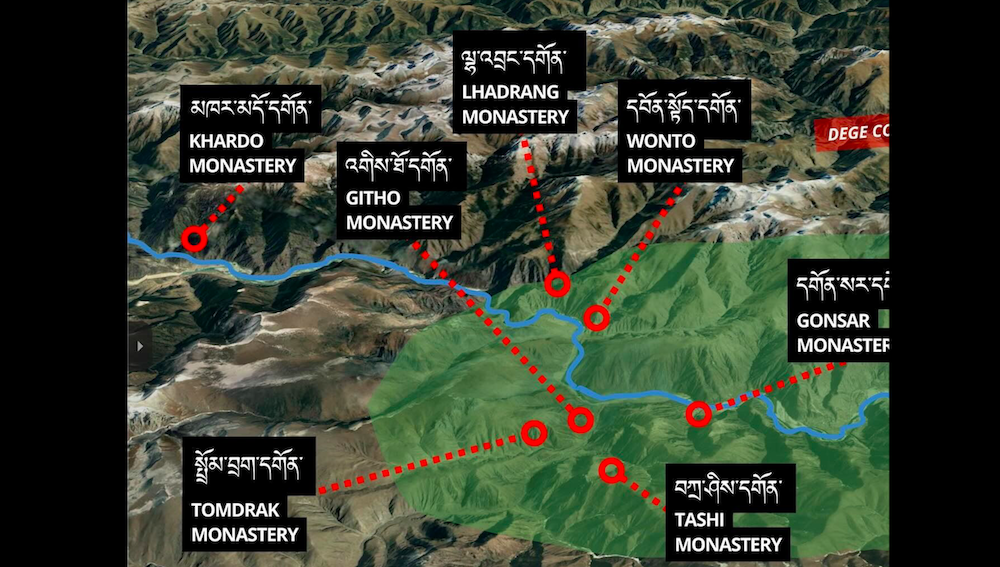
Thirteen UN human rights experts [1] have today made public their concerns about the construction of the Kamtok (Ch: Gangtuo) hydroelectric dam on the Drichu River (Ch: Cháng Jiāng / commonly known as Yangtze) in Tibet, warning of “dire and irreversible environmental and climate impacts” and “irreversible destruction of important cultural and religious sites” should it go ahead [2].
The Kamtok dam came to widespread attention in February 2024, when large public protests in eastern Tibet against the dam were broken up by police. Tibetans in Dege and Jomda counties have long opposed the dam, because it would displace Tibetan communities, destroy cultural heritage, and cause severe environmental damage. Research by Tibet groups has found that the dam would displace a minimum of 4,000 Tibetans across the two counties, and submerge two villages [2], as well as six Tibetan monasteries, some of which house precious Buddhist murals more than 500 years old [3].
In their communication to China, the UN experts raised concerns that the dam construction will cause the “forced displacement and relocation of Tibetans”. They noted that this concern extends far beyond Dege and Jomda counties, citing a 2009 announcement by authorities that the broader hydropower development on the Tibetan plateau would see 120,000 residents in the upper reaches of the Yellow River in Qinghai Province relocated from their homes by 2030.
Notably for a hydropower project, the UN experts also raised the “irreversible or significant environmental (biodiversity and climate) impacts” that the Kamtok dam would have. The communication notes that the dam would impact one of the largest rivers on Earth “and an important and strategic area to guarantee water and food security, as well as ecosystem health and climate stability”.
According to the experts, the dam threatens not only Tibet’s fragile biodiversity but also contributes to worsening climate change, as large-scale hydroelectric dams are known to increase greenhouse gas emissions and exacerbate natural disasters like landslides and floods.
Local Tibetans have expressed opposition to the Kamtok dam since plans were first proposed in 2012 [4]. The February 2024 protests were notable for their scale and for the number of images and videos of them, both of which are rare in occupied Tibet due to the intense levels of surveillance and security. Several hundred Tibetans were arrested and detained for opposing the dam’s construction. Research groups noted numerous instances of protesters, including monks, being beaten and denied access to their families. There is no evidence that they have been granted access to lawyers.
The UN experts expressed numerous concerns over this response to the peaceful protests, noting “the widespread crackdown” on Tibetan individuals peacefully expressing their opposition to the construction of the Kamtok dam as well as China’s use of force, arbitrary arrests, and detentions against Tibetans simply exercising their “legitimate” human rights. “These incidents underscore the alarming reality for people living in Tibet, who have faced similar allegations and consequences, for exercising their fundamental rights,” said UN experts.
The Kamtok dam project, developed by a subsidiary of the state-owned enterprise China Huadian Corporation Ltd (Huadian Jinsha River Upstream Hydropower Development Co., Ltd), is part of a broader strategy to export hydropower from Tibet to eastern China.
Yet UN experts state that the relocation of Tibetans from these lands will “adversely [impact] their rights to development and self-determination, to maintain their ways of life, to land and housing, to access and enjoy heritage, to exercise their religious and cultural practices, and their right to a clean, healthy and sustainable environment.”
Their statement spotlights the lack of free, prior, and informed consent from affected Tibetan communities, as well as China’s failure to provide for meaningful consultation about their forced displacement. There are also no indications that any environmental impact assessment that specifically considered the Kamtok project was ever conducted.
The communication was issued to the Chinese government on 8 July 2024 and they were requested to reply within 60 days. As of yet, the Chinese government has failed to issue a response.
Pema Doma of Students for a Free Tibet said, “China’s crackdown on peaceful opposition to this dam project is part of a broader campaign to suppress Tibetan voices and erase our culture. The repression of the Derge protests, including the arbitrary arrests and detentions of hundreds of Tibetans, is a clear violation of their human rights. We call on China to immediately release all those who remain in detention for peacefully exercising their rights and demand an end to Beijing’s systematic oppression of the Tibetan people.”
Lhadon Tethong from Tibet Action Institute said: “With this communication UN experts have confirmed what Tibetans have known all along: China’s so-called development projects in Tibet have disastrous consequences for every aspect of Tibetan life, but the people are not free to object and resistance is truly perilous. The courageous resistance the people of Derge mounted to this devastating dam project shows that the Tibetan people have not lost the will to fight to protect their ancestral lands and precious cultural heritage, even in the Xi Jinping era.
Gloria Montgomery of Tibet Advocacy Coalition said, “This project is threatening the very fabric of Tibetan life—displacing communities, destroying ancient monasteries, and wreaking havoc on the environment. UN experts have sought to shine a light on the injustices Tibetans face and we call on the international community to amplify these concerns, calling on China to immediately halt this project before it inflicts further irreparable harm.”
John Jones from Free Tibet said, “This communication by some of the world’s foremost human rights experts lays bare why the Kamtok dam is such a danger to the people of Dege and Jomda county, and why they need our support. It should prompt fresh efforts from international governments to oppose the dam. It should prompt companies with links to China Huadian, the company behind the dam, to sever them. And it must see the release of any Tibetans who remain in detention for opposing this dam. Not only is their detention unjust, but their concerns have been vindicated.”
“Tibet is often referred to as the ‘Third Pole’ because of its critical role in regulating global climate patterns,” explained Lobsang Yangsto of International Tibet Network. “The destruction of Tibet’s environment through massive infrastructure projects like this one will have ripple effects far beyond the region.The UN’s recognition of this danger is timely and crucial as China continues to trample over the rights of Tibetans, their heritage and environment.”
Ends
Contact:
Lhadon Tethong, Tibet Action Institute: lhadon@tibetaction.net +1 917 418 4181
John Jones, Free Tibet: john@freetibet.org +44 7591 188383)
Pema Doma, Students for a Free Tibet | English or Tibetan language inquiries | pemadoma@studentsforafreetibet.org
Gloria Montgomery, Tibet Justice Center: +447541362001
Rashi Jauhri, International Tibet Network: rashi@tibetnetwork.org +44 7587 094876
Notes for editors:
[1] UN Communication to China, AL CHN 8/2024, 8 July 2024, https://spcommreports.ohchr.org/TMResultsBase/DownLoadPublicCommunicationFile?gId=29120.
Signed by 13 UN mandate holders: Mandates of the Special Rapporteur in the field of cultural rights; the Working Group on Arbitrary Detention; the Working Group on the issue of human rights and transnational corporations and other business enterprises; the Special Rapporteur on the promotion and protection of human rights in the context of climate change; the Special Rapporteur on the right to development; the Special Rapporteur on the human right to a clean, healthy and sustainable environment; the Special Rapporteur on the promotion and protection of the right to freedom of opinion and expression; the Special Rapporteur on the rights to freedom of peaceful assembly and of association; the Special Rapporteur on adequate housing as a component of the right to an adequate standard of living, and on the right to non-discrimination in this context; the Special Rapporteur on the rights of Indigenous Peoples; the Special Rapporteur on the human rights of internally displaced persons; the Special Rapporteur on minority issues and the Special Rapporteur on freedom of religion or belief
[2] Wonpotoe (Wangbuding) township in Derge (Dege (Kardze)) County and Shepa village in Jomda (Jiangda) County (Chamdo (Changdu)
[3] Yena, Wontoe, Khadho, Rabten, Gonsar and Tashi Monasteries.
[4] ‘Tibetans’ appeal against the construction of hydropower stations, and “Running to grab water in Tibet – On the large-scale development of hydropower in Tibet”’, Invisible Tibet, 29 October 2012 http://woeser.middle-way.net/2012/10/blog-post_29.html
2 minutes. Italics only for written version.
Mr. President,
This is a joint statement, in solidarity with the victims of human rights violations committed by the Chinese government.
Numerous UPR recommendations echo the long-standing, deep concerns of dozens of UN experts and committees raised since China’s last review, including: stopping lengthy, arbitrary detention on national security grounds of human rights, lawyers and journalists ; ending Residential Surveillance at a Designated Location (RSDL) and all other forms of enforced disappearances; putting an end to the cultural, religious persecution of Uyghurs and Tibetans; repealing Hong Kong’s draconian National Security Law; and respecting the rights of women and the LGBTI community.
We regret that China dismissed 30% of recommendations received – unsurprisingly related to the plight of Uyghurs, Tibetans, Hong Kongers, feminist and LGBTI activists, human rights defenders and lawyers – an increase from the 18% already noted five years ago. This shows a blatant disregard for human rights principles. The claim that some are ‘already implemented’ is nothing short of deceitful, in light of damning UN findings.
Many countries, including from the Global South, called for the implementation of UN Treaty Body recommendations. To this, Beijing stated it (quote) ‘opposed [Treaty Body] recommendations that are based on false information’ (end of quote).
Beijing scrapped calls for unrestricted access to the country for UN experts: if no abuses are being committed, then why not accept the 15 pending visit requests from UN experts?
Beijing’s facade as a constructive actor at the UN is shattered by its acts of reprisals against human rights defenders throughout this UPR cycle, and by attempts to block NGO access to this very room. We remind this Council that Cao Shunli died for trying to take part in this same review process ten years ago.
Dear Council members,
How can this record be reconciled with any attempt to become a constructive, reliable multilateral actor?
We are at a crossroads.
We urge China to genuinely engage with the UN human rights system to enact meaningful reform, and ensure all individuals and peoples enjoy internationally protected human rights. Recommendations from the OHCHR Xinjiang report, UN Treaty Bodies, and UN Special Rapporteurs chart the way for this desperately needed change.
In the absence of genuine efforts, it is equally imperative that this Council establishes a monitoring and reporting mechanism as repeatedly called for by over 40 UN experts since 2020.
Thank you,
Signatory organisations (with ECOSOC consultative status):
Anti-Slavery International
Christian Solidarity Worldwide (CSW)
CIVICUS
Human Rights Watch
International Bar Association’s Human Rights Institute (IBAHRI)
International Federation for Human Rights (FIDH)
International PEN
International Service for Human Rights (ISHR)
Signatory organisations (without ECOSOC consultative status):
Campaign for Uyghurs
China Aid Association
Chinese Human Rights Defenders
China Rainbow Observation
Freedom United
Global Center for the Responsibility to Protect
Hong Kong Democracy Council
Hong Kong Watch
Human Rights in China
International Campaign for Tibet
International Tibet Network
Lawyers for Lawyers
Students for a Free Tibet
The Rights Practice
Tibet Action Institute
Tibet Justice Center
Tibetan Centre for Human Rights and Democracy
Tibet Youth Association in Europe
Uyghur Huma Rights Project
World Uyghur Congress
民間司法改革基金會 Judicial Reform Foundation
China Rejects Almost 70% of UN Member State Recommendations Urging for Justice and Accountability in Tibet
3 July 2024 – FOR IMMEDIATE RELEASE
Tibet campaigners have expressed deep concern following China’s rejection of almost 70% of the Tibet-specific recommendations put forward by governments aimed at improving human rights.
In January 2024, 20 UN Member States used China’s Universal Periodic Review (UPR) [2] in Geneva to raise concerns about the deteriorating human rights situation in Tibet, making 24 uncompromising recommendations on Tibet.
The increased concern about Tibet by governments was hailed as a “landmark” showing a two-fold increase on the last Review in 2018, signalling the severity of the worsening of the human rights situation on the ground, as China continues to deny independent UN human rights monitors access to the country.
While China claims to have accepted 290 recommendations, a closer look reveals a disturbing pattern of dismissal and deflection when it comes to Tibet.
China rejected the majority of Tibet-related recommendations on the grounds that they “are based on false information” despite years of UN documentation detailing the urgency of the human rights crisis in Tibet.
Among those recommendations rejected were that China abolish the coercive system of residential boarding schools in Tibet; end forced labour and coercive labour transfer in Tibet; cease the persecution and arbitrary detention of Tibetans.
Beijing simultaneously rejected all calls for UN human rights monitors to access Tibet, stating that they “undermine China’s sovereignty”, yet again showcasing China’s refusal to engage with the UN and its mechanisms for the promotion and protection of the rights of the Tibetan people.
While China “accepted” a handful of recommendations on Tibet on the grounds that they are “already implemented”; an extensive catalogue of evidence by UN experts points to these violations being unremedied [3].
UN Documentation Ignored
Over the last two years, multiple UN human rights bodies have raised the alarm at the escalation of human rights violations in Tibet, including the separation of nearly one million Tibetan children from their families in a residential school system [4], an extensive labour transfer programme [5]; a massive relocation program of the rural Tibetan population [6]; the imprisonment of Tibetan environmental defenders [7]; and the sidelining of Tibetan-language education. Tibetans continue to face torture, death in custody [8], and enforced disappearances at the hands of the Chinese state [9].
Years of UN reports detailing these abuses along with calls for access for UN human rights experts were cynically dismissed by China as”false information” and infringements on national sovereignty.
“By refusing to cooperate with the UN, China is doubling down on harming Tibetan children and their families,” said Lhadon Tethong, Director of Tibet Action. “It’s the UN’s job to investigate widespread abuses and try to hold those responsible to account; Beijing calling credible evidence of the coercive boarding schools in Tibet from UN experts, NGOs, scholars, and journalists ‘false information’ is an outrageous rejection of this process.”
Topjor Tsultrim of Students for a Free Tibet said:“China’s shamelessness is astounding. Beijing continues to use the processes of the United Nations, including this UPR, as opportunities to broadcast their propagandized lies about Tibet. China’s blatant lies are nothing short of an effort to whitewash a catalogue of abuses in front of the international community.”
“The UPR process has laid bare for the entire international community what we’ve known all along: China has no intention of improving the human rights situation in Tibet,” said Gloria Montgomery of Tibet Advocacy Coalition “Their response to the UPR is a cynical attempt to whitewash well-established abuses.”
Londen Thoding of Tibetan Youth Association Europe said: “China’s response to the UPR review is a slap in the face to the UN and the Tibetan people. It sends a chilling message that they will continue to deny Tibetans their rights at all costs. International governments must call out China for its continued intransigent behaviour that flies in the face of the most fundamental UN norms.”
Mandie McKeown of International Tibet Network said: “This UPR process has yet again exposed China’s true colours. They are more brazen than ever, showing absolutely no regard for the human rights of the Tibetan people. China could have used this UPR as an opportunity to meaningfully engage on the urgent need for human rights improvements in Tibet. Instead, they opted to deny the extensive UN documentation of their abuses in Tibet.”
CONTACTS:
Gloria Montgomery, Tibet Advocacy Coalition: +44 7541 362001
Lhadon Tethong, Tibet Action Institute: +1 917-418-4181
Topjor Tsultrim, Students for a Free Tibet: +1 610-745-1022
Mandie McKeown, International Tibet Network: +44 7748 158618
Notes for Editors:[1] https://www.ohchr.org/en/hr-bodies/upr/cn-index
[2] Tibet-specific recommendations can be seen at https://tibetnetwork.org/china-upr-tibet/
The OHCHR, Universal Periodic Review – China report is available at https://www.ohchr.org/en/hr-bodies/upr/cn-index
The Universal Periodic Review (UPR) is a peer-review process under the auspices of the UN Human Rights Council, where UN Member States assess each other’s human rights records, their fulfilment of human rights obligations and commitments, and provide recommendations to the State under review: https://www.ohchr.org/en/hr-bodies/upr/upr-home
This is China’s fourth review under the Universal Periodic Review, and whilst China has nominally participated in the process, in reality, it has failed to adhere to any of the accepted recommendations agreed in the last three Reviews (2009, 2013 and 2018), has failed to include any public consultation in the preparing of its national report, and has presented the UNHRC with false information about improvements that have been made.[3] https://spcommreports.ohchr.org/TMResultsBase/DownLoadPublicCommunicationFile?gId=27444
[4] https://www.ohchr.org/en/press-releases/2023/02/china-un-experts-alarmed-separation-1-million-tibetan-children-families-and; https://tbinternet.ohchr.org/_layouts/15/treatybodyexternal/Download.aspx?symbolno=E%2FC.12%2FCHN%2FCO%2F3&Lang=en
[5] https://spcommreports.ohchr.org/TMResultsBase/DownLoadPublicCommunicationFile?gId=27776
[6] Committee on Economic, Social and Cultural Rights, Concluding Observations, 6 March 2023: https://tbinternet.ohchr.org/_layouts/15/treatybodyexternal/Download.aspx?symbolno=E%2FC.12%2FCHN%2FCO%2F3&Lang=en
[7] https://spcommreports.ohchr.org/TMResultsBase/DownLoadPublicCommunicationFile?gId=28246
[9] https://spcommreports.ohchr.org/TMResultsBase/DownLoadPublicCommunicationFile?gId=28160
Share this post
Join our photo exhibition to pay tribute to Cao Shunli and honour Chinese, Tibetan, Uyghur and Hong Kong defenders who hold the Chinese government accountable.
Location: Geneva, Switzerland
Date: 14 March 2024
‘Our impact may be large, may be small, and may be nothing. But we must try. It is our duty to the dispossessed and it is the right of civil society.’
– Cao Shunli
Ten years ago, Chinese woman human rights defender Cao Shunli was a victim of deadly reprisals for engaging with the United Nations.
The International Service for Human Rights (ISHR) and partners invite you to attend a photo exhibition on 14 March 2024, at Place des Nations to honour her memory.
The photo exhibition will also display cases of Chinese, Tibetan, Uyghur, and Hong Kong human rights defenders who have been targeted for upholding the promise of the Universal Declaration of Human Rights.
You are invited to join us beneath the tents at Place des Nations on this occasion.
Who was Cao Shunli?
Cao Shunli was a brave Chinese woman human rights defender and lawyer. She campaigned for the meaningful consultation and contribution of independent civil society to the Chinese government’s national reports for its first and second Universal Periodic Reviews (UPR). On 14 September 2013, one month before this review, while on her way to Geneva to attend a human rights training organised by ISHR and CHRD, she was detained and forcibly disappeared by Chinese authorities for five weeks. When she resurfaced in custody in October 2013, she had been charged with ‘picking quarrels and provoking trouble’, and it was evident that she was experiencing serious medical issues in detention. Despite repeated international calls for her urgent release over months of being denied adequate medical treatment, Cao Shunli died of multiple organ failure on 14 March 2014, having been granted bail for medical reasons just days before her death. Cao Shunli was one of the finalists of the prestigious Martin Ennals Award for Human Rights Defenders in 2014.
To this day, Chinese authorities have ignored appeals seeking accountability for Cao’s death, including repeated calls by UN Special Procedures experts in 2014 and 2019 for a full investigation into this ‘deadly reprisal’. Her case remains one of the longest-standing unresolved cases in the UN Secretary-General’s annual reports on reprisals. March 2024 marks the 10th anniversary of Cao Shunli’s death. A decade ago, when ISHR and many other human rights groups sought to observe a moment of silence at the Human Rights Council in her memory, the Chinese delegation, together with other delegations, disrupted the session for an hour and a half. China is consistently one of the most frequent perpetrators of reprisals against individuals or groups engaging with the United Nations. Frequently mentioned alongside Saudi Arabia, it has the second highest number of reprisals cases and situations reported by the UN Secretary-General since 2010.
Cao Shunli’s story is a paradigmatic case of reprisals, not only because of her belief in the importance of civil society participation in UN mechanisms, but also due to the array of severe human rights abuses she endured because of this belief, ranging from being barred from exiting her own country, enforced disappearance, arbitrary detention, lack of due process, torture, ill-treatment, and denial of adequate medical care, to subsequent death in custody without any accountability for these abuses.
Calls for Justice and Accountability for Tibet Grow Louder, more than doubling the number of States raising Tibet than during last review
23 January 2023 – FOR IMMEDIATE RELEASE
[Geneva] China faced an unprecedented challenge to its human rights violations in Tibet today, in what Tibet advocates hailed as a “landmark” session at the United Nations.
20 UN Member States used China’s Universal Periodic Review (UPR) [1] in Geneva to raise concerns about the deteriorating human rights situation in Tibet, making 24 uncompromising recommendations on Tibet. [2]
Among governments’ recommendations to China were that it end the residential boarding school system in Tibet; to end forced labour and coercive labour transfer in Tibet; to grant the UN full and unfettered access to Tibet; to guarantee access to Tibetan language education [in every aspect of their schooling]; and to respect the rights to freedom of religion, or belief, opinion, and expression, peaceful assembly and culture in Tibet.
The rise in governments raising Tibet has increased two-fold since China’s last UPR in 2018 and is up almost five-fold since China’s first UPR in 2009, signalling the severe worsening of the human rights situation on the ground [3], as China continues to deny independent UN human rights monitors access to the country.
Tibet advocates have been pressing governments to use the UPR as a platform to spotlight China’s systematic attack on Tibetans’ human rights [4] including recommendations of wide-ranging concerns that governments should raise. It also follows a growing number of reports and communications to the Chinese government by UN human rights experts, expressing concern at the status of Tibetan political prisoners and China’s residential boarding school system, where nearly 1 million Tibetan children have been placed following their separation from their families and communities. [5]
A more systematic and deepening crackdown is being implemented in Tibet under the leadership of Xi Jinping to the point that Freedom House currently ranks Tibet as the least free place in the world for civil and political rights, alongside Syria. [6]
Witnessing the Review first hand at Palais Nations in Geneva, Tibet campaigners spoke out about the outcome:
Lhadon Tethong of Tibet Action Institute said: “China thinks it can get away with atrocity crimes, including holding one million Tibetan children in a coercive residential school system designed to stamp out their identity, but today’s UN review shows governments are willing to hold Beijing accountable. The dramatic increase in the number of UN Member States who spoke out for Tibet at China’s review speaks to the existential threat China’s assimilationist policies pose to the Tibetan people.”
Topjor Tsultrim of Students for a Free Tibet said “Today is a landmark moment for Tibetans in Tibet who have lived under China’s occupation for over 70 years. China would like the world to continue to ignore its violations in Tibet, but 20 governments have ignored China’s coercive pressure and taken a decisive stand for Tibet.”
Gloria Montgomery of Tibet Advocacy Coalition, said: “Today we witnessed a significant turning point in the global response to the human rights crisis in Tibet, with a twofold increase in the number of governments raising Tibet at the UN since China’s last review. UN Member States refused to shy away from their responsibility to hold China accountable for its grievous human rights violations.”
Thinle Shitsetsang of Tibetan Youth Association Europe said: “China’s attempts to cover up their systematic human rights abuses in Tibet are failing and today we have witnessed the growing number of governments that are willing to spotlight Xi Jinping’s deliberate and systemic abuses.”
Mandie McKeown of International Tibet Network said: “The timing of these recommendations on Tibet from UN Member States could not be more urgent. Tibetans are routinely imprisoned and tortured for simply raising questions about human rights in Tibet. We’re buoyed by the number of governments that have led by example, showing the Chinese government they cannot intimidate the world to remain silent on Tibet, but equally there are more that need to step up and speak out about China’s flagrant abuses.”
John Jones of Free Tibet said: “The Chinese government thinks it can get away with appalling crimes, including holding one million Tibetan children in a coercive residential school system designed to stamp out their identity, but today’s review shows that a growing number of governments are willing to confront Beijing and hold it accountable. The dramatic increase in the number of States who spoke out for Tibetans at China’s UN review today directly reflects the devastating decline in the human rights situation on the ground inside Tibet.”
This is China’s fourth UPR, and whilst it has nominally participated in the process, in reality it has failed to adhere to any of the accepted recommendations agreed in the last three Reviews (2009, 2013 and 2018); it has failed to include any genuine public consultation in the preparation of its national report.
During the review, the Chinese delegation accused governments critical of its human rights record as being unfactual and prejudiced.
They also presented false information about human rights improvements, including that education in Tibet is free and that Tibetan parents are able to see or speak with their children in residential schools whenever they wish. They also falsely claimed Tibetan nomads voluntarily choose to leave their traditional lands.
China will now have the opportunity to review these recommendations and decide which it will ‘accept’ or not. [7] The Chinese government is then expected to implement accepted recommendations until its next UPR in 2029. The government is also encouraged by the UN to report on the status of implementation halfway through, by publishing a ‘mid-term report’ yet, China has never done it for past reviews.
Notes for Editors:
[1] OHCHR, Universal Periodic Review – China: https://www.ohchr.org/en/hr-bodies/upr/cn-index
The Universal Periodic Review (UPR) is a peer-review process under the auspices of the UN Human Rights Council, where UN Member States assess each other’s human rights records, their fulfillment of human rights obligations and commitments, and provide recommendations to the State under review: https://www.ohchr.org/en/hr-bodies/upr/upr-home
This is China’s fourth review under the Universal Periodic Review, and whilst China has nominally participated in the process, in reality it has failed to adhere to any of the accepted recommendations agreed in the last three Reviews (2009, 2013 and 2018), has failed to include any public consultation in the preparing of its national report, and has presented the UNHRC with false information about improvements that have been made.
[2] 20 countries issued the following recommendations and mentions on Tibet:
1. Australia (1)
“Consistent with the OHCHR and other treaty body reports on Xinjiang and Tibet, repeal legislation and cease practises which discriminate against Tibetans and Uyghurs on the basis of race or religion. Cease arbitrary detention, coercive labour transfer, and family separation programs, and end restrictions on movement and on rights to enjoy their own culture and language.”
2. Austria (2)
“Repeal policies to forcibly assimilate Tibetan and Uyghur people culturally, religiously and linguistically.”
“Abolish Chinese language boarding school systems for Tibetans and Uyghur pupils and ensure the right to education without discrimination to family life and cultural rights.”
3. Canada (2):
“End all coercive measures imposed on Uyghurs, Tibetans and other ethnic minorities including forced labour, coercive labour transfer, forced sterilisations and mandatory residential schools.”
“Grant the UN including the OHCHR and Special Procedures full and unfettered access to all regions of China including Tibet and Xinjiang. Canada also notes with concern the increasing extra-territorial repression of human rights defenders.”
4. Czech Republic (1)
“End the criminalisation of religious and peaceful expression by ethnic and ethno-religious groups including Muslim Uyghurs and Buddhist Tibetans and Mongolians under the pretext of protecting state security.”
5. Denmark (1)
“Immediately abolish the coercive residential school system imposed on Tibetan children; ensure persons belonging to minorities can fully enjoy their cultural rights and use their own language.”
6. Estonia (1) [New State to raise Tibet]
“Respect and ensure the rights of ethnic and religious minorities, in particular in Xinjiang and Tibet.”
7. France (1)
“Ensure protection of the freedom of religion particularly for Uyghurs and Tibetans.”
8. Germany (2)
“Respect the rights of persons belonging to ethnic and religious minorities including Xinjiang and Tibet.”
“Abolish all coercive practices and labor transfer programs and boarding schools.”
9. Japan (1) [New State to raise Tibet]
“Protect the rights of minorities including Tibetans and Uyghurs, including their rights to enjoy their cultural and religious practice as recommended by CESCR.”
10. Lithuania (2) [New State to raise Tibet]
“Ensure that children in all regions, including Tibetan children, are guaranteed the right to use their language in every aspect of their schooling.”
“Guarantee the rights of all citizens to opinion and expression without fear of reprisals and censorship in all regions including Hong Kong, Tibet and others.”
11. Netherlands (1)
“Abolish the de facto coercive residential boarding and preschool system in Tibet and guarantee access to Tibetan language education.”
12. New Zealand (1)
“Implement the 2023 recommendations by CESCR and CEDAW recommendations on the right to thought, conscience and religion for ethnic and religious minorities including ethnic Uyghurs and Tibetans.”
13. Norway (1) [New State to raise Tibet]
“Allow unhindered access to UN special rapporteurs and independent experts to evaluate persistent reports of violations of human rights in China, including in Xinjiang and Tibet.”
14. Poland (1)
“Respect the rights to freedom of religion, or belief, opinion, and expression, peaceful assembly and culture, including for Tibetans, Uyghurs and other minorities.”
15. Sweden (1)
“Take urgent steps to fully respect the rights of ethnic and religious minorities esp in Xinjiang and Tibet.”
16. Switzerland (1)
“Bolster the protection of Tibetan culture and language in the compulsory education system and authorise the creation of private Tibetan schools.”
17. United Kingdom (1)
“Cease the persecution and arbitrary detention of Uyghurs and Tibetans and allow genuine freedom of religion or belief and cultural expression without fear of surveillance, torture, forced labour or sexual violence, and implement OHCHR recommendations on Xinjiang.”
18. United States of America (3)
“Release all arbitrarily detained individuals, many of whom were named by the UN working group, cease harassment, surveillance and threats against individuals abroad and in China including Xinjiang, Tibet and Hong Kong.”
“Cease discrimination against individuals’, culture, language, religion or belief, and end forcible assimilation policies including boarding schools in Tibet and Xinjiang.”
“Permit the UN unhindered and meaningful access particularly in Xinjiang and Tibet.”
19. Ireland (1) [New State to raise Tibet]
“Ireland is deeply concerned about the continued repression of civil society in China, including harassment of human rights defenders, restrictions on freedom of expression, including in Hong Kong and the treatment of ethnic and religious groups, including in Xinjiang and Tibet.”
20. Montenegro (1) [New State to raise Tibet]
“[S]erious human rights violations have been committed in the context of the government’s strategies to fight terrorism and extremism, in particular in Xinjiang and Tibet.”
[3] Joint report by Tibet Advocacy Coalition and International Tibet Network Member Groups: https://tibetnetwork.org/tibet-group-submission-china-upr2024/
Tibet Advocacy Coalition is a project established in 2013 by International Tibet Network, Tibet Justice Center and Students for a Free Tibet to develop coordinated strategies, monitoring tools, and reports to highlight the situation in Tibet at the United Nations Human Rights Council.
The Coalition core members are Tibet Justice Center, International Tibet Network Secretariat, Students for a Free Tibet, Tibetan Youth Association Europe, Tibet Action Institute and Tibet Initiative Deutschland.
[4] ‘Separated from their families, hidden from the world’, https://tibetaction.net/colonial-boarding-school-report/
[5] Over the last 18 months, multiple UN human rights bodies raising the alarm at the escalation of human rights violations in Tibet; OHCHR, Mandates of the Special Rapporteur on minority issues; the Special Rapporteur in the field of cultural rights; the Special Rapporteur on the right to education and the Special Rapporteur on freedom of religion or belief, 11 November 2022: https://spcommreports.ohchr.org/TMResultsBase/DownLoadPublicCommunicationFile?gId=27444; OHCHR, China: UN experts alarmed by separation of 1 million Tibetan children from families and forced assimilation at residential schools, 6 February 2023:
https://www.ohchr.org/en/press-releases/2023/02/china-un-experts-alarmed-separation-1-million-tibetan-children-families-and#:~:text=GENEVA%20(6%20February%202023)%20–,%2C%20UN%20experts*%20warned%20today ; Committee on Economic, Social and Cultural Rights, Concluding Observations, 6 March 2023: https://tbinternet.ohchr.org/_layouts/15/treatybodyexternal/Download.aspx?symbolno=E%2FC.12%2FCHN%2FCO%2F3&Lang=en; Committee on Elimination of Discrimination Against Women, Concluding Observations, 30 May 2023: https://tbinternet.ohchr.org/_layouts/15/treatybodyexternal/Download.aspx?symbolno=CEDAW%2FC%2FCHN%2FCO%2F9&Lang=en; OHCHR, Mandates of the Special Rapporteur on contemporary forms of slavery, including its causes and consequences; the Special Rapporteur in the field of cultural rights; the Special Rapporteur on the right to development; the Special Rapporteur on minority issues; the Special Rapporteur on contemporary forms of racism, racial discrimination, xenophobia and related intolerance and the Special Rapporteur on trafficking in persons, especially women and children, AL CHN 14/2022, 6 February 2023: https://spcommreports.ohchr.org/TMResultsBase/DownLoadPublicCommunicationFile?gId=27776 ; OHCHR, Mandates of the Special Rapporteur on the situation of human rights defenders; the Working Group on Arbitrary Detention; the Special Rapporteur on the issue of human rights obligations relating to the enjoyment of a safe, clean, healthy and sustainable environment and the Special Rapporteur on the rights to freedom of peaceful assembly and of association, AL CHN 14/2023, 28 July 2023: https://spcommreports.ohchr.org/TMResultsBase/DownLoadPublicCommunicationFile?gId=28246; Committee on Economic, Social and Cultural Rights, Concluding Observations, 6 March 2023: https://tbinternet.ohchr.org/_layouts/15/treatybodyexternal/Download.aspx?symbolno=E%2FC.12%2FCHN%2FCO%2F3&Lang=en; and Committee on Elimination of Discrimination Against Women, Concluding Observations, 30 May 2023: https://tbinternet.ohchr.org/_layouts/15/treatybodyexternal/Download.aspx?symbolno=CEDAW%2FC%2FCHN%2FCO%2F9&Lang=en
[6] https://freedomhouse.org/country/tibet/freedom-world/2023
[7] During the 56th session of the Human Rights Council from 18 June 2024 to 12 July 2024; https://www.ohchr.org/en/hr-bodies/hrc/sessions
30 May 2023
[Geneva] On 30 May, the UN Committee on the Elimination of Discrimination Against Women (CEDAW) [1] raised concerns about the Chinese Government’s coercive residential school system in Tibet and called for it to be abolished [2].
The findings were released in today’s report of the Committee, after it scrutinised the human rights record of the Chinese government on 12 May 2023 [2]. Tibet Advocacy Coalition [3] presented evidence to the Committee, raising in particular evidence that nearly 1 million Tibetan children have been separated from their families and communities and forced into colonial boarding schools [4], and the devastating impacts this is having on the culture, religion, and language of Tibetan girls.
The Committee raised concern about reports of “a coerced residential (boarding) school system imposed on Tibetan girls”. The Committee also raised the alarm over “the closure of schools providing instruction in minority languages, such as Tibetan”. In doing so, the UN experts reiterated the strong concerns of various other UN Committees and human rights bodies [5].
The Committee made a number of recommendations in relation Tibetans’ right to education, including that China should:
- Abolish the coerced residential (boarding) school system imposed on Tibetan girls and authorise the establishment of and subsidise private Tibetan schools.
- Ensure that girls and women belonging to the ethnic minorities have access to instruction in their mother tongue, such as Tibetan, Uyghur and Kazakh, and reverse the closure of schools providing instruction in minority languages.
The Committee also made a series of other strong Tibet-specific recommendations, including in relation to the labour transfer and “vocational training” programmes in that which “ relegate Tibetan women to training in low-skilled jobs and discard their unique skills;” and “undermine the religious, linguistic and cultural identity of Tibetan women”.
The Committee simultaneously raised concern over the confiscation of passports from Tibetan women and called on China to ensure that “passports are not confiscated on the basis of ethnic minority status and that national security legislation is not arbitrarily used to do so.”
Responding to the UN Committee’s conclusions regarding China’s compliance with the Covenant on the Elimination of Discrimination against Women, Tibet Advocacy Coalition said that the Chinese government must urgently ensure the effective implementation of the prohibition of discrimination against Tibetan women and girls, provide them with access to justice, end its forced assimilation policies which negatively impact Tibetan women and girls, and meaningfully address its human rights obligations.
Lhadon Tethong, Director of Tibet Action Institute, said:
“A global and growing chorus of voices is clearly saying: China must shut down its coercive system of colonial boarding schools in Tibet. And the time to do this is now.”
Lobsang Yangtso, Programme and Environment Coordinator, International Tibet Network, said:
“The reality is that there is no Tibetan education in Tibet and China’s colonial boarding schools are having a devastating impact on the well-being of an entire generation of Tibetan children. Today’s action call by UN experts is desperately needed as we reach a tipping point for the protection of the Tibetan way of life.”
Gloria Montgomery, Coordinator of Tibet Advocacy Coalition, said:
“The top UN women’s rights body has prioritised the rights of Tibetan women and girls by adding its voice to a growing list of UN experts and Member States who have raised the alarm on China’s assimilationist policies against Tibetan children. The Committee has made clear that China must abolish the residential schools system in Tibet and to allow Tibetan schools to be established.”
CONTACTS:
Gloria Montgomery, Tibet Advocacy Coalition: +44 7541 362001
Lhadon Tethong, Tibet Action Institute: +1 917-418-4181
Mandie McKeown, International Tibet Network: +44 7748 158618
Notes for Editors:
[1] The Committee on the Elimination of Discrimination against Women (CEDAW) is the body of independent experts that monitors implementation of the Convention on the Elimination of All Forms of Discrimination against Women. The CEDAW Committee consists of 23 experts on women’s rights from around the world.
[2] Committee on Elimination of Discrimination Against Women, Concluding Observations, 30 May 2023: https://tbinternet.ohchr.org/_layouts/15/treatybodyexternal/Download.aspx?symbolno=CEDAW%2FC%2FCHN%2FCO%2F9&Lang=en
[3] Tibet Advocacy Coalition is a project established in 2013 by International Tibet Network, Tibet Justice Center and Students for a Free Tibet to develop coordinated strategies, monitoring tools, and reports to highlight the situation in Tibet at the United Nations Human Rights Council. The Coalition core members are Tibet Justice Center, International Tibet Network Secretariat, Students for a Free Tibet, Tibetan Youth Association Europe, Tibet Action Institute and Tibet Initiative Deutschland.
[4] Tibet Action Institute, “Separated From Their Families, Hidden From the World: China’s Vast System of Colonial Boarding Schools Inside Tibet,” 2021, pg. 24, available at: https://s7712.pcdn.co/wp-content/uploads/2022/01/2021_ColonialBoardingSchoolReport_Digital.pdf
[5] Committee on Economic, Social and Cultural Rights, Concluding Observations, 6 March 2023: https://tbinternet.ohchr.org/_layouts/15/treatybodyexternal/Download.aspx?symbolno=E%2FC.12%2FCHN%2FCO%2F3&Lang=en; Special Procedures Communication, 11 November 2023: https://spcommreports.ohchr.org/TMResultsBase/DownLoadPublicCommunicationFile?gId=27444; Committee on the Elination of Racial Discrimination, September 2018, https://www.ohchr.org/en/documents/concluding-observations/cerdcchnco14-17-concluding-observations-combined-fourteenth
6 March 2023
[Geneva] On 6 March, the UN Committee on Economic, Social and Cultural Rights (CESCR) [1] strongly criticised the Chinese Government’s coercive residential school system in Tibet and called for it to be immediately abolished [2].
The findings were released in today’s report of the Committee, after it scrutinised the human rights record of the Chinese government on 15-16 February 2023 [2]. Tibet Advocacy Coalition [3] presented evidence to the Committee, raising in particular evidence that nearly 1 million Tibetan children have been separated from their families and communities and forced into colonial boarding schools [4], and the devastating impacts this is having on the culture, religion, and language of Tibet’s new generation.
The Committee raised concern about “the large-scale campaign to eradicate Tibetan culture and language, as well as the general undermining of the linguistic identity of ethnic minorities by the assimilation policy… including the coerced residential (boarding) school system imposed on Tibetan children”.
The Committee also raised the alarm over the closure of schools providing instruction in the Tibetan language as well as reports that Tibetans “continue to face severe restrictions in the realization of their right to take part in cultural life, including the right to use and teach minority languages, history and culture.” In doing so, the UN experts reiterated the strong concerns of various other UN Committees and human rights bodies [5].
The Committee made a number of recommendations in relation Tibetans’ right to education, including that China should:
- Immediately abolish the coerced residential school system imposed on Tibetan children, as well as allowing private Tibetan schools to be established.
- Ensure that Mandarin is not the only language allowed as the language of instruction.[in Tibetan schools.
The Committee also stressed that the Chinese authorities should:
- Take all necessary measures to ensure the full and unrestricted enjoyment by peoples and minorities of their right to fully enjoy their own cultural identity and take part in cultural life, and to ensure the use and practice of their language and culture.
The Committee also made a series of other strong Tibet-specific recommendations, including in relation to the forced relocation of Tibetan nomads and the destruction of Tibetan religious and cultural sites.
Responding to the UN Committee’s conclusions regarding China’s compliance with the International Covenant on Economic, Social and Cultural Rights (ICESCR), Tibet Advocacy Coalition said that the Chinese government must urgently halt its ruthless crackdown against the Tibetan people, end its forced assimilation policies, and meaningfully address its human rights obligations.
Gloria Montgomery, Coordinator of Tibet Advocacy Coalition, said:
“This top UN body has now joined the chorus of voices calling for an urgent overhaul of China’s assimilation policies and for the immediate abolition of the residential schools system in Tibet. The Committee’s findings read like a checklist of human rights violations and shows the extent to which the Chinese authorities continue to blatantly trample on the fundamental human rights of the Tibetan people, including those as young as 4-5 years old.”
Lhadon Tethong, Director of Tibet Action Institute, said:
“The language of the committee’s findings on China’s residential schools in Tibet leaves no room for interpretation: They are coercive, assimilationist, and systemically violate Tibetans’ fundamental rights. They must be shut down now.”
Topjor Tsultrim, Communications Coordinator of Students for a Free Tibet, said:
“The UN Committee’s unequivocal condemnation of China’s policies in Tibet clearly demonstrates the epistemological strength of evidence of civil society reports and the weakness of China’s paltry attempts at adorning their horrendous human rights record with false plaudits. Though China may have brought over 40 suited diplomats to champion Beijing’s deceit-riddled propaganda, the Committee has laid bare the deplorable human rights reality on the ground.”
CONTACTS:
Gloria Montgomery, Tibet Advocacy Coalition: +44 7541 362001
Lhadon Tethong, Tibet Action Institute: +1 917-418-4181
Topjor Tsultrim, Students for a Free Tibet: +1 610-745-1022
Mandie McKeown, International Tibet Network: +44 7748 158618
Notes for Editors:
[1] The Committee on Economic, Social and Cultural Rights (CESCR) is the body of 18 independent experts that monitors implementation of the International Covenant on Economic, Social and Cultural Rights by its State parties. The Covenant enshrines economic, social and cultural rights such as the rights to adequate food, adequate housing, education, health, social security, water and sanitation, and work. The Committee seeks to develop a constructive dialogue with State parties, determine whether the Covenant’s norms are being applied, and assess how the implementation and enforcement of the Covenant could be improved so all people can enjoy these rights in full.
[2] Committee on Economic, Social and Cultural Rights, Concluding Observations, 6 March 2023: https://tbinternet.ohchr.org/_layouts/15/treatybodyexternal/Download.aspx?symbolno=E%2FC.12%2FCHN%2FCO%2F3&Lang=en
[3] Tibet Advocacy Coalition is a project established in 2013 by International Tibet Network, Tibet Justice Center and Students for a Free Tibet to develop coordinated strategies, monitoring tools, and reports to highlight the situation in Tibet at the United Nations Human Rights Council. The Coalition core members are Tibet Justice Center, International Tibet Network Secretariat, Students for a Free Tibet, Tibetan Youth Association Europe, Tibet Action Institute and Tibet Initiative Deutschland.
[4] Tibet Action Institute, “Separated From Their Families, Hidden From the World: China’s Vast System of Colonial Boarding Schools Inside Tibet,” 2021, pg. 24, available at: https://s7712.pcdn.co/wp-content/uploads/2022/01/2021_ColonialBoardingSchoolReport_Digital.pdf
[5] Special Procedures Communication, 11 November 2023: https://spcommreports.ohchr.org/TMResultsBase/DownLoadPublicCommunicationFile?gId=27444; Committee on the Elination of Racial Discrimination, September 2018, https://www.ohchr.org/en/documents/concluding-observations/cerdcchnco14-17-concluding-observations-combined-fourteenth
16 February 2023
[Geneva] A delegation of almost 40 Chinese government officials appeared before the UN Committee on Economic, Social and Cultural Rights (CESCR) [1] for an intense two-day review by UN rights experts. Tibet Advocacy Coalition representatives, who submitted evidence to the Committee, were in Geneva to witness the proceedings.
Today the Committee questioned the delegation over the almost one million Tibetan children who have been separated from their families and communities and coerced into residential schools. [2] The Committee added that “Tibetan children as young as four to six are being sent to boarding schools where they are completely deprived of access to their language and their culture.”
The UN experts reiterated the strong concerns of various other UN Committees and human rights bodies [3] about Tibetan language erosion “in the push for a unified curriculum and the national common language policy” that has resulted in Tibetan being replaced by Chinese as the medium of instruction in schools throughout Tibet, including in kindergartens. [4]
The UN Committee challenged China’s claims that residential boarding schools in Tibet exist to cater to a scattered population with economic difficulties, requesting evidence to show how this claim can be reconciled with the reality that at least 78% of all Tibetan children aged 6-18 years old are living in residential schools.
In response to the Committee’s human rights concerns, the Chinese delegation raised a number of spurious claims, including that math and science were taught in Mandarin because Tibetans lacked the “right terminology” to learn those subjects in their mother tongue.
There was not a single Tibetan or Uyghur in the nearly 40-person Chinese delegation, nor were there any delegates representing those areas. There were ten delegates from the Hong Kong Special Administrative Region, three from the Macao Special Administrative Region, and no delegates from Tibet or East Turkistan (Ch: Xinjiang).
Gloria Montgomery, Coordinator of Tibet Advocacy Coalition, said: “The breadth and strength of the concerns raised by the UN Committee over residential schools in Tibet is a forceful reminder that China’s human rights violations and assimilationist policies in Tibet will not go uninvestigated – or unpunished. China has bulldozed over the rights of Tibetan children for too long, in an effort to entirely strip the new generation of their Tibetan culture, language and religion. The independent experts have played a crucial role in spotlighting these urgent concerns, and have placed them firmly and unequivocally on the UN’s agenda.”
Lhadon Tethong, Director of Tibet Action Institute, said:
“China spent far more time attempting to justify the fact that the vast majority of Tibetan children now live in colonial boarding schools rather than disputing their overwhelming numbers and shockingly young ages. They exhibited a complete lack of awareness of the international consensus that colonial boarding schools are a genocidal tool used to extinguish distinct nations and peoples.”
Topjor Tsultrim, Campaigns Director of Students for a Free Tibet, said:
“China must be held accountable to international human rights standards. It’s one thing to read the UN experts’ communications on China’s human rights violations and forced assimilation policies in Tibet, but the impact of the Chinese government being questioned directly is enormous.”
Mandie McKeown, Executive Director of International Tibet Network, said:
“Since China’s last Review in 2014, the situation in Tibet has deteriorated at an alarming rate and looks set to continue on a downward spiral. The Committee has put China’s assimilationist policies under the microscope and given Beijing a strong push to implement serious changes in line with international standards.”
CONTACTS:
Gloria Montgomery, Tibet Advocacy Coalition: +44 7541 362001
Lhadon Tethong, Tibet Action Institute: +1 917-418-4181
Topjor Tsultrim, Students for a Free Tibet: +1 610-745-1022
Mandie McKeown, International Tibet Network: +44 7748 158618
NOTES TO EDITORS:
[1] The Committee on Economic, Social and Cultural Rights (CESCR) is the body of 18 independent experts that monitors implementation of the International Covenant on Economic, Social and Cultural Rights by its State parties. The Covenant enshrines economic, social and cultural rights such as the rights to adequate food, adequate housing, education, health, social security, water and sanitation, and work. The Committee seeks to develop a constructive dialogue with State parties, determine whether the Covenant’s norms are being applied, and assess how the implementation and enforcement of the Covenant could be improved so all people can enjoy these rights in full.
[2] Tibet Action Institute, “Separated From Their Families, Hidden From the World: China’s Vast System of Colonial Boarding Schools Inside Tibet,” 2021, pg. 24, available at: https://s7712.pcdn.co/wp-content/uploads/2022/01/2021_ColonialBoardingSchoolReport_Digital.pdf
[3] Special Procedures Communication, 11 November 2023: https://spcommreports.ohchr.org/TMResultsBase/DownLoadPublicCommunicationFile?gId=27444; Committee on the Elination of Racial Discrimination, September 2018, https://www.ohchr.org/en/documents/concluding-observations/cerdcchnco14-17-concluding-observations-combined-fourteenth
[4] Human Rights Watch, ‘China’s “Bilingual Education” Policy in Tibet Tibetan-Medium Schooling Under Threat’ 4 March 2020, https://www.hrw.org/report/2020/03/04/chinas-bilingual-education-policy-tibet/tibetan-medium-schooling-under-threat
78% of Tibetan students aged 6 to 18 separated from their families and forced into China’s colonial boarding school system in Tibet
UN human rights experts have raised urgent concern about China’s residential [1] schools in Tibet, which are part of a “large scale campaign [by the Chinese authorities] to assimilate Tibetan culture and language.” The Special Rapporteurs spotlighted the “substantial increase in the number of residential schools operating in Tibet and in the number of Tibetan children living in them,” as well as that preschools in Tibet are required to operate in Mandarin Chinese despite Chinese government claims to the contrary.
Special Rapporteurs on the right to education, cultural rights, freedom of religion or belief and minority issues raise concern about China’s policies that attempt to assimilate Tibetan culture into Chinese “through a series of oppressive actions against Tibetan educational, religious and linguistic institutions, in contradiction with the right to freedom of religion and belief, the right to education and cultural rights of the Tibetan people.”
The UN human rights experts’ concerns follow findings by Tibet Action Institute [2] that Chinese government policies in occupied Tibet [3] are forcing three out of every four Tibetan students between the ages of six and 18 into a vast network of colonial boarding schools. In addition, at least 100,000 four- and five-year-old children are estimated to be separated from their parents and living in boarding preschools [4] for at least five days in a week. [5]
Tibetan leaders and rights advocates have denounced China’s colonial boarding schools in Tibet as a part of a program of cultural genocide, and have brought the issue before the United Nations in order to shine a spotlight on this previously unknown policy that threatens to eliminate Tibetan childrens’ connection with their unique cultural identity within a generation.
Separated from their families and communities and almost completely cut off from their traditional culture, the nearly one million Tibetan children living in colonial boarding schools are forbidden to practice their religion, taught mainly in Chinese, and subjected to intense political indoctrination. “Students are restricted in following traditional Tibetan religious practices connecting them back to their families and communities”, the UN experts note.
The loss of family connection and support causes Tibetan children in these residential schools severe levels of alienation and trauma. As the UN experts make clear, it “produces deep and serious negative psychological and social impacts on such children, including loss of family connections, apathy, anxiety, interaction disorders, feelings of loneliness, isolation, alienation, homesickness, and other forms of physical or emotional distress.”
Reports from Tibet indicate that Chinese authorities use a variety of methods to coerce parents into sending their children away to these state-run institutions, including closing local schools so as to leave no other schooling alternatives. Those who dare to resist are subject to intimidation and threatened with financial and other punishments.
The communication was issued to the Chinese government on 11 November 2022 and they were requested to reply within 60 days. As of yet, they have failed to issue a response.
Lhadon Tethong, Director of Tibet Action Institute, said:
“We welcome this critical action by UN human rights experts exposing China’s horrific policy of separating almost a million Tibetan children from their families. We urge governments to take concerted action to hold China accountable and end China’s colonial boarding school system in Tibet which is in flagrant violation of international law. As a mother of three young children, the idea of being forced to send them away is one of the worst nightmares I can imagine. That this suffering and trauma is being experienced by almost every family in Tibet — right now — is horrifying.”
Gloria Montgomery, Coordinator of Tibet Advocacy Coalition, said:
“Today’s communication marks a turning point. Top UN experts have now sent an unequivocal and long overdue message: China’s residential boarding school system, which is part of a residential school policy to eradicate Tibetan language, culture and community, can no longer go unaddressed. The international community must now follow suit and urgently take meaningful action to hold the Chinese authorities accountable for these crimes. If we stand on the sidelines and do not act, we will witness the human rights of an entire culture collapse.”
Dr Gyal Lo, a Tibetan scholar and education expert, said:
“There is no longer Tibetan education in Tibet. The Chinese government’s colonial boarding school policies are designed to completely subsume Tibetans into the occupier’s culture. As an education expert who fled Tibet in 2020, I’ve been working to sound the alarm on these residential schools and the devastating impact they are having on the wellbeing of an entire generation of Tibetan children. Today’s action by four UN experts is desperately needed as we reach a tipping point for the protection of the Tibetan way of life.”
—
CONTACTS:
Lhadon Tethong, Tibet Action Institute, +1 (917) 418-4181
Gloria Montgomery, Tibet Advocacy Coalition, +44 7541362001
Tenzin Dorjee, Tibet Action Institute, +1 646-724-0748
Mandie McKeown, International Tibet Network, +44 7748 158618
NOTES TO EDITORS:
- Special Rapporteur on minority issues; the Special Rapporteur in the field of cultural rights; the Special Rapporteur on the right to education and the Special Rapporteur on freedom of religion or belief: https://spcommreports.ohchr.org/TMResultsBase/DownLoadPublicCommunicationFile?gId=27444
- See Tibet Action Institute, “Separated From Their Families, Hidden From the World: China’s Vast System of Colonial Boarding Schools Inside Tibet,” 2021, pg. 17-21, available at: https://tibetaction.net/wp-content/uploads/2022/12/2021_TAI_ColonialBoardingSchoolReport_Digital.pdf
- Historical Tibet includes the Tibet Autonomous Region and Tibetan Autonomous Prefectures and Counties in Qinghai, Gansu, Sichuan, and Yunnan Provinces.
- In China these programs are described as “kindergarten.” In Tibetan areas, preschool education consists of at least two years of Mandarin-medium instruction, misleadingly called “bilingual education.”
Tibet Action Institute “Eyewitness: China Operating Mandatory Boarding Preschools Across Tibet, 2022: https://tibetaction.net/2022/05/24/eyewitness-confirms-mandatory-boarding-preschools-operating-across-tibet/
Activists slam Michelle Bachelet’s six-day visit for whitewashing repression against Uyghurs, Tibetans, Southern Mongolians, Hong Kongers and others
8 June 2022
We, 230 Uyghur, Tibetan, Southern Mongolian, Hong Kong, and Chinese democracy and international human rights advocacy groups, call for the immediate resignation of the United Nations High Commissioner for Human Rights after she whitewashed the Chinese government’s human rights atrocities during her recent visit to China. We further call on the UN Secretary General to not propose the renewal of her mandate [1] and demand the High Commissioner immediately release the report on the human rights violations against Uyghurs and other Turkic communities in East Turkistan [Ch: Xinjiang Uyghur Autonomous Region].
During her six-day visit to China, the first by a High Commissioner since 2005, Michelle Bachelet squandered a rare opportunity to promote accountability by failing to address the litany of systematic human rights violations committed by the Chinese authorities. This includes genocide and crimes against humanity in East Turkistan. Bachelet also neglected to offer a single specific recommendation to address the gravity of the human rights crisis [2]. This abject failure to hold the Chinese government accountable for its crimes comes despite an unprecedented call in June 2020, by over 50 UN experts for “decisive measures” to protect fundamental freedoms in China [3].
The High Commissioner legitimized Beijing’s attempt to cover up its crimes by using the Chinese government’s false “counter-terrorism” framing [4] and repeatedly referred to the notorious internment camps by the Chinese government’s term: “Vocational Education and Training Centers” (VETCs). Just days prior, the ‘Xinjiang Police Files’ revealed further incriminating evidence of the mass internment of thousands of Uyghurs and Directives from Beijing to treat detainees like dangerous criminals and to open fire to stop escapees [5]. While world leaders responded by calling for an immediate investigation, Bachelet remained silent. Since 2021, the High Commissioner has also stalled on the commitment to release a report on the human rights violations against Uyghurs and other Turkic communities in East Turkistan. The repeated, open-ended, and unexplained delays call into serious question the credibility of her Office to fulfil its mandate.
During her four year tenure, Bachelet has been entirely silent on the human rights crisis enveloping Tibet and failed to even request access to the occupied country despite no High Commissioner visiting since 1998. She did not visit Tibet on this trip, and when she finally mentioned Tibet during her end-of-visit press conference it was brief and in general terms, failing to take the rare opportunity to critique and address the unprecedented, systematic and escalating attacks taking place on Tibetan language and identity today [6]. She also referred only to the “Tibet Autonomous Region,” – what China refers to as Tibet – ignoring the Tibetan autonomous prefectures and counties in Sichuan, Qinghai, Gansu, and Yunnan that make up half of Tibet and are home to more than half of the total Tibetan population [7].
Moreover, the High Commissioner did not visit Hong Kong and failed to condemn the Chinese government’s unrelenting campaign to destroy human rights and democracy in the city, which had escalated since the most recent mass protests broke out in 2019. In her end-of-visit statement, she grossly underplayed the crackdown, calling the arbitrary detention and incarceration of over 1,000 political prisoners under the National Security Law and other alleged crimes only as “deeply worrying”[8]. This is yet another sign of her inexplicable unwillingness to confront Chinese leaders over well-documented and egregious abuses of human rights.
The High Commissioner also made no mention of Southern Mongolia (Ch: Inner Mongolia), despite Chinese authorities engaging in a far-reaching assault on Mongolian identity and the unprecedented mass protests across Southern Mongolia in 2020. No reference was made to China’s so-called “bilingual” education program which recently replaced Mongolian with Chinese as the language of instruction in all elementary and middle schools nor to all the Mongolian herders who have been targeted for fighting policies that are destroying their traditional livelihoods, including China’s illegal land confiscations.
The High Commissioner has wasted a much needed opportunity to meet with top Chinese leaders as she shied away from publicly raising and condemning the widespread torture, enforced disappearance, arbitrary detention, organ harvesting, and routine persecution of faith communities. Instead, Bachelet lauded the Chinese authorities for making what she called “important legislative and judicial reforms” as well as “improvements for protection of women’s rights.”
Bachelet also naively posed for a photo opportunity with Chinese Minister of Foreign Affairs, Wang Yi, who presented her with a book of Xi’s quotations on “human rights”. She furthermore gave praise to China’s commitment to multilateralism, despite widespread evidence that Beijing has routinely sought to silence criticism of its human rights record before UN bodies and weaken UN institutions [9].
The High Commissioner’s end-of-visit statement, attempted to claw back some legitimacy by stating that she “met virtually with a number of civil society organisations.” In doing so, she failed to mention that this was the first time in four years that she agreed to meet with any affected communities despite consistent requests. By holding a two hour virtual meeting a matter of days before her visit, she limited the space and scope of any substantive discussions. The meeting invitation only came after 220 Tibetan, Uyghur, Hong Kong, Southern Mongolian, and Chinese democracy groups demanded the High Commissioner reverse her plans to visit China or risk walking into a propaganda minefield laid out by the Chinese Communist Party [10]; a that fear that has now been materialised.
The failed visit by the High Commissioner has not only worsened the human rights crisis of those living under the Chinese government’s rule, but also severely compromised the integrity of the Office of the High Commissioner for Human Rights in promoting and protecting human rights globally. An independent, experienced and honest High Commissioner is crucial to ensure truth, justice, and reparations for crimes committed in violation of international law. Michelle Bachelet has repeatedly fallen short in her ability to uphold this vital mandate and it is under such reprehensible conditions that we are calling for her immediate resignation.
| Signed by: Act with HK Aide aux Refugies Tibetains Alaskans for Tibet Alberta Uyghur Association Amigos de Tibet Colombia Amigos del Tíbet Chile Amigos del Tibet El Salvador Anterrashtriya Bharat – Tibbet Sahyog Samiti Asociación Cultural Peruano Tibetana Asociación Cultural Tibetano Costarricense Association Cognizance Tibet Association Drôme Ardèche-Tibet Associazione Italia-Tibet Australia Tibet Council Australian Uyghur Association Australian Uyghur Tangritagh Women’s Association Bay Area Friends of Tibet Belgium Uyghur Association Bharrat Tibbat Samvad Manch, India Blue Crescent Humanitarian Aid Association Boston Tibet Network Briancon05 Urgence Tibet CADAL Campaign for Uyghurs Canada Tibet Committee Casa del Tibet Casa Tibet México Centro De Cultura Tibetana, Brazil Chi Milk Tea Alliance Chicago Solidarity with Hong Kong 芝援香港 China Against the Death Penalty China Aid Association Circle of Friends Citizen Power Initiatives for China Comite de Apoyo al Tibet Committee of 100 for Tibet Core Group for Tibetan Cause, India Czechs Support Tibet Dawn of Hong Kong DC4HK (Washingtonians Supporting Hong Kong) Dialogue China Dream for Children, Japan DUQ Ayallar komtiti Dutch Uyghur human rights foundation Dutch Uyghur Human Rights Foundation East Turkestan Press and Media Association East Turkestan Union in Europe East Turkestan Union of Muslim Scholars East Turkistan Association of Canada East Turkistan Education and Solidarity Association East Turkistan Entrepreneur Tradesmen and Industrialists Businessmen Association East Turkistan Human Rights Watch East Turkistan New Generation Movement East Turkistan New Generation Movement East Turkistan Nuzugum Culture and Family Association East Turkistan Sports and Development Association East Turkistan Union in Europe Eastern Turkistan Foundation EcoTibet Ireland European East Turkistan Education Association Finnish Uyghur Culture Centre Foundation for Universal Responsibility of the Dalai Lama France-Tibet Free Indo-Pacific Alliance Free Tibet Free Tibet Fukuoka Friends of Tibet Costa Rica Friends of Tibet in Finland Friends of Tibet New Zealand Furkan Education and Cooperation Association Grupo de Apoio ao Tibete, Portugal Hira Education Association Hoca Ahmet Yesevi Science and lore Foundation Hong Kong Collaborative Academic Network (HKCAN) Hong Kong Committee in Norway Hong Kong Democracy Council Hong Kong Forum, Los Angeles Hong Kong International Alliance Brisbane Hong Kong Liberation Coalition Hong Kong Professional Network Hong Kongers in San Francisco Bay Area Human Rights Network for Tibet and Taiwan Ilham Tohti Initiative Ili Meshrep Educational Foundation India Tibet Friendship Society Inner Mongolia People’s Party Institute of China Studies International Society of Human Rights, Munich International Tibet Network Secretariat International Tibet Independence Movement International Union of East Turkistan Organisations Isa Yusuf Alptekin Foundation Israeli Friends of the Tibetan People Japan Association of Monks for Tibet (Super Sangha) Japan Uyghur Association Justice For All Canada Justice for Uyghurs Knowledge and Service Solidarity and Cooperation Association Les Amis du Tibet Belgium Les Amis du Tibet Luxembourg Lions Des Neiges Mont Blanc, France Lungta Association Belgium Maison des Himalayas Maison du Tibet – Tibet Info McMaster Stands With Hong Kong National Campaign for Tibetan Support, India National Democratic Party of Tibet Norwegian Uyghur Committee Objectif Tibet Omer Uygur Foundation Passeport Tibetain Phagma Drolma-Arya Tara Public Association of Uyghurs “Ittipak” of the Kyrgyz Republic RangZen:Movimento Tibete Livre, Brazil Roof of the World Foundation, Indonesia Sakya Trinley Ling Santa Barbara Friends of Tibet Satuq Bugrakhan Foundation of Science and Civilization Save Tibet Foundation Save Tibet, Austria Shambhala Sangha Sierra Friends of Tibet Society for Threatened Peoples International Southern Mongolian Human Rights Information Center Stop Uyghur Genocide Students for a Free Tibet Students for a Free Tibet Canada Students for a Free Tibet Denmark Students for a Free Tibet France Students for a Free Tibet India Students for a Free Tibet Japan Students for a Free Tibet UK Support Hong Kong Independence Movement Svenska Uigur Union Sweden Uyghur Education Union Sweden Uyghur Union Swedish Tibet Committee Swiss Tibetan Friendship Association Taiwan Friends of Tibet Tashi Delek Bordeaux The Norwegian Tibet Committee The Youth Liberation Front of Tibet, Mongolia and Turkestan Tibet Action Group of Western Australia Tibet Action Institute Tibet cesky Tibet Committee of Fairbanks Tibet Group, Panama Tibet Initiative Deutschland Tibet Justice Center Tibet Lives, India Tibet Mx Tíbet Patria Libre, Uruguay Tibet Rescue Initiative in Africa Tibet Society Tibet Society of South Africa Tibet Solidarity Tibet Support Committee Denmark Tibet Support Group Adelaide Tibet Support Group Ireland Tibet Support Group Kenya Tibet Support Group Kiku, Japan Tibet Support Group Netherlands Tibetan Association of Germany Tibetan Association of Ithaca Tibetan Association of Northern California Tibetan Association of Philadelphia Tibetan Association of Washington DC Tibetan Community Austria Tibetan Community in Britain Tibetan Community in Denmark Tibetan Community in Ireland Tibetan Community of Italy Tibetan Community Queensland Tibetan Community Sweden Tibetan Community Victoria Tibetan Cultural Association Quebec Tibetan Programme of The Other Space Foundation Tibetan Women’s Association (Central) Tibetan Youth Association in Europe Tibetan Youth Congress Tibetans of Mixed Heritage Tibetisches Zentrum Hamburg TIBETmichigan TSG – Slovenia Turkish Welfare Association U.S. Tibet Committee Uighur Association Victoria Australia UK Uyghur Community UNFFT United Macedonian Diaspora University of Toronto Hong Kong Public Affairs and Social Service Society Unrepresented Nations and Peoples Organization US HongKongers Club Uyghur Academy Uyghur Academy Australia Uyghur Academy Canada Uyghur Academy Europe Uyghur Academy Foundation Uyghur Academy Japan Uyghur Academy USA Uyghur American Association Uyghur Association France Uyghur Association of Victoria, Australia Uyghur Association Switzerland Uyghur Center for Human Rights and Democracy Uyghur Community in Austria Uyghur Cultural and Education Union in Germany Uyghur Human Rights Project Uyghur Projects Foundation Uyghur Research Institute Uyghur Rights Advocacy Project Uyghur Science and Civilization Research Foundation Uyghur Science and Ingenuity Foundation Uyghur Transitional Justice Database Uyghur Youth Union in Kazakhstan Uyghurischer Verein Schweiz Uyghuristan Republican Party Uygur ilim – Meripet vakfi Uyhur medeniyet we maarip birliki , Germaniye Victims of Communism Memorial Foundation Victoria Uyghur Association Voces Tibet We The Hongkongers Western Australian Association for Pan-Asian Democracy Women of the World, teaming for Tibetans World League for Freedom and Democracy World Mongol Federation USA World Uyghur Congress World Uyghur Congress Foundation |
Editors Notes:
[1] “In accordance with General Assembly resolution 48/141, the United Nations High Commissioner for Human Rights is appointed by the Secretary-General of the United Nations and approved by the General Assembly, with due regard to geographical rotation for a fixed term of four years with a possibility of one renewal for another fixed term of four years.” https://documents-dds-ny.un.org/doc/UNDOC/GEN/N94/012/56/PDF/N9401256.pdf?OpenElement
[2] OHCHR, ‘ Statement by UN High Commissioner for Human Rights Michelle Bachelet after official visit to China’ 28 May 2022: https://www.ohchr.org/en/statements/2022/05/statement-un-high-commissioner-human-rights-michelle-bachelet-after-official
[3] OHCHR, ‘UN experts call for decisive measures to protect fundamental freedoms in China’ 26 June 2020: https://www.ohchr.org/en/press-releases/2020/06/un-experts-call-decisive-measures-protect-fundamental-freedoms-china?LangID=E&NewsID=26006
[4] OHCHR, ‘Expert: sustained detention is a “dark stain on our collective conscience”’ 27 April 2022: https://www.ohchr.org/en/stories/2022/04/expert-sustained-detention-dark-stain-our-collective-conscience ; OHCHR, https://spcommreports.ohchr.org/TMResultsBase/DownLoadPublicCommunicationFile?gId=24845
[5] BBC, ‘Xinjiang Police Files: Inside a Chinese internment camp’ 24 May 2022: https://www.bbc.co.uk/news/resources/idt-8df450b3-5d6d-4ed8-bdcc-bd99137eadc3 ; https://www.xinjiangpolicefiles.org/
[6] For example, see Tibet Action Institute, “Separated From Their Families, Hidden From the World: China’s Vast System of Colonial Boarding Schools Inside Tibet,” 2021, pg. 24,
available at: https://s7712.pcdn.co/wp-content/uploads/2022/01/2021_ColonialBoardingSchoolReport_Digital.pdf
[7] ‘Tibet’ refers to the three Tibetan provinces of Amdo, Kham and U-Tsang. In the 1960s, the Chinese government split Tibet into new administrative divisions: the Tibetan Autonomous Region (TAR), and Tibetan Autonomous Prefectures within Qinghai, Gansu, Sichuan and Yunnan Provinces. When the Chinese government references Tibet, it is referring to the TAR.
[8] Hong Kong Democracy Council, “Hong Kong Reaches a Grim Milestone: 1,000 Political Prisoners,” 22 May 2022:
https://hkdc.us/political-prisoners-research-report/
[9] Human Rights Watch, ‘The Costs of International Advocacy: China’s Interference in United Nations Human Rights Mechanisms’ September 2017: https://www.hrw.org/report/2017/09/05/costs-international-advocacy/chinas-interference-united-nations-human-rights
[10] Tibet Advocacy Coalition, ‘Over 220 groups urgently demand UN High Commissioner immediately postpone her visit to China‘ 5 May 2022: https://tibetadvocacy.org/over-220-groups-urgently-demand-un-high-commissioner-immediately-postpone-her-visit-to-china/
Activists warn the upcoming visit risks aiding Beijing’s attempts to whitewash repression against Tibetans, Uyghurs, Hong Kongers, Southern Mongolians and others
5 May 2022
We, a coalition of over 220 Tibetan, Uyghur, Hongkonger, Southern Mongolian and Chinese democracy groups, are demanding the High Commissioner reverse her current plan to visit China or risk walking into a propaganda minefield laid out by the Chinese Communist Party.
Reports suggest that the UN High Commissioner, Michelle Bachelet, is due to visit China in less than two weeks, and that her advance team arrived in China on 25 April.
To date, she has not met with any of the affected communities despite multiple requests and the overwhelming evidence of genocide and rampant human rights abuses (including widespread torture and sexual abuse) nor has she met with wider civil society organisations for specific briefings on Beijing’s crackdown.
Ms Bachelet has also ignored all offers to meet with survivors from the Uyghur camps, Tibetan former political prisoners or Chinese democracy activists linked to the Tiananmen Square Massacre. She has simultaneously remained silent on the unprecedented statement by over 50 UN experts calling for “urgent” and “decisive measures” to protect the fundamental rights and freedoms of those living under Chinese rule.
During her time in office, the current High Commissioner has failed to raise any concern about the situation in occupied Tibet, which has not been mentioned as a visit location, despite being ranked as the least free place in the world for the second year in a row. Hong Kong and Southern Mongolia are also missing from her list of visit locations though both places have witnessed historic protests and subsequent crackdowns on human rights and freedom in the past two years.
Securing access to these locations is more imperative than ever given the scale of the crackdown, which has largely taken place behind closed doors. Tibet has been sealed off to her office since 1998, neither East Turkistan, Southern Mongolia nor Hong Kong have ever been visited by a High Commissioner, and China itself has not seen a High Commissioner visit since 2005. As some of the most restricted areas in the world, these locations are desperately in need of independent human rights monitoring and investigation and the Chinese authorities are required to grant the High Commissioner access to them.
Compounding this failure to do her duty, the High Commissioner has also failed on her commitment from 2021 to release a report on the grave human rights violations targeting Uyghurs and other Turkic communities in East Turkistan [CH: Xinjiang Uyghur Autonomous Region]. To continue to withhold the release of this urgent report ahead of her visit to China raises further concern about her ability to offer robust independent scrutiny during her visit.
Tibetan, Uyghur, Hongkonger, Southern Mongolian and Chinese communities are urgently calling for crucial guarantees that they expect to be met ahead of Bachelet’s visit, including:
- Release of the OHCHR report on serious human rights violations in East Turkistan;
- Assurances of secure meetings with independent civil society organisations, human rights defenders and survivors of China’s human rights abuses including groups in the diaspora, in advance of the visit;
- Transparency about the measures taken to date to ensure unfettered access to all areas including Tibet, East Turkistan, Southern Mongolia and Hong Kong.
Without any assurances that her office has secured meaningful and unfettered access, the undersigned organisations are calling for an immediate postponement of the trip.
Proceeding with the visit under such ill-negotiated terms and without adequate briefing from those affected by China’s human rights violations, Ms Bachelet risks jeopardising a rare opportunity for independent human rights monitoring and grants Beijing yet another opportunity to further whitewash its repression against Tibetans, Uyghurs, Hong Kongers, Southern Mongolians, Chinese dissidents and others.
Lead signatories:
Campaign for Uyghurs
China Against the Death Penalty
Free Tibet
Hong Kong Watch
International Campaign for Tibet
International Tibet Network
Southern Mongolian Human Rights Center
Students for a Free Tibet
Tibet Action Institute
Tibet Initiative Deutschland
Tibet Justice Center
Tibetan Youth Association in Europe
Uyghur Human Rights Project
We The Hongkongers
World Uyghur Congress
On behalf of the following 221 global rights groups and communities:
| AfricaHongKongFrance(AHKF)Association Drôme Ardèche-TibetAide aux Refugies TibetainsAlaskans for TibetAssociation Cognizance TibetAmigos del Tíbet ChileAmigos del Tibet El SalvadorAlberta Uyghur AssociationAmigos de Tibet ColombiaAsociación Cultural Tibetano CostarricenseAnterrashtriya Bharat – Tibbet Sahyog SamitiAsociación Cultural Peruano TibetanaAssociazione Italia-TibetAustralia Tibet CouncilAustralian East Turkestan AssociationAustralian Uyghur AssociationAustralian Uyghur Tangritagh Women’s AssociationAustria Uyghur AssociationBay Area Friends of TibetBefria Hongkong Belgium Uyghur AssociationBharrat Tibbat Sahyog Manch, IndiaBharrat Tibbat Samvad Manch, IndiaBlue Crescent Humanitarian Aid AssociationBoston Tibet NetworkBriancon05 Urgence TibetCADALCampaign For Uyghurs Canada Tibet CommitteeCasa del TibetCasa Tibet MéxicoCentro De Cultura Tibetana, BrazilChina Human Rights Accountability CenterCircle of FriendsComite de Apoyo al TibetComité pour la Liberté à Hong-KongCommittee of 100 for TibetCore Group for Tibetan Cause, IndiaCzechs Support TibetDC4HK (Washingtonians Supporting Hong Kong)Dream for Children, JapanDutch Uyghur Human Rights FoundationEast Turkestan Press and Media AssociationEast Turkestan Union of Muslim ScholarsEast Turkistan Association in FinlandEast Turkistan Association of CanadaEast Turkistan Education and Solidarity AssociationEast Turkistan Entrepreneur Tradesmen and Industrialists Businessmen AssociatioEast Turkistan Human Rights WatchEast Turkistan New Generation MovementEast Turkistan Nuzugum Culture and Family AssociationEast Turkistan Sports and Development AssociationEast Turkistan Union in EuropeEastern Turkistan FoundationEcoTibet IrelandEuropean East Turkistan Education AssociationFight for Freedom. Stand with Hong Kong.Finnish Uyghur Culture CenterFoundation for Universal Responsibility of the Dalai LamaFrance-TibetFree Indo-Pacific AllianceFree Tibet FukuokaFriends of Tibet Costa RicaFriends of Tibet in FinlandFriends of Tibet New ZealandGrupo de Apoio ao Tibete, PortugalHong Kong Committee in NorwayHong Kong Democracy CouncilHong Kong Forum, Los AngelesHong Kong Professional NetworkHong Kong Social Action Movements in BostonHong Kongers in San DiegoHong Kongers in San Francisco Bay AreaHongkongers at McGillHuman Rights Network for Tibet and TaiwanHumanitarian China Ilham Tohti InitiativeIndia Tibet Friendship SocietyInstitute for China’s Democratic TransitionInternational Pen Uyghur CenterInternational Society of Human Rights, Munich ChapterInternational Support for UyghursInternational Tibet Independence MovementInternational union of East Turkistan OrganizationsInternational Uyghur Human Right and Democracy FoundationIsa Yusup Alptekin FoundationIslamic Community Milli GorusIsraeli Friends of the Tibetan PeopleJapan Association of Monks for Tibet (Super Sangha)Japan Uyghur AssociationJustice for Uyghurs Le Club Français ParaguayLes Amis du Tibet BelgiumLes Amis du Tibet LuxembourgLion Rock CaféLions Des Neiges Mont Blanc, FranceLungta Association BelgiumMaison des HimalayasMaison du Tibet – Tibet InfoNational Campaign for Tibetan Support, IndiaNational Democratic Party of Tibet | Netherlands for Hong KongNorthern California Hong Kong ClubNorwegian Uyghur CommitteeNY4HK Objectif TibetOmer Uygur FoundationPasseport TibetainPerth Anti-CCP AssociationPhagma Drolma-Arya TaraRangZen:Movimento Tibete Livre, BrazilRoof of the World Foundation, IndonesiaSakya Trinley LingSanta Barbara Friends of TibetSatuq Bugrakhan Foundation of Science and CivilizationSave Tibet FoundationSave Tibet, AustriaSierra Friends of TibetSociety for Threatened Peoples InternationalSociety Union of Uyghur National AssociationStop Uyghur Genocide CanadaStudents for a Free Tibet CanadaStudents for a Free Tibet DenmarkStudents for a Free Tibet FranceStudents for a Free Tibet IndiaStudents for a Free Tibet JapanStudents for a Free Tibet UKSweden Uyghur Education UnionSwedish Tibet CommitteeSwiss Tibetan Friendship AssociationSwitzerland East Turkestan AssociationTaiwan Friends of TibetTashi Delek BordeauxThe Norwegian Tibet CommitteeThe Youth Liberation Front of Tibet, Mongolia and TurkestanTibet Action Group of Western AustraliaTibet ceskyTibet Committee of FairbanksTibet Group, PanamaTibet Lives, IndiaTibet MxTíbet Patria Libre, UruguayTibet Rescue Initiative in AfricaTibet SocietyTibet Society of South AfricaTibet SolidarityTibet Support Committee DenmarkTibet Support Group AdelaideTibet Support Group IrelandTibet Support Group KenyaTibet Support Group Kiku, JapanTibet Support Group NetherlandsTibetan Association of GermanyTibetan Association of IthacaTibetan Association of Northern CaliforniaTibetan Association of PhiladelphiaTibetan Association of Washington DCTibetan Community AustriaTibetan Community in BritainTibetan Community in DenmarkTibetan Community in IrelandTibetan Community in ItalyTibetan Community of ItalyTibetan Community QueenslandTibetan Community SwedenTibetan Community VictoriaTibetan Cultural Association QuebecTibetan Programme of The Other Space FoundationTibetan Women’s Association (Central)Tibetans of Mixed HeritageTibetisches Zentrum HamburgTIBETmichiganToronto Association for Democracy in ChinaTSG – SloveniaU.S. Tibet CommitteeUigur Society of the Kyrgyz RepublicUmer Uyghur TrustUNFFTUS HongKongers ClubUyghur Academy Uyghur Academy AustraliaUyghur Academy CanadaUyghur Academy EuropeUyghur Academy FoundationUyghur Academy JapanUyghur Academy USAUyghur American AssociationUyghur Association of VictoriaUyghur Center for Human Rights and DemocracyUyghur Cultural and Education Union in GermanyUyghur Education UnionUyghur Projects FoundationUyghur Refugee Relief FundUyghur Research InstituteUyghur Rights Advocacy Project Uyghur Science and Civilization Research FoundationUyghur Support Group NetherlandsUyghur Transitional Justice DatabaseUyghur U.K. AssociationUyghur Youth Union in KazakhstanUyghurischer Verein Schweiz Uyghuristan Republican Party Uzbekistan Uyghur Culture CenterVictoria Uyghur AssociationVoces TibetWorld League for Freedom and DemocracyWorld Uyghur Congress Foundation |
Lack of transparency surrounding Michelle Bachelet’s visit will see her walk into China’s carefully controlled minefield.
2 May 2022
PRESS CONFERENCE VIDEO FOOTAGE AVAILABLE HERE
Tibetan, Uyghur, Hongkonger and Chinese representatives have today, in a press conference, called for an immediate postponement of the UN High Commissioner’s upcoming visit to China, raising the credibility of her office is now at stake over the handling of this extremely volatile trip. [1]
The group condemned the UN High Commissioner, Michelle Bachelet, for her abject failure to consult with affected communities given China’s severe restrictions on access will prevent her from getting a full and accurate picture of the human rights situation during her trip.
“Not only has she not consulted with Tibet groups about this visit, she has not responded to at least ten letters we have sent to her since 2018 and has never even spoken about Tibet publicly,” said Lhadon Tetong of Tibet Action Institute. She added that “[Michelle Bachelet’s] silence and failure to act stands in stark contrast to her predecessor [Zeid Ra’ad Al Hussein].”
The lack of consultation with Tibetan, Uyghur, Hongkonger, and Chinese communities in exile includes her ignoring numerous survivors of the Tiananmen Square massacre, the concentration camps in East Turkistan, the 2008 uprising in Tibet, and the recent severe crackdown in Hong Kong.
Zumretay Arkin of the World Uyghur Congress said “Victims of atrocity crimes, including genocide, deserve to be heard, consulted with, and to have access to accountability measures. The United Nations is supposed to play this role, but unfortunately, [the UN High Commissioner] has failed our community on multiple occasions, and this is one of them.”
Affected communities slammed her office’s stalling of the long-delayed report on East Turkistan (CH: Xinjiang), which appears nowhere to be seen despite well-founded allegations of genocide and the arbitrary detention of millions of Uyghurs and Turkic Muslims in camps.
Tibetan, Uyghur, Hongkonger, and Chinese rights activists strongly criticised the High Commissioner for her lack of transparency surrounding the circumstances of her trip, including locations to be visited and red-line guarantees obtained from the Chinese authorities; concerns heightened by China’s demand for “a friendly visit” at the expense of a rigorous human rights monitoring mission. [2]
Lhadon Tetong of Tibet Action Institute said: “It is unconscionable, that now on the eve of her visit to China, the first of a UN High Commissioner for Human Rights in 16 years (and over 20 to Tibet), has not said anything about her plans to try to visit Tibet.”
Joey Siu of Hong Kong Watch said: “[…] despite the continuous efforts from not just Hongkongers but also other members of affected communities and international human rights groups, the High Commissioner showed no intention to visit Hong Kong and meet with political prisoners… It is unreasonable and troubling that the High Commissioner is now choosing to neglect the worsening situations in Hong Kong.”
The fact that a UN High Commissioner has not visited China in over 16 years, Tibet in over 22 years, and has never before visited East Turkistan (CH: Xinjiang) nor Hong Kong, makes securing meaningful and unfettered access to human rights defenders, political prisoners, internment camps and colonial boarding schools absolutely imperative.
The group expressed serious concern that without assurances, the visit risks simply being a convenient tick-box exercise for the Chinese Government, which could see Tibetans, Uyghurs, Hong Kongers, and other affected communities rendered once again inaccessible for decades.
Gloria Montgomery of Tibet Advocacy Coalition said: “It is utterly shocking that there is so little transparency around this extremely important visit by the High Commissioner. Without consulting those with first-hand experience and knowledge of the situation, the High Commissioner is simply walking into a minefield that is controlled by the Chinese government.”
Kai Muller of International Campaign for Tibet said: “In the short-term, the visit may be used as a propaganda tool to discredit the numerous accounts of gross human rights violations in East Turkistan (Xinjiang), Tibet and across China.”
Questions over whether the Chinese authorities will use the COVID-19 pandemic to further limit access to the High Commissioner remain unanswered.
Editors Notes:
[1] Video conference footage is available to view and to use for broadcast HERE[2] Global Times, ‘China opposes UN High Commissioner’s erroneous remarks on Xinjiang, HK: spokesperson’ 21 June 2021: https://www.globaltimes.cn/page/202106/1226742.shtml
[GENEVA] Six leading UN human rights experts have written to the Chinese government raising the case of detained Tibetan musician Lhundrup Drakpa [1], Tibetan writer Lobsang Lhundrub [2] and Tibetan school teacher Rinchen Kyi [3], in a communication that just became public [4]; a push for accountability welcomed by Tibet Advocacy Coalition [5].
In their six page communication, which was first sent privately to the Chinese government on 17 February 2022, the UN experts expressed concern for the “physical well-being” of Lhundrup Drakpa, Lobsang Lhundrub and Rinchen Kyi, who they said were arrested and disappeared “in connection with their cultural activities in favour of the Tibetan minority language and culture.”
The six UN experts called on the Chinese authorities to provide the legal grounds of their arrest, as well as information on their fate, status and current whereabouts.
The communication also cited the “trend of repressive actions…against a larger number of Tibetans engaged in the promotion of Tibetan culture, including through education, or who are critical of the Chinese rule in Tibet” and called on the Chinese government to “adopt effective measures to prevent the recurrence of these acts.”
It follows an unprecedented statement by over 50 UN experts in June 2020 calling for urgent and “decisive measures to protect fundamental freedoms” of those living under Chinese rule, including in Tibet [6].
Pema Doma, Campaigns Manager at Students for a Free Tibet said “Beijing must immediately heed these calls by UN experts, provide information on the fate and whereabouts of those detained and end its retaliatory measures against Tibetans peacefully seeking to exercise their human rights. For too long the Chinese authorities have characterised Tibetans who are critical of China’s repressive policies in Tibet as ‘separatists’ and a threat to national security, and painted peaceful activism as a crime.”
Gloria Montgomery, Coordinator of Tibet Advocacy Coalition said “The Chinese authorities must heed calls by UN experts without further delay and immediately and unconditionally release Lhundrup Drakpa, Lobsang Lhundrub and Rinchen Kyi. It is unconscionable that an act as small as expressing sadness at the closing of a local Tibetan school, writing a book, or singing songs critical of China’s repressive policies can see Tibetans thrown behind bars and subject to enforced disappearance.”
“Top UN human rights experts have now sent an unequivocal, and long overdue, message: the routine arrest, imprisonment and enforced disappearances of Tibetans, such as Lhundrup Drakpa, Lobsang Lhundrub and Rinchen Kyi, cannot simply go unaddressed and unpunished. The Chinese authorities must immediately account for their whereabouts and release them”, said Mandie Mckewon, Executive Director at International Tibet Network.
Tenzyn Zöchbauer, Executive Director at Tibet Initiative Deutschland said, “The intervention from six UN experts sends a crucial message to the Chinese authorities that they cannot continue to act with impunity and must abide by international human rights law. These arrests are simply the latest chapter in the Chinese authorities’ relentless assault on Tibetan activists.”
Contacts:
Pema Doma, Students for a Free Tibet, pemadoma@studentsforafreetibet.org, +1 6177923606
Mandie McKeown, International Tibet Network, mandie@tibetnetwork.org +44 7748158618
Gloria Montgomery, Tibet Justice Center, coalition@tibetjustice.org +44 7541362001
Notes to Editors:
[1] Phayul, ‘Tibetan singer sentenced to 6 years for song criticizing Chinese policies’ 30 October 2020: https://www.phayul.com/2020/10/30/44681/
[2] Free Tibet, ‘Tibetan writer held without trial for two years’ 21 June 2021: https://freetibet.org/news-media/na/no-information-or-fair-trial-arrested-tibetan-writer-even-two-years
[3] Tibet Watch, ‘Teacher from forcibly closed school is arrested and charged with separatism’ 10 August 2021: https://www.tibetwatch.org/news/2021/8/10/teacher-from-forcibly-closed-school-is-arrested-and-charged-with-separatism ; Tibet Watch, ‘Further details emerge about Rinchen Kyi’s detention’ 20 January 2022: https://www.tibetwatch.org/news/2022/1/20/further-details-emerge-about-rinchen-kyis-detention
[4] Mandates of the Special Rapporteur in the field of cultural rights; the Working Group on Arbitrary Detention; the Working Group on Enforced or Involuntary Disappearances; the Special Rapporteur on the right to education; the Special Rapporteur on the promotion and protection of the right to freedom of opinion and expression and the Special Rapporteur on minority issues: https://spcommreports.ohchr.org/TMResultsBase/DownLoadPublicCommunicationFile?gId=26936
[5] Tibet Advocacy Coalition is a project developed to increase Tibet advocacy at the United Nations. The Coalition is made up of Tibet Justice Centre, International Tibet Network, Students for a Free Tibet, Tibet Initiative Deutschland and Tibetan Youth Association Europe.
[6] OHCHR, ‘UN experts call for decisive measures to protect fundamental freedoms in China’ 26 June 2020: https://www.ohchr.org/en/press-releases/2020/06/un-experts-call-decisive-measures-protect-fundamental-freedoms-china
In a new 46 page report published today (22 March), ‘Assaulting Identity: China’s New Coercive Strategies in Tibet’ [1], Tibet Advocacy Coalition [2] charts new and devastating patterns of China’s coercive capabilities in Tibet.
Based on Chinese government policy and other documents (up to February 2021) [3], the report calls on governments to urgently scale up efforts to end China’s crushing repression against Tibetans that risk erasing their unique cultural and religious identity.
In August 2020, a top-level conclave in Beijing presided over by Xi Jinping mapped out a plan to expand and strengthen China’s coercive capability in Tibet, with the objective of “breaking lineage, breaking roots, breaking connections, and breaking origins.” [4] Executive Deputy Party Secretary of the Tibet Autonomous Region [TAR], Ding Yexian, championed this approach praising the strategy towards “shaping the [Tibetan] soul.” [5]
Hardline TAR Party Secretary Wu Yingjie [6] further underlined the importance of “instilling the red gene” from an early age at a meeting in Lhasa in November 2020, calling for the need to “strengthen the ideological and political education work for the younger generation to love Party, the motherland and socialism, and develop Mandarin language as the national language from their childhood.”
Tashi Shitsetsang at Tibetan Youth Association in Europe said:
“For far too long, Tibet has been China’s laboratory for repression used to pioneer dystopian measures now escalated beyond comprehension in East Turkistan where millions of Uyghurs are subjected to mass internment. This escalation is increasingly evident in Tibet through pervasive social control measures that constitute an outright assault with one fundamental aim; to eradicate the Tibetan identity.”
Perhaps the most sinister aspect of China’s new is policy aimed at “controlling minds” is the targeting of Tibetan children From as young as two or three years old children are increasingly being separated from their parents and families and subjected to ideological education in an expanded programme of state-led pre-schools across Tibet, some of which includes ‘military style’ political education, wearing of military uniform and taking part in marching drills with army personnel. Furthermore, the state-led pre-schools are required to be ‘bilingual’, which in practice means Chinese language teaching and speaking is prioritised over Tibetan resulting in a deprivation of language rights for Tibetan children learning and understanding their own mother tongue, a core element of Tibetan cultural identity. An increasing number of young Tibetan children are being sent away from their families to residential schools many of which require a pledge to uphold the “ethnic unity” [7] and be patriotic citizens. These policies are reminiscent of ones used by colonial powers who forcibly removed Indigenous children in Australia, Canada and the US in order to assimilate them into ‘settler’ society. Many Tibetan parents undergoing the labour transfer process have little choice but to send their children to these schools.
Pema Doma, Campaigns Manager at Students for a Free Tibet said: “Denying Tibetan children – as young as two or three-years-old – the right to learn their own language and separating them from their parents and families is the latest horrifying example of China’s attempt to systematically stamp out Tibetan identity. We have seen residential schools before, and the world knows that did not end well. Separating families, breaking the next generation’s connection to their own identity and heritage, depriving youth of their mothertongue, those are distinctly crimes of cultural genocide. World governments must act by taking immediate coordinated action to stop this assault on Tibetan identity, culture, and existence.”
After leaving the education system, further state-run mechanisms kick-in to escalate and consolidate China’s erasure of Tibetan identity. As Tibetans move into the labour market, China has developed a programme of ideological indoctrination and rural remodelling that seeks to erode the Tibetan identity, homogenize Tibetans into the People’s Republic of China and strengthen Chinese Communist Party control. The labour transfer programme, which according to official statistics has seen over 2.8 million Tibetan herders and nomads transferred between 2015-2020, is a core part of this.
“Xi Jinping is leading an insidious campaign, beginning at infancy that is designed to eliminate Tibetan’s unique and ancient identity within a generation.” said Gloria Montgomery of Tibet Advocacy Coalition. “These new measures may be hidden beneath official government language of ‘modernisation’, ‘economic development’, ‘poverty alleviation’, ‘labour skills training’ and ‘bilingual education but make no mistake, the intention behind them is to wield unprecedented control over Tibetans everyday lives, from ‘cradle to grave’.
Tenzin Zöchbauer, Executive Director at Tibet Initiative Deutschland said: “The Chinese authorities are packaging up their repressive measures in Tibet under the guise of ‘poverty alleviation’ and feeding it back to the international community for endorsement. These measures are part of Beijing’s efforts to drive Tibetan nomads and herders from their lands, erode cultural traditions, and remodel rural economies without anyone blinking an eye. It is no longer enough for the international community to accept at face value what China wants it to believe. World leaders must confront the facts, before it’s too late.”
In recently reviewed open-source documents, Tibet Advocacy Coalition found that in the TAR, there are 147 enterprises in the ‘vocational skills training industry’ operating as of the beginning of 2019 while 332 were found as operational in Qinghai, until the end of 2018.
The Coalition found that political re-education is a mandatory component of programmes and can even constitute as much as 70% of training time, with the remaining 30% spent training in ‘low level skills’ which are often taught in Chinese language, at the expense of Tibetan.
The new documents also show the inclusion of elements designed to target current and former Tibetan prisoners to stop them being “a burden” to the Party and “ensure stability.”
Mandie McKeown, at International Tibet Network, said:
“With 70% of the “training” focussing on political re-education it is apparent that these programmes are part of a pernicious attempt to “instil the red gene” and mould Tibetans into pro-Beijing citizens. We call on the Chinese authorities to immediately cease the political indoctrination of Tibetans at all levels.”
Notes for Editors:
[1] Tibet Advocacy Coalition, ‘Assaulting Identity: China’s New Coercive Strategies in Tibet’, Embargoed version and findings: https://tibetadvocacy.org/2021-tibet-report/. The final version will be shared on 24 March 2021.
[2] Tibet Advocacy Coalition is a project established in 2013 by International Tibet Network, Tibet Justice Center and Students for a Free Tibet to develop coordinated strategies, monitoring tools, and reports to highlight the situation in Tibet at the United Nations Human Rights Council. The Coalition members are International Tibet Network Secretariat, Tibet Justice Center, Students for a Free Tibet, Tibetan Youth Association in Europe and Tibet Initiative Deutschland, who work together with support and advice from Boston University’s Asylum & Human Rights Program.
[3] The report is based on a review of official government sources including Chinese governmental publications in both Chinese and Tibetan language as well as state media reports, with specific focus on a period from September 2020 to January 2021, but with reference to these sources from 2016 and earlier in order to track policy and shifts in language used by official sources.
[4] This term was used in various official documents to summarise objectives in Xinjiang, and equally apply to the CCP’s strategies in Tibet. Cited by Adrian Zenz in ‘Break Their Roots: Evidence for China’s Parent-Child Separation Campaign in Xinjiang’, Journal of Political Risk, Vol. 7, No. 7, July 2019, http://www.jpolrisk.com/break-their-roots-evidence-for-chinas-parent-child-separation-campaign-in-xinjiang/#_ftn145 Dr Zenz was citing an article on the Kashgar government website in Xinjiang dated March 2, 2018, archived at: https://web.archive.org/web/20180813115300/http://www.kashi.gov.cn/Government/PublicInfoShow.aspx?ID=2851. Also see Human Rights Watch, ‘Eradicating Ideological viruses’, September 9, 2018, https://www.hrw.org/report/2018/09/09/eradicating-ideological-viruses/chinas-campaign-repression-against-xinjiangs#_ftn232
[5] 24 March 2019, http://epaper.chinatibetnews.com/xzrb/html/2019-03/24/content_881798.htm
[6] https://chinese-leaders.org/wu-yingjie/[7] Radio Free Asia, ‘China’s New ‘Ethnic Unity Law’ is Seen as Effort to Sinicize Tibetan Culture’ 1 May 2020: https://www.rfa.org/english/news/tibet/law-05012020182336.html
CONTACTS:
Gloria Montgomery, Tibet Advocacy Coalition, +44 (0)7541362001
Mandie McKeown, International Tibet Network, +44 (0)7748158618
Pema Doma, Students for a Free Tibet, +1 (617) 792-3606
UNPRECEDENTED CALL BY UNITED NATIONS EXPERTS: CHINA MUST BE HELD ACCOUNTABLE FOR HUMAN RIGHTS ABUSES IN TIBET
TIBET ADVOCACY COALITION ECHO CALLS AN URGENT HUMAN RIGHTS SESSION CONCERNING CHINA’S SYSTEMATIC HUMAN RIGHTS VIOLATIONS
Tibet Advocacy Coalition members champion the recent United Nations Human Rights Experts statement calling on all UN Member States to support an urgent special Human Rights Council session on China’s persistent human rights violations, and for a new UN mechanism to monitor and investigate the human rights situation in China, Tibet, Hong Kong and East Turkestan.
This unprecedented statement, signed by over 50% of UN Special Procedures Mandates, highlights the magnitude of the ongoing rights abuses carried out by President Xi Jinping’s government, and how vital it is that the international community stop looking the other way when it comes to China’s consistent failure to uphold fundamental human rights and freedoms.
Tibet Advocacy Coalition, and Tibet groups from around the globe, have long been calling for a stronger, more coordinated response by governments and the UN, to the situation in Tibet. Last week’s statement championed by globally renowned rights experts, including David Kaye, Fionnuala D. Ní Aoláin and Ahmed Shaheed must put an end to the decades of inertia and open a new chapter of strong, tangible action by governments to ensure the serious rights abuses carried out by Chinese authorities are fully addressed and further violations prevented.
China has for decades refused to cooperate with the Office of the High Commissioner on Human Rights, and has continued to deny access to independent UN human rights monitors and to engage credibly with human rights allegations. To date, there are at least 17 outstanding visit requests to China by UN experts. The last UN expert to visit Tibet was Mr. Manfred Nowak, Special Rapporteur on Torture, back in 2005 and Mary Robinson was the last UN High Commissioner to visit Tibet in 1998.
The Chinese government’s lack of cooperation has allowed the human rights situation in Tibet reach an unprecedented low, with the country being ranked as the second least free place in the world for civil and political rights, after only Syria, which has its own UN mechanism for monitoring human rights. The UN experts recognised this seriously deteriorated situation and highlighted the “collective repression” against the Tibetan people and raised grave concern over the prosecution and disappearances of human rights defenders.
“It is imperative that the Human Rights Council, and World governments, act collectively to establish an urgent mechanism to hold China to account for the widespread, systematic human rights violations. Doing so will ensure that member states do not reward non-cooperation by, but rather maintain scrutiny of, one of the world’s worst human rights violators,” said Pema Doma from Coalition member Students for a Free Tibet
Gloria Montgomery, Coordinator of the Tibet Advocacy Coalition said:
“This call by over 50 UN experts is a strong signal that the pattern of flagrant, widespread human rights violations in Tibet will not be tolerated. It is now crucial that all UN member states urgently turn these calls into a reality by establishing a UN mechanism on China in order to end the Chinese government’s impunity for its systematic human rights violations.”
Mandie McKeown from the International Tibet Network said, “We have been pushing the international community to do more to hold China accountable for a very long time. Governments cannot simply give lip service to this any longer and they must come together and do everything in their power to ensure China cooperates at the UN; including voting ‘No’ at the forthcoming Human Rights Council election – any other vote will be a direct reward of Xi Jinping’s failure to promote and protect human rights.”
- Tibet Advocacy Coalition core members are International Tibet Network Secretariat, Tibet Justice Center, Students for a Free Tibet, Tibetan Youth Association Europe and Tibet Initiative Deutschland, who work together with support and advice from Boston University’s Asylum & Human Rights Program.
- https://www.ohchr.org/EN/NewsEvents/Pages/DisplayNews.aspx?NewsID=26006&LangID=E
- The Special Rapporteurs, Independent Experts and Working Groups are part of what is known as the Special Procedures of the Human Rights Council. Special Procedures, the largest body of independent experts in the UN Human Rights system, is the general name of the Council’s independent fact-finding and monitoring mechanisms that address either specific country situations or thematic issues in all parts of the world.
- OHCHR, View Country visits of Special Procedures of the Human Rights Council since 1998, China, available at: https://spinternet.ohchr.org/ViewCountryVisits.aspx?visitType=all&country=CHN&Lang=en
- Freedom House, Freedom in the World — Country Report, https://freedomhouse.org/countries/freedom-world/scores?sort=asc&order=Total%20Score%20and%20Status
10 July 2020 – The following is the statement delivered at the 44th session of the HRC in Geneva, by TAC Coordinator Gloria Montgomery.
Item 3: Interactive Dialogue – Report of the Special Rapporteur on the rights to freedom of peaceful assembly and of association
Madam President,
We thank the Special Rapporteur on the rights to freedom of peaceful assembly and of association for his report and for the special attention drawn to the situation facing environmental human rights defenders.
Environmental defenders have witnessed increased attacks globally, including in Tibet where Tibetans shoulder a disproportionate share of the burden of climate change and environmental harm. They are also among the least empowered to exercise their rights to information, free expression and peaceful association and assembly in relation to environmental matters. Tibetans who have stood up for their right to a healthy environment and sustainable future have faced arrest and prolonged prison sentences by the Chinese authorities. Among them is A-Nya Sengra, a Tibetan nomad and environmental defender who has been in detention since 4 September 2018 after he campaigned against illegal mining and the illegal hunting and poaching of endangered animals in Tibet [1].
A-Nya is currently serving a seven years prison sentence for “picking quarrels and provoking trouble” and “gathering people to disturb public order”, despite the fact that he has committed no crime – and despite calls by five Special Rapporteurs for China to lift charges against him. [2] We urge the Council to call on China to uphold its legal obligations, cease reprisals against environmental defenders, and immediately release A-Nya and other Tibetan environmental activists who linger behind bars for asserting their rights and protecting their environment.
Thank you, Madam President.
- International Tibet Network, Sham trial against Tibetan A-Nya Sengdra exposes China’s continued crackdown in Tibet, 6 December 2019: https://tibetnetwork.org/tibetan-nomad-and-environment-activist-sentenced-to-seven-years-in-prison/
- UN experts urge China to drop charges against jailed Tibetan minority human rights defender, 19 May 2020, https://www.ohchr.org/EN/NewsEvents/Pages/DisplayNews.aspx?NewsID=25894&LangID=E
10 July, 2020 – Tenzin Jigdal, from the International Tibet Network, speaking on Tibet for The Nonviolent Radical Transnational and Transparty Party, Interactive Dialogue with: – the Special Rapporteur on the promotion and protection of the right to freedom of opinion and expression.
Item 3: Interactive Dialogue – Report of the Special Rapporteur on the promotion and protection of the right to freedom of opinion and expression.
Statement delivered by Tenzin Jigdal on behalf of the The Nonviolent Radical Transnational and Transparty Party
Madam President,
We thank the Special Rapporteur for his report and for drawing attention to the use of COVID-19 as “a pathogen of repression.”
The Chinese government has systematically exploited this global health emergency as a pretext to adopt repressive measures for purposes unrelated to the pandemic, including by initiating a further crackdown in Tibet.
On 4 February 2020, authorities [1] in the TAR issued a legal announcement designed to “regulate online behaviours” and combat the “spreading of rumours” amidst the current health crisis. [2] According to this seven point announcement, Tibetans disseminating information “endangering national security”, “undermining national unity”, “subverting state power” and “attacking the party” would be punished according to the Cyber Security Law and the Criminal Law. Under China’s Criminal Law, Tibetans found guilty of “endangering national security” risk up to life imprisonment. [3]
In early March 2020, the Chinese authorities, under the pretext of enforcing COVID-19 restrictions, shutdown 75 WeChat groups across two Tibetan townships and searched WeChat groups around 16 villages and inside five Tibetan buddhist monasteries. A further 223 WeChat groups were suspended and forced to submit letters pledging they would not “spread rumours.”36
We urge the Council to condemn China’s use of COVID-19 as a pretext for repression in Tibet, call for the end to such restrictions on freedom of expression, and urgently support a special session on China to investigate and monitor the systematic human rights violations by the Chinese government.
Thank you, Madam President.
- The Internet Information Office of the Tibetan Autonomous Region and the Public Security Department of the Tibetan Autonomous Region.
- Announcement to control illegal internet activities in the TAR, Internet Information Office and Public Security Department of the TAR, 4 February 2020, http://www.xizang.gov.cn/xwzx_406/bmkx/202002/t20200213_132233.html
- Criminal Law of the People’s Republic of China, https://www.ilo.org/dyn/natlex/docs/ELECTRONIC/5375/108071/F-78796243/CHN5375%2520Eng3.pdf
GENEVA (26 June 2020) – UN independent experts have repeatedly communicated with the Government of the People’s Republic of China their alarm regarding the repression of fundamental freedoms in China. They have denounced the repression of protest and democracy advocacy in the Hong Kong Special Administrative Region (SAR), impunity for excessive use of force by police, the alleged use of chemical agents against protesters, the alleged sexual harassment and assault of women protesters in police stations and the alleged harassment of health care workers.
They have also raised their concerns regarding a range of issues of grave concern, from the collective repression of the population, especially religious and ethnic minorities, in Xinjiang and Tibet, to the detention of lawyers and prosecution and disappearances of human rights defenders across the country, allegations of forced labour in various sectors of the formal and the informal economy, as well as arbitrary interferences with the right to privacy, to cybersecurity laws that authorise censorship and the broadly worrying anti-terrorism and sedition laws applicable in Hong Kong. They have expressed concerns that journalists, medical workers and those exercising their right to free speech online in relation to the COVID-19 outbreak and pandemic have allegedly faced retaliation from the authorities, including many being charged with ‘spreading misinformation’ or ‘disrupting public order’.
Most recently, the National People’s Congress took a decision to draft a national security law for the Hong Kong SAR – without any meaningful consultation with the people of Hong Kong – which would, if adopted, violate China’s international legal obligations and impose severe restrictions on civil and political rights in the autonomous region. The national security law would introduce poorly defined crimes that would easily be subject to abuse and repression, including at the hands of China’s national security organs, which for the first time would be enabled to establish ‘agencies’ in Hong Kong ‘when needed’.
The draft law would deprive the people of Hong Kong, who constitute a minority with their own distinctive history, cultural and linguistic and even legal traditions, the autonomy and fundamental rights guaranteed them under the 1984 Sino-British Joint Declaration and the ‘One Country, Two Systems’ governance framework. It would undermine the right to a fair trial and presage a sharp rise in arbitrary detention and prosecution of peaceful human rights defenders at the behest of Chinese authorities. The national security law would also undermine the ability of businesses operating in Hong Kong to discharge their responsibility to respect human rights in line with the UN Guiding Principles on Business and Human Rights.
The independent experts urge the Government of China to abide by its international legal obligations, including under the International Covenant on Civil and Political Rights (ICCPR) and the Sino-British Joint Declaration, and withdraw the draft national security law for Hong Kong.
The UN independent experts believe it is time for renewed attention on the human rights situation in the country, particularly in light of the moves against the people of the Hong Kong SAR, minorities of the Xinjiang Autonomous Region, the Tibet Autonomous Region, and human rights defenders across the country.
The independent experts acknowledge that the Government of China has responded to the communications of UN independent experts, if almost always to reject criticism.
However, unlike over 120 States, the Government of China has not issued a standing invitation to UN independent experts to conduct official visits. In the last decade, despite many requests by Special Procedures, the Government has permitted only five visits by independent experts (pertaining to rights involving food, discrimination against women and girls, foreign debt, extreme poverty and older persons).
Keeping in mind China’s obligations under international human rights law, and the obligation to adhere to the ICCPR with respect to the Hong Kong SAR, and in view of the UN Human Rights Council’s prevention mandate to act on the root causes of crises which may lead to human rights emergencies or undermine peace and security, the UN experts call on the international community to act collectively and decisively to ensure China respects human rights and abides by its international obligations.
The independent experts urge the Government of China to invite mandate-holders, including those with a mandate to monitor civil and political rights, to conduct independent missions and to permit those visits to take place in an environment of confidentiality, respect for human rights defenders, and full avoidance of reprisals against those with whom mandate-holders may meet.
They further urge the UN Human Rights Council (HRC) to act with a sense of urgency to take all appropriate measures to monitor Chinese human rights practices. Measures available to the Council and Member States include but need not be limited to the possibility of:
- A special session to evaluate the range of violations indicated in this statement and generally;
- The establishment of an impartial and independent United Nations mechanism – such as a United Nations Special Rapporteur, a Panel of Experts appointed by the HRC, or a Secretary General Special Envoy – to closely monitor, analyse and report annually on the human rights situation in China, particularly, in view of the urgency of the situations in the Hong Kong SAR, the Xinjiang Autonomous Region and the Tibet Autonomous Region; and
- All Member States and UN agencies in their dialogues and exchanges with China specifically demanding that China fulfills its human rights obligations, including with respect to the issues identified in this statement.”
ENDS
* The experts: Ms. Agnès Callamard, Special Rapporteur on extrajudicial, summary or arbitrary executions; Mr. David Kaye, Special Rapporteur on the promotion and protection of the right to freedom of expression; Ms. Mary Lawlor, Special Rapporteur on the situation of human rights defenders; Ms. Fionnuala D. Ní Aoláin, Special Rapporteur on the promotion and protection of human rights and fundamental freedoms while countering terrorism; Mr. Ahmed Shaheed, Special Rapporteur on freedom of religion or belief; Mr. Fernand de Varennes, Special Rapporteur on minority issues; Mr. Clément Nyaletsossi Voule,Special Rapporteur on the rights of peaceful assembly and association; Surya Deva, Elżbieta Karska, Githu Muigai (Chair), Dante Pesce, Anita Ramasastry (Vice-chair), Working Group on Business and Human Rights; Ms. E. Tendayi Achiume, Special Rapporteur on Contemporary Forms of Racism; Mr. Balakrishnan Rajagopal, Special Rapporteur on adequate housing as a component of the right to an adequate standard of living, and on the right to non-discrimination in this context; Ms. Leigh Toomey (Chair-Rapporteur), Ms. Elina Steinerte (Vice-Chair), Mr. José Guevara Bermúdez, Mr. Seong-Phil Hong, Mr. Sètondji Adjovi, Working Group on Arbitrary Detention; Mr. Diego García-Sayán, Special Rapporteur on the Independence of Judges and Lawyers; Mr. Michael Lynk, Special Rapporteur on the situation of human rights in the Palestinian Territory occupied since 1967; Mr. Michael Fakhri, Special Rapporteur on the right to food; Mr. Tomoya Obokata, Special Rapporteur on contemporary forms of slavery, including its causes and consequences; Mr. Nils Melzer, Special Rapporteur on torture and other cruel, inhuman or degrading treatment or punishment; Mr. Baskut Tuncak, Special Rapporteur on the implications for human rights of the environmentally sound management and disposal of hazardous substances and wastes;Mr. Léo Heller, Special Rapporteur on the human rights to water and sanitation; Mr. Livingstone Sewanyana, Independent Expert on the promotion of a democratic and equitable international order, Ms. Karima Bennoune, Special Rapporteur in the field of cultural rights; Ms. Kombou Boly Barry, Special Rapporteur on the right to education; Ms. Claudia Mahler, Independent Expert on the enjoyment of all human rights by older persons; Ms. Maria Grazia Giammarinaro, Special Rapporteur on trafficking in persons especially women and children; Mr. Dainius Pūras, Special Rapporteur on the right to physical and mental health; Members of the Working Group on Enforced or Involuntary Disappearances: Mr. Luciano Hazan (Chair), Mr. Tae-Ung Baik (Vice Chair), Mr. Bernard Duhaime, Ms. Houria Es-Slami, and Mr. Henrikas Mickevičius; Ms. Mama Fatima Singhateh, Special Rapporteur on sale and sexual exploitation of children; The Working Group on the use of mercenaries as a means of violating human rights and impeding the exercise of the right of peoples to self-determination: Mr. Chris Kwaja (Chair), Ms. Jelena Aparac, Ms. Lilian Bobea, Ms. Sorcha MacLeod and Mr. Saeed Mokbil; Mr. Olivier De Schutter, Special Rapporteur on extreme poverty and human rights; The Working Group on discrimination against women and girls: Ms. Elizabeth Broderick (Chair),Ms. Alda Facio, Ms. Meskerem Geset Techane, Ms. Ivana Radačić, andMs. Melissa Upreti (Vice Chair); Mr. Joe Cannataci, Special Rapporteur on the right to privacy.
The Special Rapporteurs, Independent Experts and Working Groups are part of what is known as the Special Procedures of the Human Rights Council. Special Procedures, the largest body of independent experts in the UN Human Rights system, is the general name of the Council’s independent fact-finding and monitoring mechanisms that address either specific country situations or thematic issues in all parts of the world. Special Procedures’ experts work on a voluntary basis; they are not UN staff and do not receive a salary for their work. They are independent from any government or organization and serve in their individual capacity.
UN Human Rights, country page – China
For more information and media requests, please contact Alessandro Marra (+41 22 928 93 21 / amarra@ohchr.org) or write to eje@ohchr.org
For media enquiries regarding other UN independent experts, please contact Renato de Souza (+41 22 928 9855 / rrosariodesouza@ohchr.org) and John Newland (mediaconsultant2@ohchr.org)
GENEVA (19 May 2020) – UN human rights experts* have called on China to lift charges against a Tibetan minority human rights defender who is awaiting an appeal hearing against a seven-year jail sentence imposed on disturbing public order charges.
“We are deeply concerned by what appears to be the criminalisation of the legitimate work of a minority community member and human rights defender. We are also concerned about the reports of deterioration of his physical and mental integrity due to poor detention conditions,” said the experts.
A-Nya Sengdra had been campaigning against alleged corruption, illegal mining and illegal hunting and poaching of endangered animals before he was arrested and allegedly beaten on 4 September 2018 in Qinghai province.
The human rights defender was sentenced on 6 December last year after being found guilty on charges of “gathering people to disturb public order” and “picking quarrels and provoking trouble”. Other Tibetan minority representatives from Qinghai province were also charged and given similar jail terms.
Sengdra’s appeal court hearing was postponed last month and is now expected anytime soon.
“The charges against Mr Sengdra stem from a wider crackdown on Tibetan minority human rights defenders. They constitute violations of Mr Sengdra’s right as a member of a minority community to exercise his human rights without discrimination or intimidation, including his freedom of expression,” the experts said.
“We urge the authorities to comply with their obligations under international law, including by lifting the charges against Mr Sengdra. The human rights of the Tibetan minority must be fully respected.”
The experts have sought information from the Chinese Government.
ENDS
*The UN experts: Mr. Fernand de Varennes, Special Rapporteur on minority issues, Ms. Leigh Toomey (Chair-Rapporteur), Ms. Elina Steinerte (Vice-Chair), Mr. José Antonio Guevara Bermúdez, Mr. Sètondji Roland Adjovi and Mr. Seong-Phil Hong, Working Group on Arbitrary Detention; Mr. David Kaye, Special Rapporteur on the promotion and protection of the right to freedom of opinion and expression; Ms. Mary Lawlor, Special Rapporteur on the situation of human rights defenders; and Mr. Nils Melzer, Special Rapporteur on torture and other cruel, inhuman or degrading treatment or punishment
The Special Rapporteurs and Working Groups are part of what is known as the Special Procedures of the Human Rights Council. Special Procedures, the largest body of independent experts in the UN Human Rights system, is the general name of the independent fact-finding and monitoring mechanisms of the Human Rights Council that address either specific country situations or thematic issues in all parts of the world. Special Procedures experts work on a voluntary basis; they are not UN staff and do not receive a salary for their work. They are independent from any government or organization and serve in their individual capacity.
UN Human Rights country page: China
For more information and media requests, please contact Ms. Marina Narváez (+41 22 917 96 15 / mnarvaez@ohchr.org) or Ms Hee-Kyong Yoo (+41 22 917 97 23 / hyoo@ohchr.org)
For media inquiries related to other UN independent experts, please contact Xabier Celaya (+ 41 22 917 9445 / xcelaya@ohchr.org)
For immediate release: 19 May 2020
UN EXPERTS CALL ON CHINA TO RELEASE TIBETAN NOMAD AND ENVIRONMENT ACTIVIST, A-NYA SENDGRA
Five UN experts [1] have called for China to drop charges against Tibetan nomad and environmental activist A-Nya Sendgra. [2]
In a press statement released today, the experts expressed deep concern about “the criminalisation of the legitimate work” of A-Nya Sengdra highlighting that his case can be seen to be part of “a wider crackdown on Tibetan” human rights defenders. The UN experts urged the Chinese Government to comply with international law and lift “the charges against Mr Sengdra.”
On 6 December 2019, A-Nya Sendgra was sentenced to seven years imprisonment in a closed trial after he was found guilty of ‘picking quarrels and provoking trouble’ and ‘gathering people to disturb public order’ by a court in Golog Prefecture, Amdo, eastern Tibet. [3] A-Nya Sendgra is awaiting his appeal hearing, which was due to take place on 27 April 2020 but was postponed. The UN experts expressed concern that he is known to have serious health issues and is being held in extremely poor conditions.
Padma Dolma, Co-Coordinator of Tibet Advocacy Coalition [4], said: “The detention and sentence of A-Nya Sendgra are entirely politically motivated to intimidate the Tibetan people and their identity and the Chinese authorities must heed calls by UN experts, and the international community, to immediately and unconditionally release him and cease the criminalisation of Tibetans for peacefully exercising their human rights. ”
A-Nya Sengdra has campaigned against government corruption and environmental destruction caused by illegal mining activities and endangered animal poaching. He was sentenced [5] on accusations of hosting two WeChat groups with words that included “anti-corruption” and “environmental protection’’. Amidst the coronavirus outbreak, further crackdowns on Tibetans using WeChat have been reported, including the detention of at least three individuals. [6]
“China’s widespread attempts to criminalise Tibetans legitimate activities must be seen for what they are; blatant abuses of an authoritarian government hell bent on stamping out any criticism of the failed Tibet policies,” said Lobsang Yangtso from International Tibet Network.
John Jones, at Free Tibet said: “This intervention from five United Nations experts is a necessary counterweight to China’s rampant disregard for human rights in Tibet. Tibetans like A-Nya Sengdra are regarded as heroes in their community for their willingness to challenge wrongs such as environmental destruction and government corruption. It is this bravery that has caused Chinese authorities to panic, to detain, mistreat and sentence him to prison after a sham trial. China must heed the call of these experts, release A-Nya Sengdra and listen to Tibetans’ calls for human rights and freedom”.
A-Nya Sengdra was arrested on 4 September 2018 by Chinese security forces in Gade County. He was held in incommunicado detention for 48 days, without access to a lawyer, and during this time, he reported being beaten in custody. He was held in pre-trial detention 14 months before he was sentenced [7]. His detention period was extended several times between 2018 and his trial and a request by his lawyer for bail was rejected.
The arrest and sentence of A-Nya Sengdra takes place amid a renewed crackdown against the Tibetan people by the Chinese government. On 1 May 2020, new regulations came into effect in Tibet which makes ‘ethnic unity’ in Tibetan government and social institutions mandatory. The law grants the Chinese authorities sweeping powers to round up and sentence Tibetans for the vague and overly broad offence of ‘undermining ethnic unity’ and sets out punitive measures for individuals ‘spreading rumours’, ‘producing information’ or ‘holding a stubborn or determined attitude’.
Gloria Montgomery from the Tibet Advocacy Coalition said “The Chinese authorities have exploited the definition of ‘terrorism’, ‘separatism’, ‘extremism’ and ‘undermining ethnic unity’ to encompass peaceful protests, the sharing of information online and legitimate activities, resulting in peaceful Tibetan activists being treated as enemies of the state.” She added, “The Chinese government must repeal all oppressive laws being used to clamp down on dissent, and urgently end human rights violations being used to stifle Tibetan civil society.”
– ends –
Contacts:
John Jones, Free Tibet, E: john@freetibet.org, +44 7770681938
Lobsang Yangtso, International Tibet Network [Tibetan, English], +91 88265 07768
Gloria Montgomery, Tibet Justice Center, E: coalition@tibetjustice.org +44 7541362001
Notes To Editors:
- The UN experts: Mr. Fernand de Varennes, Special Rapporteur on minority issues, Ms. Leigh Toomey (Chair-Rapporteur), Ms. Elina Steinerte (Vice-Chair), Mr. José Antonio Guevara Bermúdez, Mr. Sètondji Roland Adjovi and Mr. Seong-Phil Hong, Working Group on Arbitrary Detention; Mr. David Kaye, Special Rapporteur on the promotion and protection of the right to freedom of opinion and expression; Ms. Mary Lawlor, Special Rapporteur on the situation of human rights defenders; and Mr. Nils Melzer, Special Rapporteur on torture and other cruel, inhuman or degrading treatment or punishment
- OHCHR, ‘UN experts urge China to drop charges against jailed Tibetan minority human rights defender’, 19 May 2020: https://www.ohchr.org/EN/NewsEvents/Pages/DisplayNews.aspx?NewsID=25894&LangID=E
- Golog County, Amdo, eastern Tibet [Chinese: Gande County, Guoluo Tibetan Autonomous Prefecture, Qinghai Province.
- Tibet Advocacy Coalition is a project developed to increase Tibet advocacy at the United Nations. The Coalition is convened by Tibet Justice Centre and International Tibet Network with core members Students for a Free Tibet, Tibet Initiative Deutschland and Tibetan Youth Association Europe.
- December 2019: ‘Tibetan Activist handed seven year prison sentence’ https://www.freetibet.org/news-media/na/tibetan-activist-handed-seven-year-prison-sentence
- 19 March 2020: ‘Crackdown on communication in areas of Tibet amidst coronavirus crisis’ https://freetibet.org/news-media/na/crackdown-communications-areas-tibet-amidst-coronavirus-crisis; 3 April 2020: ‘Three Tibetans detained for spreading “rumours” about coronavirus’ https://freetibet.org/news-media/na/three-tibetans-detained-spreading-%E2%80%9Crumours%E2%80%9D-about-coronavirus
- Free Tibet, Local Tibetan Activist held without charge, 24 January 2019: https://freetibet.org/news-media/na/local-tibetan-activist-held-without-trial
UN GENEVA: CHINA DISMISSES KEY HUMAN RIGHTS RECOMMENDATIONS ON TIBET
Campaigners express shock at China’s claim to have “accepted and implemented” a call to resume dialogue on Tibet
China has rejected 62 out of 346 recommendations made during the United Nations third cycle Universal Periodic Review (UPR), calling them “inconsistent with China’s national conditions, contradictory with Chinese laws, politically biased or untruthful.” [1].
In a statement published ahead of next Thursday’s adoption session, China claims to have already implemented a number of key recommendations relating to Tibet, including – bizarrely – New Zealand’s recommendation to “resume the two-way dialogue on Tibet”. [2] In reality China suspended all formal dialogue with representatives of the Dalai Lama in January 2010. [3]
“China’s responses to the 2018 UPR recommendations beggar belief” said Dorjee Tseten of Students for a Free Tibet, speaking on behalf of the Tibet Advocacy Coalition. [4] “A significant number of the rejected recommendations simply called for cooperation with the Human Rights Council, such as allowing visits to Tibet by UN officials – recommendations that China has accepted in the past but has this time rejected as being politically motivated.”
In rejecting Denmark’s request that full access to Xinjiang and Tibet be granted for human rights experts, China responded that it “firmly opposes the practice of using the visits as an excuse to pressure the Chinese government and interfere in China’s internal affairs.” [5]
“We are shocked by China’s claim that the State has “already implemented” a recommendation to resume dialogue on Tibet when the reality is that China has not only refused to come back to the table for discussions since 2010 but has been denying that there are problems to solve in Tibet” said Migmar Dolma of Tibet Initiative Deutschland. She continued, “such false claims are clearly another proof of China’s unwillingness to change their oppressive policies against the Tibetan people.”
China also rejected recommendations from the United States and Canada on interference in religion in Tibet, saying “Religious affairs must be run in accordance with laws and regulations. The reincarnation of Living Buddhas should be consistent with religious rituals, historical conventions and China’s laws and regulations [6] and “those who break the law must be punished in accordance with law whether they are religious believers or not.” [7]
“China’s reaction to many of the recommendations [8] are a repetition of the denials and obfuscation that we have seen so often by China at the Human Rights Council“ said Mandie Mckeown of International Tibet Network. “With the scale of the crisis in Tibet, Uyghur areas and across China at a tipping point, and Beijing’s continued unwillingness to acknowledge the widespread concern, we urge UN Members States to issue a strong international response to combat the flagrant disregard for fundamental human rights, and China’s violent and systematic assault on the Tibetan people.”
Contacts:
Dorjee Tseten, Students for a Free Tibet, +1 6467533889 (English, Tibetan)
Migmar Dolma, Tibet Initiative Deutschland: +49 (0)1773366528 (English, German, French, Tibetan)
Mandie McKeown, International Tibet Network: +44 (0)7748158618 (English)
NOTES:
- Downloaded from https://www.ohchr.org/EN/HRBodies/UPR/Pages/CNindex.aspx. “The Chinese side has decided to accept most of the 346 recommendations, or 284 of them, covering more than 20 areas, including poverty reduction, rule of law, people’s wellbeing, counterterrorism, religion, and international cooperation. This fully demonstrates China’s determination and its active, open attitude toward promoting and protecting human rights. On the other hand, China has decided not to accept 62 of the recommendations, mainly because they are inconsistent with China’s national conditions, contradictory with Chinese laws, politically biased or untruthful.” The percentage of the overall recommendations China has accepted (82%) versus those rejected is almost identical to 2014.
- New Zealand Recommendation 28.318 Resume the two-way dialogue on Tibet; China replied “Accepted and already implemented.” China rejected the same recommendation in 2014.
- See https://tibet.net/important-issues/sino-tibetan-dialogue/an-overview-of-sino-tibetan-dialogue/sino-tibetan-dialogue-renewed-contacts-2002/
- Tibet Advocacy Coalition is a project developed to coordinate strategies, monitoring tools, and reports to highlight the situation in Tibet at the United Nations Human Rights Council. The Coalition core members are International Tibet Network Secretariat, Tibet Justice Center, Students for a Free Tibet, Tibetan Youth Association Europe and Tibet Initiative Deutschland.
- Denmark Recommendation 28.27 Facilitate full access to Xinjiang and Tibet for all relevant United Nations special procedures; China replied: Not Accepted. China welcomes visits to the Xinjiang Uygur Autonomous Region and the Tibet Autonomous Region by foreigners in accordance with relevant laws and regulations, but firmly opposes the practice of using the visits as an excuse to pressure the Chinese government and interfere in China’s internal affairs.
- United States Recommendation 28.189 Cease interference in the selection and education of religious leaders, such as Tibetan Buddhist lamas; China Replied Not Accepted. Religious affairs must be run in accordance with laws and regulations. The reincarnation of Living Buddhas should be consistent with religious rituals, historical conventions and China’s laws and regulations.
- Canada Recommendation 28.190 End prosecution and persecution on the basis of religion or belief, including for Muslims, Christians, Tibetan Buddhists and Falun Gong; China replied: Not Accepted. China is a country under the rule of law, and its citizens’ freedom of religious belief is protected in accordance with law. However, those who break the law must be punished in accordance with law whether they are religious believers or not.
- Other Tibet-specific recommendations and China’s response included:
Australia Recommendation 28.317 Cease restrictions on the freedom of movement of Uighurs and Tibetans and allow the media and United Nations and foreign officials access to Xinjiang and Tibet; China replied: Not Accepted. The Chinese government guarantees, in accordance with law, the right to reside and travel of people of all ethnic groups, and their entry into and exit from the country. The Chinese government also ensures social order and sound port administration in accordance with laws and regulations to prevent violent terrorists at home and abroad from committing crimes.
Switzerland Recommendation 28.320 Respect all the human rights of the Tibetan people and other minorities, including the importance of an environment that is safe, clean, healthy and sustainable, which is essential for the enjoyment of many of these rights; China replied: Accepted and already implemented.
United States Recommendation 28.336 Cease the harassment and extraterritorial abduction of human rights defenders and their family members, cease house arrest and travel restrictions for people based on their rights defence work, and release those imprisoned for such work, including Tashi Wangchuk, Ilham Tohti, Huang Qi and Wang Quanzhang. China replied Not Accepted. China is a country under the rule of law, and all its citizens are equal in front of law. The request to release those who are under compulsory measures or serving sentences in accordance with law is an interference in China’s judicial sovereignty.
France Recommendation 28.194 Guarantee freedom of religion or belief, including in Tibet and in Xinjiang; China replied: Accepted and already implemented.
Germany Recommendation 28.195 Respect the rights to freedom of religion or belief, opinion and expression, peaceful assembly and culture, including for Tibetans, Uyghurs and other minorities. China replied: Accepted and already implemented.
13 States criticise China’s abuses in Tibet at the UN Human Rights Council [1]
Diplomatic support for Tibet [2] increased at the United Nations Human Rights Council as nine countries [3] raised 12 recommendations concerning China’s human rights abuses in Tibet during China’s third Universal Periodic Review (UPR). During China’s second UPR in 2013, 7 states made Tibet-related recommendations. [4]
In addition to the recommendations, Austria, UK and Japan raised Tibet critically in their statement to China. Advanced written questions on Tibet had been raised prior to the review by Belgium, UK, Sweden, USA, Austria, Germany and Switzerland.
New Zealand reiterated its 2013 recommendation that the two-way dialogue between Tibetan and Chinese representatives should be “resumed”. This was the only recommendation that pointed to the political occupation of Tibet and to the Tibetan people’s right to self-determination.
Other states raised concern about Tibetans’ lack of freedom of movement, assembly, association, expression, and religious belief under the Chinese government. The United States of America called for the release of imprisoned Tibetan language rights defender Tashi Wangchuk, who was arrested after advocating for Tibetan language in schools, and is currently serving a 5-year sentence. The UK had raised his case in Advanced Questions.
The Tibet Advocacy Coalition, which has been monitoring China since the last UPR in 2013, and which submitted a UPR stakeholder report to the UNHRC in March about Tibet, welcomed the number of Tibet-related recommendations.
Migmar Dolma of Tibet Initiative Deutschland said “Today’s review shows concerted diplomatic progress for Tibet. The fact that 13 countries criticised the Chinese government over Tibet at the highest level here at the United Nations is a win for Tibet – it demonstrates that there is more willingness at the UN to challenge the new giant China”
Mandie McKeown of International Tibet Network said “The timing of the recommendations from so many member states on Tibet could not be more urgent. Tibetans are imprisoned and tortured for simply raising questions about human rights in Tibet. A number of States have today led by example, showing that the Chinese government cannot intimidate the world with its economic influence, but equally there are governments that must be stronger in speaking out about these flagrant abuses.”
Swiss-based Tibetan monk and ex-political prisoner Golog Jigme said “Today, is a critical moment for Tibetans in Tibet who have lived under China’s occupation for nearly 70 years. China would like the world to continue to ignore its abuses in Tibet, but 13 countries have taken a stand for human rights in Tibet, and more will follow. Although Tibet is under lockdown, the Tibetan people’s concerns have been heard here today.”
NOTES:
- This includes advanced questions, statements during the review and recommendations.
- Tibet was invaded by China in 1949 and remains under military occupation by the Chinese government until today. The Chinese government has annexed Tibet into parts of five Chinese provinces: Tibet Autonomous Region, Gansu, Qinghai, Sichuan, Yunnan.
- Australia, Canada, Denmark, Germany, France, New Zealand, Sweden, Switzerland and the US all made recommendations directly concerning Tibet or the Tibetan people.
- This is China’s third review under the Universal Periodic Review, and whilst China has nominally participated in the process, in reality it has failed to adhere to any of the accepted recommendations agreed in the last two Reviews (2009 and 2013), has failed to include any public consultation in the preparing of its national report, and has presented the UNHRC with false information about improvements that have been made.
Contacts:
Padma Dolma, Tibet Advocacy Coalition: +49 (0)1516 386 1199, (English, German)
Migmar Dolma, Tibet Initiative Deutschland: +49 (0)1773366528 (English, German, French, Tibetan)
Mandie McKeown, International Tibet Network: +44 (0)7748158618 (English)
GENEVA (13 August 2018) – The Committee on the Elimination of Racial Discrimination today concluded its consideration of the combined fourteenth to seventeenth periodic report of China on measures taken to implement the provisions of the International Convention on the Elimination of All Forms of Racial Discrimination.
Presenting China’s report, Yu Jianhua, Permanent Representative of China to the United Nations Office at Geneva, said that the March 2018 changes to the Constitution reflected more fully the ethnic policy focused on ethnic equality and solidarity, and that the ethnic legal framework had taken shape, underpinned by the Constitution and the Law on Regional National Autonomy. Great efforts were being made to bridge the developmental gap between ethnic and other areas, including through the Thirteenth Five-Year Plan of Economic and Social Development 2016-2020. The economy in five autonomous regions (Inner Mongolia, Guangxi, Tibet, Ningxia and Xinjiang) and three multi-ethnic provinces (Guizhou, Yunnan and Qinghai) had made significant progress and people’s living standards continued to rise: the population living in poverty went down from 31 million in 2012 to 10 million, and the poverty rate dropped from 34 per cent to six per cent.
Cheung Doi-Ching, Principal Assistant Secretary, Constitutional and Mainland Affairs Bureau, Hong Kong Special Administrative Region of China, said that a steering committee had been set up in 2018 to coordinate and review the support for ethnic minorities, and Hong Kong $ 500 million had been earmarked for support services in the 2018-19 budget. Chinese was being taught as a second language in primary and secondary schools to help the non-Chinese speakers join mainstream Chinese language classes as early as possible and dedicated employment services were being provided by the Labour Department.
Liu Dexue, Director of the Legal Affairs Bureau, Macao Special Administrative Region of China, reaffirmed that, as a city of tourism and culture, Macao Special Administrative Region of China embraced the values of tolerance and respect for cultural diversity; every ethnic group shared the same dignity and was entitled to its own cultural life, to practice its own religion and to use its own language. The public consultation mechanism for government policies and future legislation was an important tool to engage the population in public affairs, including different ethnic and minority groups.
Committee Experts, in the dialogue that followed, congratulated China for creating extraordinary prosperity and lifting hundreds of millions of people out of poverty, including in the eight multi-ethnic provinces and regions, but remained concerned over the growing inequality, particularly for ethnic minorities who continued to disproportionally experience poverty. China was lacking an anti-racial discrimination law and a national human rights institution in line with the Paris Principles, while the recent Foreign Non-Governmental Organization Management Law and the Charity Law imposed restrictions on the funding and operations of domestic non-governmental organizations. A great source of concern was racial discrimination in the context of laws fighting terrorism, separatism and extremism, particularly against Tibetans, Uyghurs and other ethnic minorities. In the name of combatting “religious extremism” and maintaining “social stability”, an Expert said citing “credible sources”, China had turned the Xinjiang Uyghur Autonomous Region into something that resembled a massive internment camp shrouded in secrecy, a “no rights zone”, while members of the Xinjiang Uyghur minority, along with others who were identified as Muslim, were being treated as enemies of the State based on nothing more than their ethno-religious identity. Experts recognized China’s vigorous efforts to promote education among ethnic minorities, and in this context raised concerns about the quality of and access to education in ethnic minority areas and the provision of bilingual education for ethnic minorities, which was sometimes at the detriment of ethnic languages.
Gun Kut, Committee Rapporteur for Follow-up to Concluding Observations, in his concluding remarks expressed disappointment because most of the answers were very defensive, while some rejected certain Experts’ questions as baseless. There could have been a better and more fruitful discussion on how to ameliorate the situation in China, for the benefit of China itself.
Noureddine Amir, Committee Chairperson, in his closing remarks, stressed that the Committee worked on the exclusive basis of the Convention; it was a legal rather than a political Committee, and it was not a tribunal or a court of justice.
Nicolás Marugán, Committee Rapporteur for China, thanked the delegation for the many good responses provided, and emphasising the importance that the Committee attached to freedom of expression, thanked civil society organizations for the reports and information submitted.
In conclusion, Yu Jianhua, Permanent Representative of China to the United Nations at Geneva, said that eliminating racial discrimination was a daunting task facing the international community, and reiterated China’s commitment to ethnic equality and solidarity and to conscientious implementation of the Convention.
The delegation of China included representatives of the central Government, namely the Ministry of Foreign Affairs, Ministry of Civil Affairs, Ministry of Education, Ministry of Public Security, Ministry of Justice, Ministry of Human Resources and Social Security, Office of Poverty Alleviation and Development, Central Committee of the China Communist Party, National Ethnic Affairs Committee, Supreme People’s Procuratorate, National Immigration Administration, National People’s Congress, National Health Commission, National Radio and Television Administration, State Council Information Office, Yunan Provincial Ethnic and Religious Affairs Commission, Xinjiang Medical University, and Tibet Socialism College; representatives of the Hong Kong Special Administrative Region of China: Constitutional and Mainland Affairs Bureau, Security Bureau, Education Bureau, Labour Department, and Department of Justice; representatives of the Macao Special Administrative Region of China, including Legal Affairs Bureau, Social Welfare Bureau, Office of the Secretary for Administration and Justice, Office of the Secretary for Security, Education & Youth Affairs Bureau, and Health Bureau; and representatives of the Permanent Mission of China to the United Nations Office at Geneva.
The Committee will resume in public at 10 a.m. on Tuesday, 14 August, to informally meet with non-governmental organizations from Mauritius, Cuba and Japan, whose reports it will review this week.
Report
The Committee has before it the combined fourteenth to seventeenth periodic report of China CERD/C/CHN/14-17.
Presentation of the Report
YU JIANHUA, Permanent Representative of China to the United Nations Office at Geneva, said that since its last review by this Committee in 2009, China had made great progress and had entered a new phase in its development. A strong sense of community for the Chinese nation guided China’s work in the new era, said Mr. Yu, noting that Han and the other 55 ethnic groups made up one Chinese nation. The March 2018 changes to the Constitution reflected more fully the features of ethnic policy whose most important features were ethnic equality and solidarity, and inter-ethnic mutual assistance and harmony for common prosperity and the realization of the Chinese dream on national rejuvenation. China continued to steadfastly develop the system of regional ethnic autonomy, and the ethnic legal framework had taken shape, underpinned by the Constitution and supplemented by the Law on Regional National Autonomy. Law-based governance had been pursued vigorously since 2012 to protect the legitimate rights and interests of people of all ethnic groups, and over 20 laws and administrative regulations had been adopted which provided for the prohibition of ethnic discrimination or hatred and the promotion of ethnic equality. Autonomous ethnic regions had enacted or amended over 20 regulations on the exercise of autonomy, thus further improving the legal framework on ethnic affairs, while 14.7 per cent of the deputes to the National People’s Congress were ethnic minorities, higher than the proportion of ethnic minorities in the overall population.
In recent years, the Government had made great efforts to bridge the developmental gap between ethnic and other areas and the Thirteenth Five-Year Plan of Economic and Social Development 2016-2020 included sections on the promotion of the healthy development of ethnic areas and the development and opening of border regions. In 2017, in five autonomous regions – Inner Mongolia, Guangxi, Tibet, Ningxia and Xinjiang – and three multi-ethnic provinces – Guizhou, Yunnan and Qinghai – the economy had made significant progress and people’s living standards continued to rise. The population living in poverty went down from 31 million in 2012 to 10 million, and the poverty rate dropped from 34 per cent to six per cent. Supported by economic growth, health, education, cultural and ecological preservation programmes had also made headway, and the Government remained committed to protecting and promoting the cultures of ethnic minorities. Some ethnic areas were still lagging behind, said Mr. Yu, adding that China was at a crucial phase of poverty eradication and that it needed to further address livelihood, health, education, protect the environment, and improve the legal framework for ethnic autonomy. The implementation of the Convention on the Elimination of Racial Discrimination was a major contributing factor to the realization of the Chinese dream through the united effort of all the ethnic groups in China, and China stood ready to enhance the cooperation with the Committee.
CHEUNG DOI-CHING, Hong Kong, Special Administrative Region of China, said that there were some 250,000 ethnic minority members in Hong Kong Special Administrative Region of China. In order to strengthen their adaptation and social integration, sometimes difficult due to language and cultural differences, a steering committee had been set up in 2018 to coordinate and review the support for ethnic minorities, and Hong Kong $ 500 million had been earmarked for support services in the 2018-19 budget. Chinese was being taught as a second language in primary and secondary schools since the 2014/15 academic year to help non-Chinese speakers and facilitate their joining to mainstream Chinese language classes as early as possible, thus providing them with more opportunities to pursue studies and career. The funding to schools to facilitate the implementation of the Chinese language as the second language framework had been increased to over Hong Kong $ 200 million per year since the 2014/15 school year. The Government attached great importance to providing ethnic minorities with equal opportunities in seeking employment, including through dedicated employment services provided by the Labour Department and dedicated training courses to meet career aspirations by the Employees Retaining Board. Under the labour laws, foreign domestic workers enjoyed the same employment rights and protection as local workers in relation to rest days, paid holidays, annual leave, sickness allowance, maternity protection, and severance payment. In March 2018, the action plan to tackle trafficking in persons and to enhance the protection of foreign domestic helpers had been promulgated in Hong Kong Special Administrative Region of China.
LIU DEXUE, Director of the Legal Affairs Bureau, Macao Special Administrative Region of China, reaffirmed that all persons in Macao Special Administrative Region of China or subject to its jurisdiction were equal before the law, irrespective of their nationality, descent, race, sex, language, religion, political views and other grounds. This cornerstone principle was expressly stipulated in the Basic Law, and rights to equality and non-discrimination were enshrined in the legal system by a diversity of sources, and everyone was equal before the law and through the law. Illegitimate subjective discrimination was prohibited, and positive discrimination was only admissible under the law to correct de facto inequalities. Of the 650,000 inhabitants, 170,000 were non-resident workers, thus Macao Special Administrative Region of China, a city of tourism and culture, embraced the values of tolerance and respect for cultural diversity; every ethnic group shared the same dignity and was entitled to its own cultural life, to practice its own religion and to use its own language. The public consultation mechanism for government policies and future legislation was an important tool to engage the population in public affairs, including different ethnic and minority groups. The Commissioner against Corruption accumulated other Ombudsman functions, including to promote and protect rights and freedoms, safeguard interests of individuals, and ensure that the exercise of public powers abided by the criteria of justice, legality and efficiency. The Commissioner could directly propose to the Chief Executive the enactment of normative acts, their amendment or repeal, and could conduct inquiries and issue recommendations and redress measures.
Questions by the Country Rapporteurs
NICOLÁS MARUGÁN, Committee Rapporteur for China, congratulated China for creating extraordinary prosperity and lifting hundreds of millions of people out of poverty over the past 30 to 40 years: between 500 and 767 million according to the World Bank, including in the eight multi-ethnic provinces and regions where the incidence of poverty had dropped from 26 per cent in 2011 to 12 per cent in 2015. However, ethnic minorities continued to suffer the greater rate of poverty and inequality: they represented 8.49 of the total population but made up around one third of the poor in China. In its National Human Rights Action Plan 2016-2020, China had acknowledged the very high levels of inequality, said the Rapporteur, noting that the GINI coefficient in the distribution of net household income had grown from 0.28 in 1981 to 0.49 in 2007. Was ethnic disaggregated data on poverty available?
The Rapporteur commended China for the adoption of the National Human Rights Action Plan 2012-2015 and 2016-2020 and asked for the progress made in the fight against racial discrimination and the concrete outcomes resulting from the implementation of those plans. What concrete measures were included in the 2016-2020 plan to accelerate the development of ethnic minorities?
Turning to the legal, institutional and policy frameworks for combatting racial discrimination, the Rapporteur reiterated the concern expressed by several other human rights treaty bodies about the absence of a national human rights institution in China and asked for more information about the establishment of 25 new Government institutions with similar functions to a national human rights institution. What was the Government’s view concerning the establishment of national human rights institutions in line with the Paris Principles in the two Special Administrative Regions of China, Hong Kong and Macao?
The Committee was concerned about the restrictions on the funding and operations of domestic non-governmental organizations imposed by the Foreign Non-Governmental Organization Management Law and the Charity Law. How was China planning to work with non-governmental organizations and what in its view could be done to improve the collaboration with non-governmental organizations?
The domestic legislation did not define racial discrimination in line with the Convention, remarked Mr. Marugán, and while ethnic discrimination was prohibited, the law was silent on the type of action or behaviour that constituted discrimination. Would China enact laws that would prohibit discrimination on all grounds, including on the grounds of descent and national origin, and draft an anti-discrimination law? Was there any data available on discrimination against ethnic minorities in the areas of employment, education, housing, health care, and access to social services and economic opportunities?
What measures were in place to ensure that laws aiming to fight terrorism, separatism and extremism did not undermine the non-discrimination provisions of the Convention and those contained in the Constitution and the Law on Regional National Autonomy protecting ethnic minorities? Mr. Marugán asked the delegation to explain why there were very few complaints of racial discrimination in China, Hong Kong Special Administrative Region of China and Macao Special Administrative Regions of China, and to explain how the under-reporting of hate crimes was being addressed.
There were reports that the situation of Tibetans and Uyghurs was deeply problematic, and that most ethnic minorities in China were exposed to serious human rights challenges. In Hong Kong Special Administrative Region of China, despite having one of the highest rates of gross domestic product per capita in the world, inequality had worsened and the rate of ethnic minorities living in poverty had increased from 15.8 per cent in 2011 to 19.4 in 2016, while the poverty rate among South Asians was at 25.7 per cent, with Pakistanis registering the rate of 56 per cent. The Rapporteur reiterated the concern expressed in 2016 by the Committee against Torture about cases of torture, deaths in custody, arbitrary detention and disappearance of Tibetans, Uyghurs and Mongolians. Would China impartially investigate officials implicated in such cases and bring them to justice?
GAY MCDOUGALL, Committee Co-Rapporteur for China, raised concern about the numerous and credible reports that in the name of combatting “religious extremism” and maintaining “social stability”, the State party had turned the Xinjiang Uyghur Autonomous Region into something that resembled a massive internment camp shrouded in secrecy, a “no rights zone”, while members of the Xinjiang Uyghur minority, along with others who were identified as Muslim, were being treated as enemies of the State based on nothing more than their ethno-religious identity. The Co-Rapporteur noted reports of mass detention of ethnic Uyghurs and other Turkic Muslim minorities, and estimates that upwards of a million people were being held in so-called counter-extremism centres and another two million had been forced into so-called “re-education camps” for political and cultural indoctrination. All the detainees had their due process rights violated, while most had never been charged with an offense, tried in a court of law, or afforded an opportunity to challenge the legality of their detention.
Reports further indicated, continued Ms. McDougal, that the State party was making even the most common-placed expressions of ethno-religious significance to Muslims into a penal offence, including daily greetings, possession of certain Halal products, and growing a full beard or wearing a full-face headscarf. Recent amendments to the legal framework appeared designed to enable even greater control of Xinjiang Uyghur and other minority groups; the Criminal Law amendments, the National Security Law of 2015, the Counter-Terrorism Law of 2016, the Cybersecurity Law of 2017, and the Religious Affairs Regulations Law amended in 2018, established imprecise and too broad definitions on national security offences related to “terrorism” and “extremism” that enabled abusive, arbitrary and discriminative prosecution and conviction.
VERENE SHEPHERD, Committee Co-Rapporteur for China, recognized China’s vigorous efforts to promote education among ethnic minorities, as well as the education on ethnic unity in the country, and expressed concern about the failure in the implementation of some policies. The Committee’s main concerns related to the quality of education, provision of bilingual education for ethnic minorities, improving literacy rates in ethnic minority areas, and ensuring access to education for ethnic minority children. Was there ethnically disaggregated data and statistics available on school enrolment and on drop outs?
The Constitution, the Law on Regional National Autonomy and the Compulsory Education Law clearly stipulated the provisions in relation to the provision of education for ethnic minorities, including the use of ethnic languages; Ms. Shepherd asked how those laws worked in practice. The Committee applauded the Chinese as the second language policy, but it seemed that insufficient attention was dedicated to the bilingual education for ethnic minority students, including in Hong Kong Special Administrative Region of China, where segregation rather than integration seemed to happen in practice, which impeded Chinese language learning, social integration and career opportunities.
Questions by Other Experts
GUN KUT, Committee Rapporteur for Follow-up to Concluding Observations, commended China for the timely provision of the follow-up report to the Committee’s concluding observations issued after the 2009 review. China had implemented the recommendation to extend the national human rights plan, and the Committee wished to hear more about its results and outcomes. The second theme for follow up concerned re-education in labour camps, which in law had been abolished but had – alarmingly – continued in practice in different shapes and forms. The Committee had asked China to ensure that lawyers exercised their profession freely, particularly in cases involving human rights violations. China had amended the Lawyers Law, however, the harassment and intimidation of human rights lawyers, including disbarment and administrative sanctions of various sorts, continued. Was this true?
Other Experts asked about concrete measures taken to combat poverty in rural areas and the legal justification for counter-terrorism activities against the Tibetans and their religious practices. The Committee was concerned that China continued to deny refugee status to asylum-seekers from the Democratic People’s Republic of Korea and it also continued to forcibly return them to their country of origin, regardless of a serious threat of persecution and human rights violations. Also, China failed to establish a mechanism for refugee recognition and determination of refugee status.
Experts also raised the issue of statelessness, particularly for children abandoned by their Chinese fathers, and the situation of non-recognised ethnic groups, which – due to their non-recognition – found it hard to have a voice and representation. The Committee was concerned about the situation in Inner Mongolia autonomous region, and the reports of surveillance and harassment of peaceful protesters opposing mining, deforestation and other activities causing environmental degradation, as well as about mass resettlement of ethnic Mongolians to make place for development activities.
The delegation was asked whether ethnic minorities recognized themselves in the portrayal of ethnic minorities in the media, the plans to eliminate by 2020 the difference between agricultural and non-agricultural workers, and the situation in accessing health services, particularly ante-natal services, for ethnic minorities. What level of religious freedom was available to Uyghurs and how was the practicing of their religion protected?
What was being done to extend protection to the defectors from the Democratic People’s Republic of Korea, including from refoulement, and to protect them from trafficking and exploitation in China?
Questions by the Country Rapporteurs
VERENE SHEPHERD, Committee Co-Rapporteur for China, said that the use of bilingual education seemed to have completely displaced the use of Uyghur language in education. What was being done to protect the use of ethnic languages? What policies were in place to support Portuguese or Macanese speakers in learning Chinese and so enable them to take advantage of the rapid development of the Macao Special Administrative Region of China? The Committee was concerned about the laws and attitudes towards the use of the Tibetan language in schools and everyday life.
GAY MCDOUGALL, Committee Co-Rapporteur for China, asked the delegation to explain the grounds on which Uyghurs were sent to re-education camps, which laws they had violated and were there police reports of those violations. What were the current circumstances of Uyghurs who, following the issuing of the 2017 directive, returned to China, voluntarily or not, from their studies abroad, including in Egypt, Turkey and Thailand?
Replies by the Delegation
YU JIANHUA, Permanent Representative of China to the United Nations Office at Geneva, said that as a developing multi-ethnic country with a large population, there was still room for improvements in China, which was why China accorded importance to the work of this Committee. The Government was making a mid-term assessment of the implementation of the National Human Rights Action Plan, said Mr. Yu, emphasising that the right of ethnic minorities to participate in political affairs had been guaranteed. All 55 ethnic groups were represented in the National People’s Congress and the Chinese People’s Political Consultative Conference, where they accounted for 14.7 per cent of the delegates. Poor populations in ethnic minority areas had dropped from 14 million in 2016 to 10 million in 2017, and education for ethnic minorities had developed rapidly, as rural students were exempted from all tuition and fees for compulsory education and the public funding for primary and secondary schools in rural areas had been increased.
The Belt and Road Initiative had greatly opened up ethnic minority areas and was serving as a driver of development there. The Xinjiang Uyghur Autonomous Region served as a core area on the Silk Road Economic Belt, and remarkable achievements had been made in ethnic minorities areas, for example, Xinjiang had become a major corridor of energy and resources on land, a large-scale base of coal, coal-fired electricity and coal chemical industry, a large-scale wind power base, and a hub for transportation and commercial logistics.
Instead of establishing a stand-alone national human rights institution, China had designated the human rights promotion and protection responsibilities to different departments, for example, the Office of Letter and Calls of People’s Congress and Governmental departments at all levels to investigate and handle human rights violations. The State Ethnic Affairs Commission bore significant responsibility for protecting and promoting the rights of ethnic minorities.
Citizens of the Democratic People’s Republic of Korea who illegally entered China were dealt with in accordance with international law, domestic laws, and humanitarian principles. These individuals had entered China for economic reasons and did not qualify as refugees as defined by the Refugee Convention. China provided such individuals with a great deal of humanitarian assistance, therefore their exploitation and maltreatment did not exist.
Poverty-stricken areas were mainly located in the central and western regions of China due to historical reasons, and within the same region, poverty did not differentiate between different ethnic minorities. The population of the 12 provinces where ethnic minorities were concentrated was 347 million, or 27 per cent of the total population, but only 16 million of that population were poor. Extraordinary measures had been adopted to lift ethnic minorities out of poverty, including additional state funding: 60 per cent of the central Government’s additional funding in 2018 was earmarked for the three regions and three prefectures, to benefit the 3 million poor. For ethnic minorities, the past five years had witnessed the fastest increase in living standards, reaffirmed the delegation.
On the definition of racial discrimination and the anti-racial discrimination law, a delegate said that China had a comprehensive legal system underpinned by the Constitution to promote ethnic equality and prohibit racial discrimination in line with the spirit of the Convention, whose provisions had been fully implemented under a range of laws, including the Law on Regional National Autonomy, Electoral Law, Labour Law, Public Security Administration Punishments Law, and others. Though there was no definition of “racial discrimination”, the understanding and interpretation of “racial discrimination” by the legislature, judicial authority and the administrative departments was consistent with the Convention, said the delegate.
The Counter-Terrorism Law stated the State’s opposition to extremism in all forms, including distorting religious doctrines to incite hatred, discrimination and violence. It aimed to eliminate the ideological basis of terrorism and was to be carried out in accordance with law to respect and safeguard human rights.
Laws such as Amendments to the Criminal Law, the National Security Law, the Counter-Terrorism Law and the Cyber-Security Law of China stipulated the measures and procedures to safeguard national security, public security and the security of people’s lives and property. Provisions of the laws, said the delegate, were specific and clear and there was no so-called ambiguity in the provisions concerning national security.
Another delegate explained the system of complaints for discrimination by ethnic minorities and said that the central Government had instructed sub-governments on handling of ethnic discrimination, direct and indirect. To ensure the implementation, special long-term inspection projects had been set up, such as the United Front Work Department of the Communist Party of China, the State Ethnic Affairs Commission, the Ministry of Public Security, and others. Some local authorities had set up community legal aid centres and made hotlines available to ethnic minorities. Any victim of criminal behaviour had the right to report such events to the public security organs, who took measures to stop the crime and impose sanctions on the offenders, or to transfer the case to judicial organs for criminal punishment.
Starting from 1949, the Chinese Government had identified 55 ethnic minorities through an ethnic identification process, and had ensured their rights on an equal footing. There were no unrecognized ethnic minorities in China, but there were 600,000 unidentified people, who still fully and equally enjoyed their rights, even if their ethnic identities had not been recognized due to complex reasons, said the delegate.
The purpose of the Non-Governmental Organizations Management Law and the Charity Law was to protect the legitimate rights and interests of all individuals and organizations involved in charity activities, including foreign non-governmental organizations, the delegation said. Public security organs, civil affair departments and other relevant departments at all levels had made great efforts to facilitate the activities of foreign non-governmental organizations operating in China in accordance with the law. The Ministry of Civil Affairs had recently rolled out regulations enabling it to serve as a competent department to facilitate non-governmental organizations’ activities.
In recent years, China had been studying the possibility of formulating domestic laws governing the application for and the recognition of refugee status. The Exit and Entry Administration Law of 2012 had a clause that allowed for the issuance of certificates of temporary stay for people who applied for refugee status, and certificates of residence to those whose applications were approved. According to the United Nations Refugee Agency in China, in June 2018, there were 943 refugees in the country as well as asylum-seekers from 46 countries.
As a permanent member of the International Labour Organization, China was serious and responsible about ratifying its Conventions, and had expressly banned forced labour. China would step up its efforts to research the possibility of ratifying the conventions on industrial and commercial labour supervision and on domestic workers.
Bilingual education of ethnic minorities was a concrete measure to respect and guarantee the right of ethnic minorities to receive education in their own languages and to enable ethnic minorities to master the commonly-used language, in order to ensure their equal enjoyment of political life and the fruits of the country’s economic development. In some ethnic minority areas, the local people used ethnic minority languages in the daily life, and the popularity of the commonly-used language was still relatively low. China was strengthening the education of the commonly-used language and characters and strove to make ethnic minority students master both languages. Bilingual education in Xinjiang and Tibet was fully guaranteed in terms of bilingual teachers, curricula, textbooks and class time. The statements that “Xinjiang or Hoten prohibited teaching in Uyghur language”, and that bilingual education aimed at replacing ethnic minority languages, were not true, said the delegation. Nearly 40 laws and regulations, including the Constitution and the Law on Regional National Autonomy, provided for the use and development of languages of ethnic minority groups. Of the 55 ethnic minorities, 53 had their own languages except the Hui and Manchu, 22 groups used a total of 28 languages, and ethnic minority languages were widely used in political and social life across China.
Concerning the protection of the freedom of lawyers to practice, a delegate explained that in recent years, the judicial reform, which aimed at promoting the rule of law in all respects, had contained measures to ensure the rights of lawyers to practice law. The 2012 revision to the Criminal Procedural Law had improved the provisions governing lawyers’ right to interview clients, read case files and collect evidence, while in September 2015, the Supreme People’s Court, the Supreme People’s Procuratorate, and the Ministries of Public Security, State Security, and Justice had issued a joint document: Provisions on Securing the Right of Lawyers to Legal Practice according to Law. It had clarified the general requirements for authorities to protect the lawyers’ right to practice law and put forward concrete safeguard measures. In April 2017, a joint quick response mechanism to safeguard lawyers’ rights to legal practice had been created.
The delegation said that the allegations of excessive use of force, torture, arbitrary detention and disappearance of ethnic minorities were “against the fact”. China consistently adhered to the principles of ethnic equality, ethnic solidarity, and common prosperity of all ethnic groups, while judicial and law enforcement authorities treated all ethnic groups equally and fully protected their legal rights. The delegate explained that Tashi Wangchuck had not been arrested for his comments on the protection of ethnic minority languages, but on suspicion of inciting secession, for which he had received in May 2018 a sentence of five years’ imprisonment by the Intermediate People’s Court of Yushu Tibetan Autonomous Prefecture. His trial had been handled in strict accordance with the law and in an impartial and independent manner; the defendant’s rights had been guaranteed throughout the process, said the delegate.
The Xinjiang Uyghur Autonomous Region always respected and guaranteed the human rights of people of all ethnic groups in accordance with the law. There was no arbitrary detention or lack of freedom of religious belief, while the view that Xinjiang was a “no rights zone” was completely “against the fact”. There were no such things as “re-education centres”, or “counter-terrorism training centres” in Xinjiang. Xinjiang, an integral part of China, pointed the delegate, was a victim of terrorism, therefore, in order to secure the life and property of all ethnic groups, the Xinjiang Uyghur Autonomous Region had undertaken special campaigns to clamp down on violent terrorist activities according to the law, and had put on trial and imprisoned a number of criminals involved in severe offenses. Criminals involved in minor offenses were provided with assistance and education to assist them in their rehabilitation and reintegration. The legal rights of the offenders assigned to vocational education and employment training centres were duly protected and they were not subject to any arbitrary detention, let alone ill-treatment.
The delegate went on to reiterate that there was no deliberate targeting of any ethnic minority nor supressing or restraining the rights of the freedom of religious belief of the Uyghur people, and emphasised that the Regulations on Anti-Extremism of the Xinjiang Uyghur Autonomous Region targeted religious extremism and not a particular religion. There was no “de-Islamization” and there was no violation of ethnic minorities’ freedom of religion in the name of counter-terrorism. Since the 1990s, the “three forces” of terrorism, extremism and separatism had been present in Xinjiang, which attempted to undermine its stability. In response, measures had been adopted to strengthen social and security management, collect information, crack down on illegal and criminal activities of the “three forces”, and protect the State’s stability and citizen safety and security, in accordance with the law.
On the protection of the religious freedom and the traditional culture of the Tibetans, another delegate emphasised that Tibet enjoyed sound and rapid growth, ever-increasing living standards, improving eco-environment, progress and unity shared by all ethnic groups, harmonious religious lives, social law and order, and happiness enjoyed by all people. The Chinese Government had taken good care of the Tibetan religion and culture, and long-gone were the days when Tibet had been secluded thanks to the tremendous development there.
In response to questions raised on the Hong Kong Special Administrative Region of China, a delegate said that human rights were fully protected and enshrined in the Basic Law and other pieces of legislation, while the existing institutional framework helped the protection of rights, especially through the Equal Opportunities Commission. The existing institutions worked well, therefore there was no need to set up a separate national human rights institution, especially as the Equal Opportunities Commission followed the Paris Principles, especially as its autonomy and independence were protected by the law.
The Race Discrimination Ordinance prohibited discriminatory acts of the Government and public officials in all areas specified in the Ordinance, including in employment, education and the provision of goods and services. Public bodies were always prohibited from racial discrimination, including by the Hong Kong Human Rights Ordinance, while complaints about any act of discrimination could be submitted through the Office of the Ombudsman and the Legislative Council.
As for the Macao Special Administrative Region of China, another delegate said that the Commission against Corruption was an independent and autonomous authority with criminal investigation powers to counter corruption, and it had Ombudsman functions, namely to promote and protect rights and freedoms, to safeguard interests of individuals, and to ensure that the exercise of public powers abided by the criteria of justice, legality and efficiency. The Commissioner was appointed by the Chief Executive and exercised Ombudsman functions with total independence, bound only by the law and not subjected to any administrative or executive authority, and thus it was consistent with the Paris Principles.
With regard to the legislation on hate speech, the delegate explained that the prohibition of the dissemination of racism, and incitement to racial discrimination, hatred or violence, was expressly provided and sanctioned in the Criminal Law, the Press Law, the Law on the freedom of association, and the Law governing Radio and TV Broadcasting. There had indeed been no prosecution or judicial cases of racial or ethnic discrimination, which could be explained by the deeply-rooted respect for cultural diversity, customs and traditions.
Questions by Committee Experts
NICOLÁS MARUGÁN, Committee Rapporteur for China, asked for details concerning the budgeting and resource allocation for the implementation of the National Human Rights Action Plan. What were the Government’s views on how the relationship with non-governmental organizations could improve? What types of discriminatory actions and behaviours were prohibited by laws? The concept of “separatism” was not clearly defined in the law, noted the Rapporteur, citing the example of Tibetans who were charged with separatism for peacefully protesting violations of their rights and the use of the law to hand down heavy handed sentences on Uyghurs. What measures were in place to protect them from racial discrimination in the context of counter-terrorism? What were the intentions concerning the removal of the two reservations to the International Convention?
GAY MCDOUGALL, Committee Co-Rapporteur for China, said that the Committee needed more than just denials that state and national security laws violated the rights of ethnic minorities. To this end, the Committee needed numbers, figures, data on investigations, prosecutions and detentions, and the number of people in re-education camps.
VERENE SHEPHERD, Committee Co-Rapporteur for China, recognized the critical importance of social integration in diverse societies and asked how the implementation of the education policy, in particular the bilingual language policy, was being monitored. How was the history-teaching curriculum, which had an enormous power to divide or to unite, being developed?
The delegation was asked about specific measures adopted to protect the environment in the course of development; initiatives to inform domestic workers of their rights in the Macao Special Administrative Region of China, and the mechanism to deal with complaints of racial discrimination; and tens of thousands of stateless children who, due to statelessness, could not access basic services.
Replies by the Delegation
Over the past five years, one person was alleviated from poverty every two seconds, and those persons were mainly from north-west China. This represented an important contribution to the defence of the rights of ethnic minorities, the delegation said. In terms of the implementation of the provisions of the Convention, China stressed that States were different in their concrete situations, and there were no unified answers in this regard. In the course of the dialogue, China was concerned that some Committee Members had made unsubstantiated statements; most materials on which such statements were made were not credible and were aimed at splitting China.
China attached greatest importance to the Committee on the Elimination of Racial Discrimination and to the goals of the International Convention on the Elimination of Discrimination, and stressed that the dialogue must be based on the United Nations Charter principles of respecting State sovereignty and territorial integrity. Equally, the Committee must share the objectives of fighting terrorism which was the best way to protect ethnic minorities.
Concluding Remarks
GUN KUT, Committee Rapporteur for Follow-up to Concluding Observations, expressed disappointment because most of the answers were very defensive, while some rejected certain Experts’ questions as baseless. There could have been a better and more fruitful discussion on how to ameliorate the situation in China, for the benefit of China itself, he concluded.
NOUREDDINE AMIR, Committee Chairperson, thanked civil society organizations for their interest in the constructive dialogue with China, and thanked the delegation for all the efforts to respond to hundreds of questions asked. The Committee, stressed the Chair, worked on the exclusive basis of the Convention; it was a legal rather than a political Committee, and it was not a tribunal or a court of justice.
NICOLÁS MARUGÁN, Committee Rapporteur for China, asked China to provide written information on the allegations of torture and on the intentions concerning the establishment of an independent mechanism for the investigation of allegations of torture and deaths in custody in Tibet and in Xinjiang Uyghur Autonomous Region. The Rapporteur thanked the delegation for the many good responses provided, and emphasised the importance that the Committee attached to freedom of expression, thanking civil society organizations for the reports and information submitted.
YU JIANHUA, Permanent Representative of China to the United Nations at Geneva, said that China took a factual approach and had provided much information and hoped that there would be opportunities for further exchange, within the limits of the Committee’s mandate. Unfortunately, China was not able to provide answers to the questions that were not factual. Eliminating racial discrimination was a daunting task facing the international community as a whole, Mr. Yu said, and reiterated China’s commitment to ethnic equality and solidarity and to conscientious implementation of the Convention.
__________
For use of the information media; not an official record
GENEVA (7 August 2018) – The Committee on the Elimination of Racial Discrimination this morning held an informal meeting with representatives of non-governmental organizations with respect to Latvia and China, whose reports on the implementation of the provisions of the International Convention on the Elimination of All Forms of Racial Discrimination will be considered this week.
The reports of Montenegro and Bosnia and Herzegovina will also be reviewed by the Committee this week but there were no civil society representatives present to speak about the situation in those countries.
Noureddine Amir, Committee Chairperson, welcomed the representatives of non-governmental organizations, and thanked them for their efforts to come to Geneva and to allow the Committee to understand all of their concerns.
During the discussion, a representative of a non-governmental organization from Latvia drew attention to two problems: non-citizens and the inability to teach in Russian. Non-citizens comprised 11 per cent of the population, and 13 per cent of the voting population. Almost all of them belonged to ethnic minorities. Despite repeated recommendations, their access to public services, legal professionals, pensions and social benefits remained limited. Turning to the issue of languages, the organization said that it particularly affected the Russian-speaking population. Russian was considered a foreign language. There was only teaching in Latvian in public schools, in addition to some European Union languages, but not in Russian. According to the new law, at least 50 per cent of lessons had to be conducted in Latvian, and that percentage increased in higher grades of school.
The non-governmental organization Latvian Human Rights Committee spoke on Latvia.
On China, civil society organizations underlined the problem of shrinking space for civil society activism and public participation in policy-making, discriminatory policies, sentencing and detention practices in the province of Xinjiang (Uyghur minority), and restrictions on civil and political rights in Tibet. Organizations reminded that Tibetan nomads were becoming landless and impoverished, and were forced to give up their culture due to the Chinese Government targeting them with resettlement policies, forced evictions, and Government land confiscation for the purpose of tourism, hydropower and mining activities, and massive infrastructure programmes. The same was happening to Mongolian herders.
Non-governmental organizations from Hong Kong, special administrative region of China, spoke of challenges to the “One Country, Two Systems” doctrine, lack of a statutory national human rights institution, deficiencies of the Race Discrimination Ordinance, education of ethnic minorities, employment, poverty, housing and health of ethnic minorities, protection of asylum seekers and refugees, the situation of migrant domestic workers, mainlanders and split families, and human trafficking.
Speaking on China were International Service for Human Rights, Tibet Advocacy Coalition Report China Review, Southern Mongolian Human Rights Information Centre, Happiness Realization Research Institute, International Campaign for Tibet, and World Uyghur Congress.
Speaking on Hong Kong, special administrative region of China, were Justice and Peace Commission of the Hong Kong Catholic Diocese, Centre for Comparative and Public Law at the University of Hong Kong, Hong Kong Ethnic Minority Student and Hong Kong Unison, Society for Cultural Integration and Hong Kong Unison, Mission for Migrant Workers, Civil Human Rights Front, and the Office of Dennis Kwok, Legislative Councillor and Hong Kong Human Rights Monitor.
The Committee will next meet in public on Tuesday, 7 August, at 3 p.m., to consider the combined fourth to sixth periodic report of Montenegro (CERD/C/MNE/4-6).
Opening Statement
NOUREDDINE AMIR, Committee Chairperson, on behalf of the Committee welcomed the representatives of non-governmental organizations, and thanked them for their efforts to come to Geneva and to allow the Committee to understand all of their concerns.
Statement on Latvia
Latvian Human Rights Committee referred to “two big elephants in the room,” namely non-citizens who comprised 11 per cent of the population, and 13 per cent among the voting populations, and education in the Russian language. Almost all of the non-citizens belonged to ethnic minorities. Despite repeated recommendations, their access to public services, legal professionals, pensions and social benefits remained limited. There were about 700,000 non-citizens in the beginning of the 1990s. In the meantime, the reduction of their numbers had occurred because of migration and mortality, or because they had obtained citizenship of other countries. Turning to the issue of languages, the organization said that it particularly affected the Russian-speaking population. Russian was considered a foreign language. There was a restriction on teaching in minority languages. There was only teaching in Latvian in public schools, in addition to some European Union languages, but not in Russian. According to the new law, at least 50 per cent of lessons had to be conducted in Latvian, and that percentage increased in higher grades of school. Universities and colleges, even private ones, could only teach in European Union languages. There were limits on radio and TV stations to broadcast mostly in Latvian. Furthermore, a local counsellor had been removed from office because he did not speak Latvian sufficiently, even though he had been elected for the post three times in a row. There were fines for not speaking Latvian for professional requirements. Moreover, only Latvian could be used in the public sphere, such as street signs, and the writing of personal names was mandatorily written with Latvian endings.
Questions by Committee Experts
YANDUAN LI, Committee Expert and Country Rapporteur for Latvia, asked what the legal status of persons without Latvian citizenship was, since they were neither considered foreigners nor stateless persons. The number of so-called non-citizens had decreased. What was the reason for that?
Why did the Government of Latvia every year approve the manifestations honouring Second World War Nazi forces? Did the Government have a fund for bilingual education in private schools?
One Expert reminded that for a long time in Latvia the law discriminated again people who were not Latvian ethnically. Did the law on acquiring Latvian nationality continue to be discriminatory? What were the requirements for foreigners to require Latvian nationality?
What was the situation of the Roma people in Latvia?
Responses by the Non-Governmental Organization from Latvia
Latvian Human Rights Committee explained that non-citizens were a separate legal category, according to a decision of the Latvian Constitutional Court, which was explained as necessary due to the fact that Latvia was a State party to the United Nations Conventions on Statelessness. Some 43 per cent of non-citizens were born in Latvia since its independence, whereas others had lived in Latvia since the Soviet times. The reduction in the number of non-citizens was due, among other things, to the fact that some persons had been able to pass Latvian language exams. The 2018 requirements for teaching mostly in Latvian were also applicable to private schools. As for the Government’s approval of gatherings honouring former Nazi soldiers, the Ministry of Foreign Affairs stated that it was just a private meeting of persons commemorating their former Latvian Waffen-SS comrades. However, there was also a claim that they were freedom fighters fighting under the command of Adolf Hitler. As for the Latvian law on acquiring citizenship, the most recent amendments of 2013 had rendered ethnic preferences more symbolic. Children of non-citizens could now apply for Latvian citizenship if one of the parents applied for it. However, one should get citizenship automatically at birth. The law allowed dual nationality only with European Union and NATO countries, Switzerland, Australia, Iceland, and Norway. However, it was not allowed to also hold dual citizenship with Russia, Ukraine or Israel. On conditions for acquiring Latvian nationality, the organization explained that one had to live in Latvia for five years without interruption, hold no criminal record whatsoever, pass an exam on the history, language and institutions of Latvia, and take an oath of allegiance. As for the situation of Roma, there were very limited statistics. But it was evident that unemployment and lack of education among the Roma were very problematic. Available data on the prison population showed that Roma figured significantly among prisoners.
Statements on China
International Service for Human Rights reminded that since the last review in the Committee, the space for civil society activism and public participation in policy-making continued to shrink in China. The organization drew particular attention to discriminatory policies, sentencing and detention practices in the province of Xinjiang, restrictions on civil and political rights in Tibet, and the structural legal and policy background, including limits on the role of non-governmental organizations and lawyers. The organization underlined that the evidence indicated that most of the detentions were taking place outside the criminal justice system, and targeted specifically Uyghur and other Muslim minorities, such as Kazakh. A severe tightening of national security policy vis-à-vis ethnic minorities was in large part a result of China’s military and policy responses to the 2008 uprising in Tibet, 2009 riots in Xinjiang, and the increase in oppressive policies in Tibet since Xi Jinping’s presidency had begun in 2012. Tibetans were extremely restricted in their movements within Tibet. Approximately 44 per cent of imprisoned or detained journalists in China were from ethnic minority groups. For comparative purposes, ethnic Uyghurs made up approximately one per cent of China’s population, whereas Tibetans made up less than one per cent.
Tibet Advocacy Coalition Report China Review drew attention to Tibetan nomads who were becoming landless and impoverished, and were forced to give up their culture due to the Chinese Government targeting them with resettlement policies, forced evictions, and Government land confiscation for the purpose of tourism, hydropower and mining activities, and the massive infrastructure programme Belt and Road Initiative. Tibetan protesters had peacefully protested their resettlement to which the Chinese authorities had responded with reprisals, such as threats and actual military and police violence, detention and imprisonment. Furthermore, the Tibetan language was marginalized and reduced to an auxiliary language, while Tibetans had faced intense restrictions on receiving Chinese passports since 2012. Tibetan human rights defenders were viewed as a threat to the integrity of China and were often charged with terrorism charges.
Southern Mongolian Human Rights Information Centre noted that the traditional lifestyle of Mongolian herders was under threat as the Chinese authorities portrayed it as backward, archaic and uncivilized, and that it needed to be replaced by the Chinese way of life. The Government’s five-year plan had aimed to resettle the remaining nomad population of 246,000 Mongolian households by the end of 2015. The socio-economic and political purposes of the plan was to accelerate the development mode shift of animal husbandry and grassland eco-system protection in pastoralist areas towards ethnic harmony and frontier stability, and to lay the foundation for building an all-around prosperous society. China’s newly established special police force called “Livestock Grazing Ban SWAT Team” had been deployed in rural areas to carry out that plan.
Happiness Realization Research Institute stated that it had submitted a report on racial discrimination in China, especially against ethnic minorities such as the Uyghurs. The Chinese authorities argued that the three evils of separatism were ethnic and religious extremism, and terrorism. The anti-terrorism legislation labelled as extremist almost any Uyghur activity and people’s daily lives were monitored in a totalitarian manner. The culture of Muslims was strictly limited. In February 2018, an Uyghur couple had been sent to a camp because they had given their children Muslim names. Uyghurs were also forced to sign a written pledge not to observe fasting.
International Campaign for Tibet drew attention to discriminatory policies, regulations and measures, as well as public narratives against Tibetans in China. Any expression of Tibetan identity was portrayed as extremist and separatist. Tibetans were frequently beaten, arrested and tortured for trying to practice their religion. They faced restrictions of movements even in Tibet and were denied passports to travel abroad. The Chinese authorities needed to stop promoting narratives on Tibetan backwardness. Anti-terrorism laws were used to simply suppress those who called for the use of the Tibetan language and culture. The organization urged the Committee to hold China accountable for its numerous human rights violations and abuses.
World Uyghur Congress stated that China had been operating political indoctrination camps for Uyghurs and Kazakhs. In August 2018, an estimated three million people had been detained in such camps without legal representation and forced to undergo indoctrination classes. The representative of the organization also spoke about the case of his family members who had been detained in such camps, noting that many Uyghurs had lost contact with their family members. He questioned the due process and legal basis for detention, and wondered about the number of Uyghurs in such camps. All Uyghur activities had been treated under China’s counter-terrorism law. Uyghurs faced daily surveillance and their freedom of religion was trampled on: babies could not carry Muslim names and people could not obtain halal food.
Statements on Hong Kong, Special Administrative Region of China
Justice and Peace Commission of the Hong Kong Catholic Diocese said that in recent years the Chinese Government had repeatedly undermined the rule of law in Hong Kong and it damaged its human rights regime and autonomy by ignoring its distinctive “One Country, Two Systems” doctrine, guaranteed by an international treaty, namely the Sino-British Joint Declaration, and it continued to undermine civil liberties there. A general deteriorating human rights situation further worsened the rights of minorities and vulnerable groups. The organization reminded that seven core international human rights treaties were applicable to Hong Kong, and it asked the Committee to urge the Chinese Government to restrain itself from intervening into “One Country, Two Systems” doctrine. It also asked the Committee to urge the Hong Kong Government to establish a statutory independent human rights institution in line with the Paris Principles.
Centre for Comparative and Public Law at the University of Hong Kong noted that the Equal Opportunities Commission in Hong Kong remained non-compliant with the Paris Principles. It was plagued by its lack of independence from the Government given that its funding came from a Government bureau. The Government should be urged to immediately take steps to implement the Discrimination Law Review recommendations without delay within one year. Racial minorities faced widespread discrimination in accessing Government services or when subjected to State power. The dangers of that gap were best evidenced by the case of Arjun Singh, an 11-year old Indian child, who was racially discriminated against by the Hong King police when he had sought police assistance to file a complaint against a Chinese woman.
Hong Kong Ethnic Minority Student and Hong Kong Unison spoke about education of ethnic minorities in Hong Kong and the fact that 55 per cent of ethnic minority primary and secondary school students were still concentrated within 30 schools despite there being more than 1,000 schools in Hong Kong. How were they supposed to integrate and interact when they were pushed to stay within their own community only? The other barrier they faced was the lack of a proper Chinese language curriculum. Even though the Government had set up a second language framework, ethnic minorities were still being taught a lower level of Chinese, which rendered them less competitive than their Chinese peers.
Society for Cultural Integration and Hong Kong Unison noted that half of the Pakistani community and 25 per cent of ethnic minorities were likely to be living in poverty compared with 20 per cent for the overall population in Hong Kong. Institutional racism in Hong Kong still existed. Skin colour mattered not only in employment, but also in private flat renting, access to health and medical services, and access to social services. The Government should form a multidisciplinary task force to conduct an impact assessment of legal and policy measures in place in relation to ethnic minority life prospects and wellbeing.
Centre for Comparative and Public Law at the University of Hong Kong drew attention to the issue of a comprehensive procedure for determining asylum claims, and full protection of the human rights of asylum seekers and refugees. The Unified Screening Mechanism introduced in 2014 did not meet the Committee’s requirements as it did not grant asylum and even successful non-refoulement claimants remained in Hong Kong as illegal migrants. There had been reports of ill treatment, even torture, of asylum seekers in detention. The Government should urgently intervene and investigate torture, and physical and psychological abuse by officers in detention centres.
Mission for Migrant Workers stated that there were nearly 380,000 migrant domestic workers in Hong Kong and they were taking care of 11 per cent of household families. There was a serious lack of social protection for them. They were subject to discriminatory immigration policy and restrictions. For example, the requirement that they leave Hong Kong within two weeks after a contract ended prevented them from reporting and pursuing claims against abusive employers. The organization urged the Government to establish a comprehensive monitoring and complaints mechanism and to ensure that migrant domestic workers were provided with suitable accommodation and protected from abuses.
Civil Human Rights Front noted that in order to eliminate racial profiling, the Hong Kong police force should record and collect race and ethnicity data on identity card checks, stops and searches, and on arrests and crime rates. An independent national human rights institution should urgently be established to consider and act on individual complaints of human rights violations by public authorities, especially on the police force and correction services. The organization urged the introduction of mandatory human rights training for the police and immigration academy and training centres for all new recruits. Training on cultural, gender and disability was also crucial.
Hong Kong Unison called attention to indirect discrimination with respect to the immigration status and nationality under the Race Discrimination Ordinance. Migrant children from the mainland and children born in Hong Kong with single parents originally eligible for residence, but no longer eligible due to reasons of death or desertion, had to wait for formal permissions and official papers to enter Hong Kong for settlement. The organization urged the Government to review its welfare policies, especially the social security system, to guarantee the best interests of those children, especially their right to education, social welfare, and health.
Office of Dennis Kwok, Legislative Councillor and Hong Kong Human Rights Monitor, noted that the Government’s consistent attitude towards human trafficking was to ignore the need, or even the fact that human trafficking existed in Hong Kong. Under domestic and international pressure, the Government had finally adopted an action plan to combat human trafficking and to protect migrant domestic workers. However, the implementation remained questionable and there were no corresponding legislative changes. The Palermo Protocol applied to mainland China and Macau, but not to Hong Kong.
Questions by Committee Experts
NICOLÁS MARUGÁN, Committee Expert and Country Co-Rapporteur for China, inquired about employment discrimination and about what body dealt with labour racial discrimination. How could the situation of non-governmental organizations improve?
Mr. Marugán further inquired about the efforts to tackle trafficking in persons, and hate crimes and hate speech. Ethnic minorities represented about 30 per cent of the poor in China in 2015. Was there any updated information on that issue?
GAY MCDOUGALL, Committee Expert and Country Co-Rapporteur for China, observed that there was no information on economic and social rights in China’s autonomous administrative regions. Was there another credible institution that gathered such data? Did current law cover discrimination by private entities? What was the situation of the exiled Uyghurs? What was the stance of the Government of Kazakhstan on the Uyghur question and cooperation with China in that respect?
VERENE SHEPHERD, Committee Expert and Country Co-Rapporteur for China, inquired about the content of education in Tibet, upward social mobility of ethnic minorities, and the possibility of social integration through history education.
Another Expert inquired about the name change imposed on Muslims in China. Was it required for identity documents and birth certificates? Turning to migrant domestic workers, she asked whether a monitoring and complaints mechanism was in place. Were there any labour safeguards for them?
What was the status of legislative procedures for asylum seekers and refugees? Was there any data on refugees and asylum seekers, especially those from the Democratic People’s Republic of Korea? What was the situation of stateless children?
What was the representation of ethnic minorities in the media? Were clandestine detention centres prisons? What was the situation of African migrants in the Guangzhou region?
How was the principle of burden of proof implemented?
Replies by Non-Governmental Organizations from China
International Campaign for Tibet explained that most conflicts about the use of Tibetan language were linked with the use of language in the public arena and not just in schools. There was intrusion in the private lives of Tibetans through Chinese authorities taking Tibetan monks for re-education or legal education. As for poverty among ethnic minorities, data was very anecdotal. However, it had been estimated that one million Tibetans had been taken away from their land and were not able to integrate in the labour market dominated by the Chinese language and Chinese workers.
World Uyghur Congress said that in October 2016 the Government of China had gathered all passports of Uyghurs, and had ordered all Uyghur students abroad to return. More than 300 Uyghur students had voluntarily returned, but upon arrival they had disappeared. The rest of the Uyghur students abroad then refused to return. In addition, in cooperation with China, Egypt had started the massive arrest of Uyghur students studying there. Some had escaped from Egypt to Turkey. Some Uyghurs studying in Thailand had also been deported. As for the Uyghurs living in Kazakhstan, the Government of Kazakhstan had been very cooperative with China and it had deported Uyghurs back to China. It was very difficult for young Uyghurs to find jobs in China. Uyghurs feared to use their mobile phones because the Chinese authorities could submit them to communication searches for any religious references, which would then be treated under anti-terrorism legislation.
International Service for Human Rights clarified that recently the Special Rapporteur on extreme poverty had found that in western China, where most ethnic minorities lived, extreme poverty was five times higher than in eastern seaboard China. On the situation of non-governmental organizations, over the last six years they had faced a stricter environment. In 2018, following the entry into force of the Foreign Non-Governmental Organizations Law, fewer overseas civil society organizations had been able to register. The Chinese Government exercised significant power to censor, but China did not recognize enough the problem of hate speech. The re-education was too often used to suppress the so-called “separatist” movements, which were in fact movements to protect land, culture and language.
Centre for Comparative and Public Law at the University of Hong Kong pointed out to the problem of accessing schools, employment, and health services due to skin colour, which resulted in higher rates of poverty. The poverty rate was generally higher among South Asian minorities (such as, Nepalese and Pakistani) in Hong Kong. The poverty risk was higher among women. As for hate speech, there was a widespread increase in hate speech against migrants in Hong Kong, especially just before elections. Media regularly headlined the race of alleged perpetrators of robbery and rape, and South Asians were regularly lumped together as one racial group. The Government argued that it could not remove hate speech posts online due to the principle of freedom of expression.
Hong Kong Unison stated that the Government had not provided a curriculum with Chinese as the second language for ethnic minorities, which prevented them from acquiring a higher level of Chinese and later from enrolling into higher education. Even if parents wanted their children to learn Chinese, they faced discrimination in enrolling their children into kindergartens in Hong Kong, thus negatively affecting social integration. There was no history of ethnic minorities in school curricula. Ethnic minorities were stereotyped in textbooks, such as the Filipinos being portrayed only as domestic workers. Some 65 per cent of poor ethnic minorities in Hong Kong resided in poor workers’ households. The representation of ethnic minorities in the civil administration was very low. The Government had not lowered the Chinese exam criteria for ethnic minorities.
Mission for Migrant Workers underlined that migrant domestic workers were forced to borrow money to come to work in Hong Kong, and their passports were always taken away upon arrival. The conditions of their stay further discriminated against them and when faced with abuse they were reluctant to discontinue their contracts.
Office of Dennis Kwok, Legislative Councillor and Hong Kong Human Rights Monitor stated that civil society would be very happy to have any improvement in the Government’s action plan to fight trafficking in persons. However, there was no follow-up and prosecution for the perpetrators of trafficking due to the lack of corresponding legislative changes. The burden of proof in Hong Kong required the plaintiff to prove racial discrimination. The Equal Opportunities Commission in Hong Kong was not a real national human rights institution since many members were pro-Government, and it did not have powers to review the policies of Government bodies, and to monitor and give recommendations. The Government had not committed to amend the Race Discrimination Ordinance. As for the discrimination against Africans in Hong Kong, Africans were perceived as criminals and discriminated against in the housing market.
__________
For use of the information media; not an official record
Tibet Advocacy Coalition regrets US withdrawal from UN Human Rights Council, expressing fear that China’s bullying will prevail
Contacts:
Urgyen Badheytsang, Students for a Free TIbet, +1 413 310 8160, ugen@studentsforafreetibet.org
Iona Liddell, Tibet Justice Center, execdir@tibetjustice.org
Migmar Dhakyel, Tibet Initiative Deutschland e. V., aktion@tibet-initiative.de (German, French, Tibetan)
20 June 2018
Representatives of the Tibet Advocacy Coalition project [1] today expressed disappointment at the decision of the United States to withdraw its membership of the United Nations Human Rights Council, saying it will allow China much more room to obfuscate and undermine the UN human rights system.
Urgyen Badheytsang of Coalition member Students for a Free Tibet said: “We are extremely disappointed that the US has withdrawn from the Human Rights Council. As a Tibetan, I am deeply concerned that this move will only fuel China’s arrogant behaviour in the Council, bullying states and NGOs alike, in an attempt to silence criticism. With China’s Universal Periodic Review approaching, it is essential that remaining Council members adopt a renewed and robust scrutiny of these human rights abuses.”
The US had criticised the Council for allowing states with poor human rights records to be members, and described the Council as a “cesspool of political bias” and a “hypocritical and self-serving” body that “makes a mockery of human rights”. [2] Whilst some of these criticisms are reflected in comments made to the Council on Monday by outgoing UN High Commissioner for Human Rights, Mr. Zeid Ra’ad Al Hussein, his proposed solution was very different saying, “only by pursuing the opposite to nationalism – only when states all work for each other, for everyone, for all people, for the human rights of all people – can peace be attainable”. He urged member states “I appeal to you to do more, to speak louder and work harder for the common purpose and for universal human rights law, to better our chances for a global peace.” [3]
Iona Liddell of Coalition member Tibet Justice Center said: “Tibetan human rights defenders, like all others,deserve a Human Rights Council made up of states that will speak out strongly, and press for reform from within. The US’s departure from the Council is a huge mistake; it is a blow for human rights defenders, and will be perceived as a victory by all states who seek to abuse human rights with impunity.”
Notes
- The Tibet Advocacy Coalition project offers support to other Tibet groups engaging in UN mechanisms, to strengthen the global Tibet movement’s advocacy work and leads an on-the-ground team of Tibet advocates. Its core members are Tibet Justice Center, Students for a Free Tibet, Tibetan Youth Association Europe and Tibet Initiative Deutschland, with support and advice from International Tibet Network and Boston University’s Asylum & Human Rights Program.
- https://www.bbc.co.uk/news/44537372
- https://www.ohchr.org/EN/NewsEvents/Pages/Media.aspx?mc_cid=e72c295ddc&mc_eid=002001a31a
GENEVA (6 June 2018) – UN human rights experts have condemned a five-year jail sentence handed to Mr. Tashi Wangchuk by a Chinese court for his work promoting cultural and linguistic rights of the Tibetan minority of China. The Intermediate Court in Yushu, Qinghai province, made public its verdict on 22 May, nearly five months after hearing the case against Mr. Wangchuk.
Mr. Wangchuk was arrested in January 2016 for participating in a documentary in which he appealed for education in the Tibetan minority language and for the right of Tibetan people to partake in their cultural life. He has been held in detention since his arrest.
The Court found him guilty of “incitement to separatism”.
“We are gravely concerned about the sentencing of Mr. Tashi Wangchuk, and the sanctioning of his right to freely express his opinion about the human rights of the Tibetan minority of China,” the experts said.
“Governments should under no circumstances undermine or repress legitimate human rights advocacy and action, such as in this case, using national security, public order or anti-terrorism discourses”, they added.
“It is deeply concerning that this sentencing came after we issued two joint communications calling for his immediate release and for all of the charges to be dropped,” the experts said.
“We asked the Government to provide information about specific measures undertaken to promote and protect the linguistic and cultural rights of the Tibetan minority. We regret that, to date, the Government of China has not yet provided us with a satisfactory response.”
In December 2017, the UN Working Group on Arbitrary Detention issued an Opinion which found that Mr Wangchuk’s detention was arbitrary and in contravention of the Universal Declaration of Human Rights.
“Once again, we strongly urge the Chinese authorities to comply with their international human rights commitments, to grant Mr. Wangchuk immediate release and accord him an enforceable right to compensation and other reparations.”
ENDS
*The experts:Ms. E. Tendayi Achiume, Special Rapporteur on contemporary forms of racism, racial discrimination, xenophobia and related intolerance; Ms. Karima Bennoune, Special Rapporteur in the field of cultural rights; Mr. Fernand de Varennes, Special Rapporteur on minority issues, Mr. José Antonio Guevara Bermúdez, Chair-Rapporteur of the Working Group on Arbitrary Detention, Mr. Michel Forst, Special Rapporteur on the situation of human rights defenders; Mr. David Kaye, Special Rapporteur on the promotion and protection of the right to freedom of opinion and expression
Special Rapporteurs are part of what is known as the Special Procedures of the Human Rights Council. Special Procedures, the largest body of independent experts in the UN Human Rights system, is the general name of the Council’s independent fact-finding and monitoring mechanisms that address either specific country situations or thematic issues in all parts of the world. Special Procedures’ experts work on a voluntary basis; they are not UN staff and do not receive a salary for their work. They are independent from any government or organization and serve in their individual capacity.
For further information and media requests, please contact Mr. Anis Anani (+41 22 917 91 67 / aanani@ohchr.org ) Damianos Serefidis (+41 22 917 96 81 / dserefidis@ohchr.org )
UN Human Rights, country page: China
For media inquiries related to other UN independent experts please contact
Jeremy Laurence, UN Human Rights – Media Unit (+41 22 917 9383 / jlaurence@ohchr.org)
37th session of the Human Rights Council
Item 2: Annual Report and Oral Update by the High Commissioner for Human Rights on the activities of his Office and recent human rights developments
Statement by the UN High Commissioner for Human Rights, Zeid Ra’ad Al Hussein
7 March 2018
Distinguished President,
Excellencies,
Colleagues, Friends,
A few days ago, we celebrated the centenary year of Nelson Mandela’s birth. We spoke of his example; his fortitude, his suffering and compassion, while recalling also the declaration that he and my predecessor Mary Robinson signed in 2000 on diversity and tolerance.
And it was right for us – not just to have remembered Mandela’s greatness, but to have, almost unconsciously, contrasted it with all the narrow politicians who continue to proliferate across the face of the world. Authoritarian in nature, many of them are wily political in-fighters, but most are of thin mind and faint humanity – prone to fan division and intolerance and just for the sake of securing their political ambition. While some do this more openly than others, all are well aware what they practise comes at the expense of vulnerable humans.
To them I say: you may seize power, or stubbornly hold onto it, by playing on and stoking the fears of your followers. You may congratulate yourselves for this and you may think yourself so clever for it. But we know all you’ve done is copy the behaviour of previous generations of once strong, but ultimately catastrophic, leaders and politicians. Yours will in the end become a mouse-like global reputation, never the fine example of the leader you think you are – and never even close to a Mandela. To deserve global respect, you must begin to follow his example – committing to the spirit and letter of the Universal Declaration of Human Rights.
What makes it so difficult for us to understand this Declaration, its universality and how to view our fundamental sameness relative to our differences? We are all humans. We are almost identical genetically – on average, in DNA sequence, each human is 99.9% the same as any other human. We have the same organs, we all have to breathe, eat, sleep and, to survive as a species, reproduce. We have feelings, we love, we think, we have hopes and, if fortunate, we will grow old before expiring. This is the core of what it is to be a human being.
Everything that’s bolted on – that is colour, race, ethnicity, gender and all the rest – comes only after the acquisition by each of us of our rights as human beings. And this is what the adoption of the Universal Declaration formalized seventy years ago. The present-day hatred, and its corresponding rising uncertainties, seem to come from humans who view the relationship between the core and the bolted–on characteristics in reverse. In their view, the differences decide everything. But this approach, if each of us were to adopt it, and act upon it, would be an open invitation to human self-annihilation. It cannot be – it simply cannot be!
Mr President,
Since my last update to this Council I have conducted missions to Libya, Peru, Uruguay, El Salvador, Guatemala, Indonesia, Papua New Guinea and Fiji. Recognising that not all States will accept a visit, I express my deep appreciation for these invitations, which demonstrate commendable openness to discussing human rights issues. In my statement to the Council in June, I will be addressing the issue of refusals of access to international human rights mechanisms, and to my Office.
In every instance, I encourage the concerned States to embark on deeper dialogue and cooperation with my Office and the human rights mechanisms. Before I begin what will sadly prove to be a very long list of human rights violations and abuses, I would like to highlight a sample of advances which are underway in several countries.
In Ecuador, I commend the Government for conducting a very broad dialogue, including with media and human rights defenders, as a first step towards overcoming the country’s polarization. In Saudi Arabia, I note with great interest the royal directive stipulating that all government services must from now on be provided to women without prior approval from male guardians. I commend The Gambia for its announcement of a moratorium on the death penalty last month. In Somalia, I welcome a number of positive developments, including the establishment of a national human rights commission with a diverse composition, and I encourage the Government to continue its efforts to build institutions and bring peace. Portugal has made noteworthy strides towards ending discrimination against Roma, sharply increasing the number of Roma aged 16 to 24 engaged in work, training or education.
Mr President,
Many people have suffered the violence of extremist and terrorist groups over the past few months, and I want to emphasise that I and my Office condemn acts of terrorism wherever they occur, unreservedly. There can be no justification of this blind violence which lashes out against ordinary people.
I will now turn to the geographic sections of my statement, emphasising the urgency of two situations: Syria, where the horror of eastern Ghouta needs to be spoken of time and again; and Myanmar, where the most recent reports gathered by my Office point to the continuation of ethnic cleansing in Rakhine State.
Mr President,
As this Council session opened, the conflict in Syria entered a new phase of horror. In addition to the staggering bloodshed in Eastern Ghouta, which was discussed in urgent debate last week, escalating violence in the province of Idlib is placing some two million people in danger. In Afrin, the offensive by Turkey is also threatening large numbers of civilians. People in Government-controlled Damascus are suffering a new escalation of ground-based strikes. And the offensive against extremist groups has resulted in large-scale loss of civilian life.
More than 400,000 people have reportedly been killed in the Syrian conflict, and more than a million injured, many very severely; many are children. Hundreds of thousands of people are living under sieges, the vast majority imposed by Government forces and their allies. Over 11 million people have been forced to leave their homes. Tens of thousands of people are detained, frequently in inhuman conditions, including torture; many others have been forcibly disappeared. Hospitals, schools and marketplaces have been massively, and in some cases, deliberately, damaged and destroyed: in 2017, one health centre was attacked every four days. My Office also documented over a thousand airstrikes and ground-based strikes in 2017, and numerous intolerable human rights violations and abuses by all parties to the conflict: Government forces, their allied militias, international actors, and armed opposition groups – among them, ISIL.
It must be recalled how the massive violations committed by the Government of Syria and its local allies, beginning in 2011, created the initial space in which extremist armed groups later flourished. Remember the Shabeehah? Recent attempts to justify indiscriminate, brutal attacks on hundreds of thousands of civilians by the need to combat a few hundred fighters – as in Eastern Ghouta – are legally, and morally, unsustainable. Also, when you are prepared to kill your own people, lying is easy too. Claims by the Government of Syria that it is taking every measure to protect its civilian population are frankly ridiculous.
This month, it is Eastern Ghouta which is, in the words of the Secretary General, hell on earth; next month or the month after, it will be somewhere else where people face an apocalypse – an apocalypse intended, planned and executed by individuals within the Government, apparently with the full backing of some of their foreign supporters. It is urgent to reverse this catastrophic course, and to refer Syria to the International Criminal Court.
Mr President,
The conflict in Yemen continues to escalate, creating a humanitarian disaster of new magnitudes. Civilians suffer indiscriminate shelling and sniper attacks by Houthi and affiliated forces, as well as airstrikes conducted by the Saudi-led Coalition forces; these remain the leading cause of civilian casualties, including child casualties, in the conflict. I am particularly concerned about the hundreds of thousands of civilians trapped in the city of Taiz. The Council will receive a detailed update of my concerns on 21 March.
My Office will brief this Council on Libya on 20 March. During my mission there in October I was alarmed by the near-complete lawlessness throughout the country, with almost total impunity for even the most serious crimes. I encourage all States to support the International Criminal Court’s investigation into crimes against humanity committed in the country.
The Council will be briefed on 21 March on the human rights situation in Afghanistan, where my concerns continue to deepen on protection of civilians, with ever larger suicide attacks in Kabul and other urban areas. Accountability for those responsible is imperative, and I welcome the ICC prosecutor’s decision in November to proceed with an investigation of the situation.
I deplore Iran‘s odious practice of executing people for crimes committed when they were children. I am also concerned about the excessive use of force against demonstrations in December and January for economic and social rights, as well as the subsequent deaths of a number of protestors held in custody. Widespread resentment at high levels of youth unemployment, inequality, lack of accountability of State institutions and the greater demand for rights should be addressed through dialogue and reforms. Repressive measures – such as arrests and prosecutions of human rights defenders, journalists, international environmental activists and women protesting against the compulsory hijab – can only deepen the people’s resentment. The Secretary General’s report on Iran will be presented to the Council on 21 March.
In Egypt, I am concerned by the pervasive climate of intimidation in the context of this month’s Presidential elections. Potential candidates have allegedly been pressured to withdraw, some through arrests. Legislation prevents candidates and supporters from organising rallies. Independent media have been silenced, with over 400 media and NGO websites completely blocked. My Office continues to receive reports pointing to the ongoing targeting of human rights defenders, journalists, civil society activists and supporters of the Muslim Brotherhood, as well as reports of torture in detention. Egyptians have legitimate aspirations to live in a free, inclusive and democratic country, and I urge much greater respect for their fundamental freedoms and rights. I note Egypt’s recent invitations to a number of Special Procedures mandate holders and invite the authorities to engage in discussions with my Office.
In Iraq, the application of Anti-Terrorism Law 13 of 2005 remains of particular concern, especially in regard to lack of respect for due process and fair trial standards, and the large number of death sentences handed down following convictions under this law. It is essential that the Government take urgent action to ensure that due process and fair trial standards are implemented fully in domestic law – including the Anti-Terrorism law – and observed in practice. I also remain concerned about reports of violations by forces linked to the Government; forced displacement of civilians; and the continuing unknown status of several hundred men and boys who disappeared in Saqlawiyah in June 2016, after coming in contact with armed groups. I urge the Government to fully investigate these incidents, publish the findings, and hold those responsible to account.
In Bahrain, human rights defenders and civil society organisations continue to suffer from intimidation, harassment and restrictions. The recent, and deeply regrettable, five year sentence against Nabeel Rajab over a tweet is yet another serious setback for Bahrain’s international reputation.
Six reports will be presented to the Council regarding the situation in the Occupied Palestinian Territory, under Item 7. Regarding the Council’s request to my Office to produce a database of business enterprises engaged in specific activities related to Israeli settlements, a total of 206 companies have been screened in, out of 321 companies reviewed, and we expect to release further details after we have reviewed the detailed responses of all 206. In the coming days, my Office will issue a report on what has been a significant expansion of illegal settlements over the past year, despite Security Council Resolution 2334. We will also release a report on the dramatic deterioration of the situation in Gaza, where complete economic and institutional collapse grows ever more likely. I am also concerned that human rights defenders have been detained by both Israeli and Palestinian authorities, their movement is restricted and their funding is in jeopardy.
Mr President,
The situation of the Rohingya community in Myanmar, and of some 900,000 Rohingya refugees in Bangladesh, continue to be of intense concern. As the Assistant Secretary General for Human Rights announced this week, following his mission to Bangladesh, my Office believes that ethnic cleansing is still underway in Rakhine State. While the township of Maungdaw has been essentially emptied of its Rohingya community, people continue to flee to Bangladesh because of systematic – though lower-intensity – persecution and violence in other towns and villages. Victims have reported killings, rape, torture and abductions by the security forces and local militia, as well as apparently deliberate attempts to force the Rohingya to leave the area through starvation, with officials blocking their access to crops and food supplies. This Council is aware that my Office has strong suspicions that acts of genocide may have taken place in Rakhine State since August. I am therefore not surprised by reports that Rohingya villages which were attacked in recent years, and alleged mass graves of the victims, are being bulldozed. This appears to be a deliberate attempt by the authorities to destroy potential evidence of international crimes. I have also received reports of the appropriation of land inhabited by Rohingya and their replacement by members of other ethnic groups.
A recent announcement that seven soldiers and three police officers will be brought to justice for the alleged extra-judicial killing of ten Rohingya men is grossly insufficient. The Government must take steps towards real accountability for these violations, and must fully respect the rights of the Rohingya, including to citizenship. While awaiting the final report of the Fact Finding Mission, I again recommend that this Council ask the General Assembly to establish a new independent and impartial mechanism to prepare and expedite criminal proceedings in courts against those responsible. Any repatriation agreement should lay out a clear pathway to citizenship and put an end to the discrimination and violence inflicted on the Rohingya; these conditions are clearly not in place today. I thank Bangladesh for hosting almost one million refugees, and I will continue to call on member states for long-term support for host communities, as well as to uphold the refugees’ rights to education and a livelihood.
Access for independent human rights monitoring is practically non-existent across Myanmar, but it appears clear that longstanding discriminatory policies and practices also continue against other groups. In Shan and Kachin states, civilian casualties continue to be reported as a result of attacks by the security forces. I am also alarmed by a dramatic erosion of freedom of the press; journalists have in recent months faced escalating intimidation, harassment, and death threats.
In Cambodia, I am seriously concerned at increasing moves to repress dissent and close political and civil society space. Broadly-worded legal provisions have been used to silence civil society organizations, journalists and members and supporters of political parties. Since this Council last met, the Supreme Court has dissolved the principal opposition party, disenfranchising opposition voters. Recently adopted amendments to the Constitution and Criminal Code are likely to further erode political rights and fundamental freedoms. I note and welcome recent improvements in social protection and the minimum wage, but I call on the Government to guarantee the political rights of the people, to respect the freedoms of expression, association and peaceful assembly, and to release human rights defenders and political actors.
Given the scale and gravity of reported violations in the Democratic People’s Republic of Korea, I remain convinced that the situation should be referred to the International Criminal Court. Pursuant to this Council’s resolution 34/24, my Office is moving forward with an Accountability Project to document human rights violations, particularly those which may amount to crimes against humanity. The Council will receive a briefing from my Office in this regard on 14 March.
Turning to China, President Xi has called for “people-centred development for win-win outcomes as part of a community of shared future for mankind,” a commendable ambition. Sadly, China’s global ambitions on human rights are seemingly not mirrored by its record at home. My Office continues to receive urgent appeals regarding arbitrary detentions, enforced disappearances, ill-treatment and discrimination, emanating from human rights defenders, lawyers, legislators, booksellers, and members of communities such as Tibetans and Uyghurs. Many of these cases involve people struggling against economic, social and cultural injustices, such as cases of corruption; illegal seizure of land and forced evictions; destruction of cultural sites; constraints on religious practices and restrictions on use of local languages. I look forward to resolving some of these issues with the Chinese Government as we move towards China’s UPR review in November.
In the Philippines, following the International Criminal Court’s announcement of plans to open a preliminary examination, the authorities announced their willingness to work with the UN on drug-related challenges. I deplore President Duterte’s statement last week to élite police units that they should not cooperate “when it comes to human rights, or whoever rapporteur it is” and the continued vilification of this Council’s Special Rapporteur on extra-judicial killings by the authorities. The Government has a duty to uphold human rights and to engage with persons appointed by this Council. I am concerned by deepening repression and increasing threats to individuals and groups with independent or dissenting views, including opposition Senators, current and former public officials, the Commission on Human Rights, human rights defenders and journalists. Several cases for impeachment or dismissal have been launched against members of the Supreme Court, the Office of the Ombudsman and other institutions representing democratic safeguards. Senator de Lima has now been arbitrarily detained for over a year, without clear charges. This authoritarian approach to governance threatens to irreparably damage 30 years of commendable efforts by the Philippines to strengthen the rule of law and respect for the human rights of the people. I further deplore President Duterte’s encouragement to troops to violate fundamental rules of international humanitarian law, including his statement that they should shoot women fighters in their genitals because this would render them “useless”.
More broadly, I urge all States to examine the effectiveness and human rights impact of their current approaches to the so-called “War on Drugs”. I urge more comprehensive implementation of the Outcome Document of the United Nations General Assembly Special Session on the World Drug Problem of 2016, including its 15 operational recommendations on human rights and related issues. The cross-cutting UNGASS 2016 approach constitutes a new and better linkage of the objective of drug-control – protection of the health and welfare of humanity – with the key priorities of the UN system, including the SDGs. I encourage the continuation of this structure for future UN drug policy debates. In this context, I note and commend the International Narcotics Control Board’s recent call to all States to implement international drug control conventions in accordance with their commitments to human rights treaties and the rule of law.
In Thailand, restrictions continue to be imposed on the freedom of expression, opinion and assembly, and I continue to receive reports of judicial harassment and intimidation against human rights defenders, journalists, politicians and civil society activists for legitimately expressing their opinions on political and social matters. If Thailand is committed to transitioning to democratic rule through the general elections, it is imperative that restrictions on fundamental freedoms, including on political activities, be immediately lifted. I welcome the decision of the government to mainstream human rights in its development agenda, Thailand 4.0, and I look forward to further discussions with the authorities on measures to uphold human rights in this context.
On Pakistan, I would like to begin by recognising the loss of a giant and champion for human rights, Asma Jahangir, whose work has inspired many in the human rights community. Turning to the situation of human rights in the country, I am concerned by continuing reports of violence against journalists and other independent voices – in some cases apparently committed by members of Pakistan’s security forces – and by the high number of outstanding cases of enforced disappearances. Not a single case of enforced disappearance or extrajudicial killing has been successfully prosecuted. Minorities remain vulnerable to violence and discrimination, and in several cases officials have reportedly incited hatred against minority religious groups. In this context, I welcome the Government’s passage of the Hindu Marriage Act, offering the first possibility for Hindu marriages to be registered. A Christian marriage law is also in development.
In India, I am increasingly disturbed by discrimination and violence directed at minorities, including Dalits and other scheduled castes, and religious minorities such as Muslims. In some cases this injustice appears actively endorsed by local or religious officials. I am concerned that criticism of government policies is frequently met by claims that it constitutes sedition or a threat to national security. I am deeply concerned by efforts to limit critical voices through the cancellation or suspension of registration of thousands of NGOs, including groups advocating for human rights and even public health groups.
With respect to Kashmir, on both sides of the Line of Control, regrettably unconditional access continues to be refused to my Office, and I will report on this issue at greater length in June.
In the Maldives, rather than comply with a Supreme Court ruling which ordered the release of nine arbitrarily detained political leaders, including former President Nasheed, the Government declared a state of emergency last month – suspending key rights, as well as the entire Criminal Procedure Code, and opening the door to completely arbitrary decisions. The measure was followed by a wave of arrests, including of 80-year-old former President Gayoom, Members of Parliament, and the Chief Justice. While noting the Government’s acceptance of an immediate mission by my Office, I am deeply concerned that the rule of law, which is the foundation of any democratic state, is being undermined. Moreover, this crisis could have drastic effect on the lucrative tourist sector. I urge the complete reversal of these recent measures.
In Sri Lanka, I am very alarmed by recurring and continuing episodes of mob violence targeting ethnic and religious minorities, particularly Muslims, including most recently in Ampara and in several locations in the Kandy district, leading to the declaration of a nationwide state of emergency for 10 days. There should be no impunity, either for the incitement that led to the attacks, or the attacks themselves. I have repeatedly urged the Government to advance its implementation of the transitional justice agenda. I regret the absence of meaningful progress. It is urgent for the sake of the victims that progress be made on accountability and transitional justice. In the absence of such progress I would encourage Member States to explore the use of universal jurisdiction. The Council will be fully briefed on 21 March.
During my recent mission to Fiji, I encouraged the Government to match its strong performance on climate change internationally, with greater progress at the domestic level on civil and political rights – particularly in relation to women’s rights, the rights of other discriminated groups, and freedom of expression.
The Government of Indonesia has made progress in recent years in upholding human rights. I urge the authorities to address my concerns about increasing hostility towards religious and sexual minorities, which appears to be a recent and essentially foreign import to a traditionally tolerant nation. I encourage deeper consideration of the Faith for Rights Declaration of March 2017, which draws together commitments common to many religions and beliefs, and notes that “violence in the name of religion defeats its basic foundations: mercy and compassion.” I am concerned about conditions in West Papua and thank the authorities for giving my Office access to the area.
In Papua New Guinea, violence against women remains a major concern, and I am hopeful the Government’s Sorcery National Action Plan, and other essential measures, will have positive impact.
Mr President,
I am deeply concerned about sharply deteriorating economic and social conditions in a number of African States where conflicts and insecurity are escalating. Economic, social and cultural rights are also being undermined by climate change, which contributes to displacement of people from their land, as well as to conflicts between pastoralists and farmers, in particular across the Sahel and in Nigeria. The drastic collapse of oil revenues in several countries of Central Africa has further diminished the authorities’ capacity to respond to basic social needs. I welcome recent statements by the African Union Commission Chair, Moussa Faki Mahamat, who has emphasized the importance of human rights for the future of Africa and the need for leaders to fulfill the human rights demands of their people. I look forward to increasing partnership with the AU on numerous issues.
In Burundi, gross violations of human rights continue to occur with complete impunity. Since campaigning began for a vote on the Government’s plan to revise the Constitution, new crackdowns have seen many civil society activists, and some remaining political opponents, arrested. Recent threats to my staff in Burundi are completely unacceptable, and I deeply regret the continued suspension of our cooperative assistance. The Council will be briefed on my concerns on 13 March.
The Commission on Human Rights in South Sudan has identified more than 40 senior officials who may bear individual responsibility for war crimes and crimes against humanity, and has found evidence of “a clear pattern of ethnic persecution,” for the most part by Government forces. Fighting continues unabated, irrespective of the signature of another ceasefire agreement in December. I am alarmed by the suffering of the civilian population, including the more than 200,000 people who remain in the UNSMISS Protection of Civilian sites, in a clearly unsustainable situation. Government forces pose the single biggest threat to the protection of civilians in the country, followed by opposition armed groups, and I deplore the recent promotion of three South Sudanese Generals who in 2015 were identified by the Security Council Sanctions Committee as responsible for grave human rights violations. Violations committed by the security forces, and the Government’s repression of voices perceived to oppose its views, contravene the Government’s commitments to a National Dialogue, electoral processes, truth-seeking and reconciliation. I applaud the call made by the Chair of the AU for sanctions to be adopted against the main perpetrators of human rights violations in South Sudan, and urge the Government of South Sudan to sign the Memorandum of Understanding for the Hybrid Court without further delay.
In Sudan, I am concerned that civilians in Darfur continue to suffer attacks by militias and state security forces – including the Rapid Support Force in which many Janjaweed militia members have been integrated. I am deeply concerned about the plight of 2.5 million displaced people who face continuing violence by both security forces and militias. Since January, my Office has received a new wave of reports of arrests and detentions of human rights defenders, political activists and journalists across the country, following demonstrations for economic and social rights.
The Council will receive a detailed update on the Central African Republic on 21 March. Hope for national reconciliation continues to be undermined by violence committed by armed groups. I urge the authorities to operationalize without further delay the Special Criminal Court, alongside the on-going trials before Assize courts, in order to respond to the people’s calls for justice.
In Mali, I welcome efforts to control the very volatile security situation by the G5 Sahel countries, but it is essential that their coordinated security responses integrate respect for human rights in all operations. I am glad to report that my Office is helping to put in place an appropriate human rights and international humanitarian law compliance framework, developed in the context of the implementation of UN Human Rights Due Diligence Policy. Reported violations of human rights by the national security forces, including allegations of torture, arbitrary arrests and extra-judicial killings, are deeply counterproductive and undermine national cohesion. I urge that a comprehensive strategy be employed to address the root causes of insurgency and extremism, by eliminating conditions and inequalities which lead people to develop grievances.
In Cameroon, what appears to be long-standing structural discrimination in the Anglophone region of the country has led to continuing clashes between security forces and separatist groups. The arrest, in Nigeria, of 47 Anglophone community leaders, and their extradition to Cameroon has reportedly led to renewed violence in the south-west and north-west of the country. Allegations of summary executions of civilians by members of the security forces have been reported, and are generating widespread resentment. I regret that my Office has not been given access to verify these allegations. Acknowledging the complex challenges facing the authorities – including renewed displacement from the Central African Republic and the increase in Boko Haram attacks in the north – I urge the Government to make every effort to de-escalate the conflict in the Anglophone regions, and to allow unimpeded access to human rights monitors so that accurate information on the situation can inform constructive engagement on the way forward.
In the Democratic Republic of the Congo, I deplore the continued repression of fundamental rights, as well as assaults on churches and religious sites by members of the youth wing of the ruling party. The Government is not creating an environment conducive to free or credible elections. The Council will be fully briefed on 20 March, and my Office will be releasing a detailed report in the coming days.
In Kenya, I am concerned that recent government actions against the press contravene freedom of the media, a pillar of democracy. I am also concerned by threats against civil society: Kenya’s impressive civil society groups are an inspiration for many, and the current regression is disturbing. There have also been incidents of harassment and arrest of leading opposition figures. I urge respect for the independence of the Kenyan judiciary and encourage the Government to implement the decisions of the courts. It is essential that Kenya ensure accountability for the scores of human rights violations reported during the 2017 elections, including sexual violence and unlawful killings.
I draw this Council’s attention to the deteriorating human rights situation in Tanzania, including heavy-handed restrictions on media freedoms and on civil society, and an increasing number of attacks on, and arrests of, Government critics. The Government has also taken an increasingly repressive approach to important social issues, with arrests of LGBTI activists, growing attacks on the LGBTI community, and attacks and threats against people working to provide reproductive health-care. The Government’s policy of permanently refusing any further education to girls who become pregnant is shocking, and I am disturbed by the High Court’s finding that such a policy is not discriminatory.
In Equatorial Guinea, I am deeply concerned about the arrest and detention of more than a hundred leaders and opposition members, in the aftermath of the legislative elections of November 2017, and the failed coup plot which was announced by the Government in January. I urge transparent and comprehensive investigations, and scrupulous respect for due process guarantees.
In Ethiopia, I welcome the release of more than 7,000 detainees in January and February, including several high profile figures. I am concerned about the declaration of a second State of Emergency last month. Reforms can only be carried out successfully through truly inclusive dialogue and political processes. I urge the authorities to investigate and prosecute those responsible for recent killings in the country, and I reiterate my request for access to affected regions.
In Zimbabwe, I encourage the newly formed Government to enact economic reforms to address inequalities and lay the foundations for truly sustainable and inclusive development based on human rights. It is also time to open civic and democratic space in the country, allowing all citizens to participate, associate and express their opinions freely. In this connection, I am concerned about the recent amendments to the Constitution which roll back gains on the independence of the judiciary – a real set-back for reform.
In the Republic of the Congo, I welcome the cease-fire agreement between the Government and armed groups to end the crisis in the Pool region. My Office is discussing with the Government the need for a genuinely independent and effective national commission of inquiry on allegations of serious violations since 2015, as repeatedly recommended by our assessment and follow-up missions.
Despite Eritrea’s increased engagement with the human rights mechanisms, I am concerned about the very serious lack of progress on human rights issues. Eritrea will be the subject of an interactive dialogue on 12 March and an oral update on 14 March.
Mr President,
In Turkey, respect for fundamental rights continues to deteriorate. My Office has received credible reports of arbitrary mass dismissals; arbitrary closure of civil society organizations; arbitrary detention of people arrested on broad allegations of links to terrorist organizations; torture in detention; restrictions on freedom of expression and freedom of movement; arbitrary expropriation of private property; and collective punishment targeting family members of individuals suspected of offences. Given these deepening concerns, we will be releasing a detailed report in the coming days on the human rights situation in the context of the state of emergency, including an update on the situation in the southeast.
Over two-thirds of the national Parliaments in European Union countries now include political parties with extreme positions against migrants, and in some cases, Muslims and other minority communities. This discourse based on racism, xenophobia and incitement to hatred has now expanded so significantly that in several countries it is dominating the political landscape – as we saw during the election campaign in Italy in recent weeks.
On migration policy, I am deeply concerned about the current overriding focus of EU States on preventing migrants from reaching Europe, and rushing to deport many who do I welcome the EU Commissioner for Migration, Home Affairs and Citizenship’s recent statement indicating that plans are underway to enhance regular channels for migration. I emphasise that measures which in effect externalise the borders of the European Union put the human rights of migrants at risk, by subcontracting their protection to States with often fewer resources. Support to the Libyan Coast Guard by the EU and some of its member states is one such example. The EU and its members need to review the approach they are taking in the Mediterranean, to ensure that they are not indirectly supporting the return of migrants to Libya, where they face a real risk of torture, sexual violence and other serious violations. I also call on the EU to adopt a human rights due diligence approach to their support to any Libyan authorities.
In Austria, the new government, which includes an openly anti-migrant party, has announced it will embark on stringent surveillance, financial restrictions or closure of associations, Muslim schools and places of worship; broad criminalization of irregular migrants, with the stated intention to automatically expel them; and the adoption of extremely restrictive language on integration and citizenship. With respect to the Government’s so-called “security package”, which would considerably expand surveillance of encrypted internet communication and the retention of data, I remind the authorities that broad-based discussion with all stakeholders is essential, and that any such measures must comply with human rights commitments.
In Hungary, I am shocked at the contempt for migrants, and more broadly for human rights, expressed by senior Government officials, including in this very chamber a few days ago. I also deplore newly proposed laws which would further restrict the work of civil society organizations. The most recent proposals would require Interior Ministry authorisation for any civil society group that seeks to help migrants, including advocacy, food, shelter or even simply giving out information materials, and impose punitive taxes on their funding from abroad. The impact of anti-Roma hostility is also evident: according to EU data, discrimination against Roma in employment and health worsened in the period between 2011 and 2016, while segregation in education remained entrenched.
In Poland, over the past several years, reforms targeting the Constitutional Court and the judiciary have paved the way for partisan interpretation of the Constitution and domestic laws, and severely weakened checks and balances. Other measures introduced by the Government have compromised the right to freedom of assembly, politicised the Office of the Prosecutor General, increased the powers of the secret services, and led to a significant strengthening of control by the executive branch over the judiciary, the media, civil society, and other spheres of public life. I am also concerned about measures undermining the right to privacy and rights to sexual and reproductive health. I again call on the Government to reverse or amend these problematic measures, and to implement the recommendations of this Council’s Special Rapporteur on the independence of judges and lawyers. I am disturbed by widespread reports that the Government frequently takes a passive approach to the growing number of hate crimes and incidents of hate speech against minority communities and migrants, and by the extraordinary recent legislation which could lead to up to three years’ imprisonment for those who refer to the Nazi concentration camps in Poland as “Polish”. Plans to establish a task force to strengthen efforts to tackle hate speech and xenophobia are welcome, and I emphasise the need for it to include the participation of independent civil society voices.
In Czechia, I am deeply concerned about discrimination against the Roma and the longstanding segregation of Roma children in schools, which according to the EU has remained unchanged since 2011. I join calls for remedy and compensation of the thousands of women – most of them Roma, along with others including women with disabilities – who were forcibly sterilised from the 1960s to 2004. I also urge an immediate end to the programme of surgical castration of convicted sex offenders.
In the Russian Federation, I am deeply concerned at what appears to be an orchestrated and coordinated campaign of violence and threats against members of a leading human rights group, Memorial Human Rights Centre in Chechnya, Ingushetia and Dagestan. I call on the authorities to conduct prompt and impartial investigations and to ensure the perpetrators are held to account. I also urge the authorities to fully uphold the right to political participation in the context of this month’s Presidential vote; to conduct policing of public gatherings in line with international standards; and to ensure freedoms of peaceful assembly, association and expression.
The Council will be briefed on the human rights situation in Ukraine on 21 March, including my recommendations for protecting the civic space ahead of the 2019 elections. In line with General Assembly resolution 72/190, in December, my Office is seeking to ensure that human rights monitoring mechanisms have access to the Autonomous Republic of Crimea and City of Sevastopol, and we are preparing a second thematic report on the human rights situation there.
In Spain, I was dismayed by the violence which broke out during October’s referendum on independence in Catalonia. Given what appeared to be excessive use of force by police, the Government’s characterisation of police action on 1 October as “legal, legitimate and necessary” is questionable. I remind the authorities that pre-trial detention should be considered a measure of last resort. I encourage resolution of this situation through political dialogue.
Mr President,
The human rights situation in Venezuela is deeply alarming. Malnutrition has increased dramatically throughout the country, affecting in particular children and the elderly, and credible reports indicate that government assistance programmes are often conditioned on political considerations. I am also deeply alarmed by the possibility that crimes against humanity have been committed, and by the erosion of democratic institutions. The fundamental principle of separation of powers has been severely compromised, as the National Constituent Assembly continues to concentrate unrestricted powers. Two main opposition parties have been disqualified by the Electoral Council, and the official opposition coalition has been invalidated by the Supreme Court. Freedom of expression, opinion, association and peaceful assembly are being repressed and severely restricted. My Office has also received credible reports of hundreds of extra-judicial killings in recent years, both during protests and security operations. I am seriously concerned that this context does not in any way fulfill minimal conditions for free and credible elections. I am deeply disturbed by the growing exodus of Venezuelans from their country, many of them in search of access to food and basic services. Once again, I encourage the Council to consider mandating a Commission of Inquiry to investigate human rights violations in Venezuela.
In Mexico, I am concerned that a new internal security law authorises use of the armed forces in law enforcement without adequate guarantees and oversight, and does not meet international human rights standards. I welcome the entry into force of new laws against torture, in June 2017, and against enforced disappearances, in January 2018. I look forward to assisting the authorities to ensure their prompt and effective implementation, with full participation of civil society and victims. I urge the State to create an effective and independent Attorney General’s Office. I am concerned that the systematic detention of migrants and their expedited return has become the general rule, seriously undermining due process guarantees and protection from refoulement. In the coming days, I will issue a report on elements of the investigation into the disappearance of 43 students in the town of Iguala more than three years ago.
In Brazil, I am concerned by the recent adoption of a decree that gives the armed forces authority to fight crime in the state of Rio de Janeiro, and places the police under army command. The armed forces are not specialized in public security or investigation. I deplore calls by high-ranking army officials for measures amounting in effect to a preventive amnesty for any troops who may commit human rights violations. I urge the Government to ensure that security measures respect human rights standards, and effective measures are taken to prevent racial profiling and the criminalization of the poor. I acknowledge the creation of a Human Rights Observatory last week to monitor military actions during the intervention, and I emphasize the importance of civil society participation in this body.
In Honduras, I am alarmed at the surge in threats and intimidation against human rights defenders, journalists, media workers, and social and political activists. My Office will release a report in the coming days detailing excessive use of force and mass arrests in response to protests which took place following the 2017 November elections, and the Council will be briefed on 21 March.
In Colombia, I am increasingly alarmed by the murders of human rights defenders and activists; more than 20 reports of killings were received by my Office in just the first six weeks of this year. My Office will update the Council on these and other concerns on 21 March.
In the United States, I am shocked by reports that migrants intercepted at the southern borders, including children, are detained in abusive conditions – such as freezing temperatures – and that some young children are being detained separately from their families. Detentions and deportations of long-standing and law-abiding migrants have sharply increased, tearing families apart and creating enormous hardship. In addition, the US Government has terminated the Central American Minors Refugee and Parole Programme, which offered adolescents and children a lifeline to safety, and put an end to Temporary Protected Status for hundreds of thousands of people. I deplore the continuing uncertainty about beneficiaries of the DACA programme. I am also concerned about the US decision to revoke the planned closure of the detention centre at Guantanamo Bay. Indefinite incarceration in this facility, without trial and in frequently inhumane conditions, constitutes a breach of international law. I am also concerned about proposals that could drastically reduce social protections, particularly in the light of the concerns expressed by the Special Rapporteur on extreme poverty and human rights, following his visit to the US in December.
In Haiti, I regret the lack of action regarding development of a national Plan of Action to implement recommendations of human rights mechanisms, and I remain concerned about continuing allegations of serious violations committed by elements of the National Police. The Council will be briefed in greater detail on 21 March.
In Guatemala, I am alarmed by increasingly regressive legislative proposals, including a draft law on amnesties and the reform of the Penal Code to expand the definition of the crime of terrorism. I reiterate the critical importance of the Attorney General’s work in past years with the International Commission against Impunity in Guatemala led by Ivan Velasquez. I encourage the nomination of an independent and qualified new Attorney General. The Council will be briefed on 21 March on these and other concerns.
In Peru, I was dismayed by the release of former President Alberto Fujimori, who was convicted in 2009 for severe human rights violations tantamount to international crimes. I note that he may now be tried for his alleged role in the death-squad murders of six farmers. During my mission in October I urged the authorities to strengthen accountability for crimes against women, and to ensure effective implementation of the law on consultation with indigenous peoples.
In my meetings with the authorities in Uruguay, I commended their very significant efforts to integrate human rights into public policies. I trust we will see progress regarding violence against women and the very difficult conditions for adolescents in detention.
In El Salvador, I am alarmed by consistent reports of extra-judicial killings by the security forces, fuelled by very weak accountability for these crimes. Moves to disband or restructure police units which have been accused of extra-judicial killings do not replace the need to hold perpetrators to account. The situation of women and girls in the country continues to be deeply troubling, with rates of murder and violence against women among the highest in the region, and frequently committed with impunity.
Mr President,
During my mission to El Salvador in November, I was shaken by the draconian impact of the country’s absolute prohibition of abortion. As of October last year, at least 159 women have been imprisoned since 1998 under this legislation, more than 20 of them for “aggravated homicide” and sentenced to between 30 and 40 years in jail. Many say they in fact suffered miscarriages or other obstetric emergencies – and all of those currently detained happen to be poor.
Time and again, it is always the poor everywhere who, having no access to strong legal counsel, no family connections, no money with which to travel outside the country, suffer terribly – always, always the poor.
One young woman, whom I met in detention, was recently released following the commutation of her 30-year jail sentence. However, she has not been declared innocent, and has received no reparations for the more than 10 years that she has spent in jail. And when many in the country want to raise the penalty beyond 30 years, to 50 years, it brought home to me how cruel we humans can be, and the unchallengeable need for human rights. I do not mind telling Council members: all of us who heard the testimony of the young women at the Ilopango detention centre wept, openly, with them. El Salvador should halt further application of this poorly conceived legislation, and immediately review all cases where women have been detained for abortion-related offences.
It takes real courage to stand up for women’s rights – including sexual and reproductive rights – in many parts of the world, in this 21st century. In countries across every region, women are suffering from increasingly regressive legislation, threats against activists and a renewed obsession with controlling their decisions. In the past year, a new movement for justice has risen up to combat the abuse and sexual exploitation of women: the MeToo movement, an expression of solidarity and a force for dignity that is much needed, including in the wealthiest societies. Wherever I have travelled I have been privileged to meet women who defy restrictions on their freedom. These resilient and powerful women teach us – have, indeed, taught me – that every individual can help to reshape society, and the world.
I don’t much like the phrase “speaking truth to power” because in reality it is not rank which confers moral value: the power is in truth itself.
I commend the many civil society movements fighting for decency and respect for human rights, including the rights of indigenous people facing unprincipled and lawless business activities; for LGBTI people whose Governments do not ensure their equal rights or protect them adequately from violent assault; and the rights of Afrodescendants, Roma and other ethnic, religious or caste-based communities which frequently endure discrimination. In this 70th year of the Universal Declaration of Human Rights, they are standing up for the fundamental principles which will bring a better future to all our children. I am deeply grateful for the surge of hope they bring.
I thank you Mr President.
GENEVA (21 February 2018) – UN human rights experts* expressed serious concern over the ruling by a Chinese court to uphold charges of “incitement to separatism” brought against a human rights activist who appeared in a documentary calling for linguistic and cultural rights in Tibet.
The experts said all of the charges levelled against Tashi Wangchuk over comments in an article and video documentary in the New York Times should be dropped.
In the November 2015 documentary, Mr. Wangchuk appealed for the Tibetan minority to receive education in their mother tongue, and highlighted the difficulties faced by the Tibetan minority in exercising their cultural rights.
Mr. Wangchuk was arrested on 27 January 2016, and has since been held in detention. On 4 January 2018, the Yushu Intermediate Court upheld the charges of “incitement to separatism” against Mr. Wangchuk, under article 103 section 2 of the Criminal Law of the People’s Republic of China, which may lead to a prison sentence of more than 5 years.
“We condemn the continued detention of Mr. Wangchuk and the criminalization of his freedom of expression as well as his right to stand and speak up for what he perceives as human rights violations in his region and country,” the experts said.
“Free exchange of views about State policies, including criticism against policies and actions that appear to have a negative impact on the lives of people need to be protected and further encouraged,” they said, adding that people should not be prosecuted for human rights advocacy and the promotion of culture and language in the name of ‘national security’ and ‘public order’.
In November 2017, the Working Group on Arbitrary Detention rendered Opinion 69/2017 concerning Mr. Wangchuk, according to which his deprivation of liberty, being in contravention of articles 3, 5, 6, 7, 8, 9, 10, 11 (1) and 19 of the Universal Declaration of Human Rights, is arbitrary and falls within categories I, II and III.
The experts further reminded the Chinese authorities of the right of persons belonging to minorities to use and promote their own culture and languages without restrictions, and without fear of reprisals or criminalization.
The video in which Mr. Wangchuk appeared, “A Tibetan’s Journey for Justice”, was used by the Court as principal evidence for Mr. Wangchuk’s intention to “attack the Chinese Government”, “destroy the ethnic culture”, “conspire to undermine ethnic unity, the unification of the country, and the political and social stability of the Tibetan areas” and to “demonize China’s international image on the world stage”.
“We urge the Chinese authorities to release Mr. Wangchuk immediately and accord him an enforceable right to compensation and other reparations, in accordance with international law,” the experts said.
The Yushu Intermediate Court’s decision on the sanction is pending since the January 2018 hearing.
The UN experts have notified the Government of China about their concerns.
ENDS
*The experts: Ms. E. Tendayi Achiume, Special Rapporteur on contemporary forms of racism, racial discrimination, xenophobia and related intolerance; Ms. Karima Bennoune, Special Rapporteur in the field of cultural rights; Mr. Fernand de Varennes, Special Rapporteur on minority issues, Mr. José Antonio Guevara Bermúdez, Chair-Rapporteur of the Working Group on Arbitrary Detention, Mr.Michel Forst, Special Rapporteur on the situation of human rights defenders; Mr. David Kaye, Special Rapporteur on the promotion and protection of the right to freedom of opinion and expression
Special Rapporteurs are part of what is known as the Special Procedures of the Human Rights Council. Special Procedures, the largest body of independent experts in the UN Human Rights system, is the general name of the Council’s independent fact-finding and monitoring mechanisms that address either specific country situations or thematic issues in all parts of the world. Special Procedures’ experts work on a voluntary basis; they are not UN staff and do not receive a salary for their work. They are independent from any government or organization and serve in their individual capacity.
For further information and media requests, please contact Mr. Damianos Serefidis (+41 22 917 96 81/ dserefidis@ohchr.org )
UN Human Rights, country page: China
For media inquiries related to other UN independent experts please contact
Jeremy Laurence, UN Human Rights – Media Unit (+41 22 917 9383 / jlaurence@ohchr.org)
GENEVA, 11 September 2017
Distinguished President of the Council,
Excellencies,
Colleagues,
Friends,
As I enter the final year of my current mandate – a year which I will discharge with vigour and determination – I wish to begin with a few short reflections drawn from the past three years.
First, however, I want to recall all those who were murdered in New York, Washington DC and Pennsylvania on 11 September 2001. Like many who were living in New York, I will forever remember that huge gaping hole in the side of the building, the billowing smoke, the heroism of the fire-fighters and police, the collapsing towers, the murder of so many innocent people, the horror of it all. But also I remember the piercing clarity of the sky we all awoke to that day. So blue and clear, it nudged our spirits upward as we headed to work. And then the terrorists struck.
In the opening chapters of this century, perhaps the breathtaking acceleration of technological change is our blue sky. Today, perhaps all of us wonder whether a trigger pulled, a steering wheel turned, or a pin tugged by the fingers of some violent extremist will strike down our future prematurely. But the actions of violent extremists cannot totally obliterate our world. Only governments can do that – and this is the greater tragedy of today. Left on their current course, it will be governments who will break humanity. Terrorists may attack us, but the intellectual authors of those crimes will then often sit back and watch as governments peel away at human rights protections; watch, as our societies gradually unravel, with many setting course toward authoritarianism and oppression – staging for us, not a century of achievement and pride, but a century that is small, bitter and deprived, for the vast majority of humans.
The second of my reflections focuses on States’ consistency – or lack of consistency – when it comes to human rights commitments: the so-called internal-external gap. Does it not disturb governments to defend the rights of humans elsewhere – in order to project themselves as global players – while at home they openly deny the rights of their own people? Do they not recognize the hypocrisy?
Third, does it not occur to the many Governments who engage in intimidation and bullying, and commit reprisals against human rights defenders and NGOs which work with the UN human rights mechanisms – do they not realise that this only confirms to us, and to the world, how much oppression and injustice they exercise in their own countries? This is not a shared future; it is the theft of their peoples’ inalienable rights.
Fourth, does it not disturb governments when they seize only on some of the countries cited in my oral update and reports, ignoring others? Frequently, a particular critical emergency will demand the focused attention of this Council – and in those circumstances, when swift action is taken, the Council ought to be commended for it. But when this Council does not act with the urgency and magnitude commensurate to the crisis, selectivity becomes a poison that eats away at the credibility of this body.
Fifth, I encourage the President, and Member States, to develop a stronger, more unified voice in world affairs on behalf of human rights. I also suggest consideration be given to the need to exclude from this body States involved in the most egregious violations of human rights.
My final observation is this: many senior officials and diplomats indulge in attacks against the human rights mechanisms, or deny the existence of serious violations. It has been extraordinary in the past three years to see how some of these senior officials who once took a dim view of human rights will change their views fundamentally when they themselves are stripped of some of their own rights and freedoms. Violations of human rights should not have to become so personal, for all of us to truly grasp their importance.
Mr President,
In Myanmar, another brutal security operation is underway in Rakhine State – this time, apparently on a far greater scale. According to UNHCR, in less than three weeks over 270,000 people have fled to Bangladesh, three times more than the 87,000 who fled the previous operation. Many more people reportedly remain trapped between Myanmar and Bangladesh. The operation, which is ostensibly in reaction to attacks by militants on 25 August against 30 police posts, is clearly disproportionate and without regard for basic principles of international law. We have received multiple reports and satellite imagery of security forces and local militia burning Rohingya villages, and consistent accounts of extrajudicial killings, including shooting fleeing civilians.
I am further appalled by reports that the Myanmar authorities have now begun to lay landmines along the border with Bangladesh, and to learn of official statements that refugees who have fled the violence will only be allowed back if they can provide “proof of nationality”. Given that successive Myanmar governments have since 1962 progressively stripped the Rohingya population of their political and civil rights, including citizenship rights – as acknowledged by Aung San Suu Kyi’s own appointed Rakhine Advisory Commission – this measure resembles a cynical ploy to forcibly transfer large numbers of people without possibility of return.
Last year I warned that the pattern of gross violations of the human rights of the Rohingya suggested a widespread or systematic attack against the community, possibly amounting to crimes against humanity, if so established by a court of law. Because Myanmar has refused access to human rights investigators the current situation cannot yet be fully assessed, but the situation seems a textbook example of ethnic cleansing.
The Myanmar Government should stop claiming that the Rohingyas are setting fire to their own homes and laying waste to their own villages. This complete denial of reality is doing great damage to the international standing of a Government which, until recently, benefited from immense good will. I call on the Government to end its current cruel military operation, with accountability for all violations that have occurred and to reverse the pattern of severe and widespread discrimination against the Rohingya population. I strongly urge the authorities to allow my Office unfettered access to the country.
In Bangladesh, I encourage the Government to maintain open borders for the Rohingya refugees, and I urge the international community’s support in helping the authorities receive and better assist the refugee population. Turning to the domestic situation in Bangladesh, I appreciate the Government’s constructive engagement with my Office, and I would like to continue to work with the authorities to address the range of very serious human rights issues in the country.
I deplore current measures in India to deport Rohingyas at a time of such violence against them in their country. Some 40,000 Rohingyas have settled in India, and 16,000 of them have received refugee documentation. The Minister of State for Home Affairs has reportedly said that because India is not a signatory to the Refugee Convention the country can dispense with international law on the matter, together with basic human compassion. However, by virtue of customary law, its ratification of the International Covenant on Civil and Political Rights, the obligations of due process and the universal principle of non-refoulement, India cannot carry out collective expulsions, or return people to a place where they risk torture or other serious violations.
I am also dismayed by a broader rise of intolerance towards religious and other minorities in India. The current wave of violent, and often lethal, mob attacks against people under the pretext of protecting the lives of cows is alarming. People who speak out for fundamental human rights are also threatened. Gauri Lankesh, a journalist who tirelessly addressed the corrosive effect of sectarianism and hatred, was assassinated last week. I have been heartened by the subsequent marches calling for protection of the right to freedom of expression, and by demonstrations in 12 cities to protest the lynchings. Human rights defenders who work for the rights of India’s most vulnerable groups – including those threatened with displacement by infrastructure projects such as the Sardar Sarovar Dam in the Narmada river valley – should be considered allies in building on India’s achievements to create a stronger and more inclusive society. Instead, many are subject to harassment and even criminal proceedings, or denied protection by the State.
In Pakistan, the authorities often encourage intolerance for minorities or minority views, with sometimes deadly consequences. Many journalists and human rights defenders face daily threats of violence. Even allegations of blasphemy, or suggestions that blasphemy laws require revision to comply with the right to freedom of thought and religion can lead to vigilante violence. In addition, the Government has used vague and excessive legislation on the digital space, and regulations regarding NGO activities, to limit critical voices and shrink the democratic space. Violence against women remains extremely widespread, including forced marriage, acid attacks and forced and child marriage.
I regret the reluctance of both India and Pakistanto engage with my Office on the human rights concerns I have raised in recent months. This includes their failure to grant access to Kashmir on both sides of the Line of Control to verify the worrying developments that continue to be reported there. In the absence of such access, my Office is undertaking remote monitoring of the human rights situation in Kashmir on both sides of the Line of Control, with a view to making the findings public in the near future.
In Sri Lanka, I urge the Government to swiftly operationalize the Office of Missing Persons and to move faster on other essential confidence building measures, such as release of land occupied by the military, and resolving long-pending cases registered under the Prevention of Terrorism Act. I repeat my request for that Act to be replaced with a new law in line with international human rights standards. In the North, protests by victims indicate their growing frustration over the slow pace of reforms. I encourage the Government to act on its commitment in Resolution 30/1 to establish transitional justice mechanisms, and to establish a clear timeline and benchmarks for the implementation of these and other commitments. This should not be viewed by the Government as a box-ticking exercise to placate the Council, but as an essential undertaking to address the rights of all its people. The absence of credible action in Sri Lanka to ensure accountability for alleged violations of international human rights law and international humanitarian law makes the exercise of universal jurisdiction even more necessary.
In the Philippines, I continue to be gravely concerned by the President’s open support for a shoot-to-kill policy regarding suspects, as well as by the apparent absence of credible investigations into reports of thousands of extrajudicial killings, and the failure to prosecute any perpetrator. The recent killing of a schoolboy who was dragged into an alley and shot in the head by plains-clothed policeman on 16 August was described by the Minister of Justice as “an isolated case”. However, suspicion of extrajudicial killings has now become so widespread that the initials EJK have reportedly become a verb in some communities – as in “he was EJKed”. Two days after hundreds of people turned out for the teenager’s funeral, the President again told police they would not be punished for killing suspects who resist arrest. This lack of respect for the due process rights of all Filipinos is appalling.
I am also shocked by President Duterte’s threat to bomb schools for indigenous children in the southern Philippines, which he said were teaching children to rebel against the government. His order to police to shoot any human rights workers who “are part of” the drug trade or who “obstruct justice” is yet another blow to his country’s reputation and his people’s rights. I remain concerned about the case of Senator de Lima. Many human rights defenders who are the honour of their country face a growing number of death threats, and I call on the Government to ensure they are accorded full protection and the right to freedom of expression and peaceful assembly without reprisals. Measures taken towards a reintroduction of the death penalty threaten yet another step back. I urge the Government to uphold the Philippines’ international human rights obligations, amid deeper reflection about the values that the Philippines stands for.
China is currently drafting its first national law regarding detention centres, with the aim of improving standards of treatment, oversight and accountability. I welcome this and encourage the Government to ensure that the law grants access to independent legal counsel and family members, as well as addressing the ill-treatment in detention and deaths in custody noted by the Committee Against Torture in 2015. The recent death in custody of Nobel Peace Prize laureate Liu Xiaobo shocked many around the world, as did the deaths, also in custody, of Cao Shunli in 2014 and Tenzin Delek Rinpoche in 2015. Many more are in various forms of deprivation of liberty on questionable grounds, without any independent oversight mechanism, including Wang Quanzhang, Jiang Tianyong, Li Ming-che, Tashi Wangchuk and Liu Xia. I am particularly concerned about action taken against defence lawyers. I commend China’s emphasis on the contribution of development to the enjoyment of all human rights, and suggest it should include a greater focus on vulnerable groups, in particular among the Tibetan, Uyghur and other marginalised populations.
In Viet Nam, a revision of the Penal Code in May retained the death penalty for 18 offenses, including drug offenses not considered by the human rights mechanisms as “most serious crimes” under international law. Until recently the Vietnamese people were not permitted to know the number of people put to death every year, but in January a report released by the Ministry of Public Security stated 429 were executed between August 2013 and June 2016. Official newspapers have recently reported that five new execution facilities will be built, doubling the country’s current facilities. I urge Viet Nam to reconsider its position on the death penalty. I note also that people in Viet Nam who express any form of public criticism of the government or who seek to mobilize others face the risk of arrest, incommunicado detention and long sentences, in contravention of human rights standards.
In Cambodia, I am seriously concerned at the recent arrest of opposition leader Kem Sokha, which appears to have been undertaken without respect for due process guarantees or his parliamentary immunity. He has since been charged with treason. I am also concerned that numerous public statements by the Prime Minister and high-ranking officials about Kem Sokha’s alleged guilt violate the presumption of innocence and the right to a fair trial. These developments have followed the closing of a well-known international NGO in Cambodia, the revocation of licences of numerous radio stations, and the shutting down of one of Cambodia’s main independent newspapers. I strongly urge the Government, ahead of next year’s general election, to guarantee full political and civil rights, and media freedoms. I further call on the Government to guarantee the independence of the courts; ensure due process, including the right to appeal, in all administrative measures; and to respect the rights to freedom of association and expression.
In the Maldives, as next year’s elections approach, the Government is increasingly cracking down on critical views. After several Members of Parliament were stripped of their seats following an attempted no-confidence vote against the Speaker, and the unprecedented lock-down by the military on 24 July, the Parliament remains paralysed, and several of its Members and opposition leaders face charges. I am concerned by reports of continued violations of the right to a fair trial, and allegations of political bias by the judiciary and law enforcement authorities. Trust in government institutions is breaking down and I call on the Government to establish an enabling environment for the exercise of fundamental freedoms, including freedom of expression and assembly, and to respect the people’s right to an independent and impartial judiciary. I deplore the Government’s plan to resume capital punishment by the end of this month, after more than 65 years of moratorium. There are currently 20 individuals on death row, among them several whose convictions raise serious issues of due process, including people with mental health concerns or who were under 18 when they allegedly committed crimes. I have repeatedly intervened with the Government requesting it not to go ahead with this plan and again urge it today to step back from this harsh decision.
The Democratic People’s Republic of Korea systematically and comprehensively violates the rights of its people, curtailing or extinguishing every fundamental freedom, as the Commission of Inquiry reported in 2014. The repression of civil, political, economic and social rights are without parallel in any contemporary State not engaged in war or internal conflict, and I regret to report that there has been little change to this situation in the first three years of my mandate. However, the DPRK has recently submitted a report to the Committee on the Rights of the Child, and has ratified the Convention on the Rights of Persons with Disabilities and supported the visit of the Special Rapporteur on the Rights of Persons with Disabilities earlier this year; these signs of engagement with the mechanisms and treaty bodies are positive steps forward, and I hope to see others.
Mr President,
The human rights situation in Yemen is extremely alarming, and for the third time before this Council, I urge establishment of an international and independent investigative body to carry out comprehensive investigations of violations and abuses of international human rights law and international humanitarian law. I note in this context that 62 international and Yemeni NGOs have submitted a joint letter to this Council’s member states echoing the urgent need for such an inquiry.
The minimal efforts made towards accountability over the past year are insufficient to respond to the gravity of the continuing and daily violations involved in this conflict. As of 30 August 2017, my Office has verified at least 5,144 civilians killed and more than 8,749 injured since the start of the conflict; actual numbers are likely to be far higher.Coalition airstrikes continue to be the leading cause of civilian casualties, including of children.
The suffering of the Yemeni people is now compounded by the grave epidemic of cholera, which is a direct result of indiscriminate attacks by parties to the conflict on medical centres and other protected objects, as well as sieges, blockades, and restrictions on movement. We continue to receive numerous reports of arbitrary or illegal detention, enforced disappearances and torture and ill-treatment by both sides to the conflict. The devastation of Yemen and the horrific suffering of its people will have immense and enduring repercussions across the region. I appeal to the parties to the conflict to reach a negotiated and durable solution, and to adhere to their obligations under international law, including by facilitating the unimpeded delivery of humanitarian relief. I urge this Council to do everything in its power to seek a rapid end to this carnage.
The conflict in Syria has redefined the meaning of the word horror. The continuation of this nightmare will forever darken the legacy of this generation of world leaders. All parties to the conflict continue to engage in action involving grave impact on civilians. My Office has documented hundreds of airstrikes and ground-based strikes in 2017 which have killed thousands of civilians across the country, at least a quarter of them children. Recent fighting in ISIL-controlled areas such as Ar-Raqqa and Deir-ez-Zor has seen ISIL fighters committing grave atrocities, as well as high numbers of civilian casualties following counter-ISIL airstrikes. The situation in eastern Ghouta, in Rural Damascus Governorate, remains highly volatile, and daily life of civilians is increasingly restricted by shelling, military clashes, the ongoing siege imposed by pro-Government forces and restrictions on their rights to freedom of expression, assembly and association. Across the country, thousands of people have been deprived of their liberty and are held in facilities run by the Government or armed opposition groups, where they are frequently subjected to torture or cruel treatment, including sexual violence. In a very high number of cases amounting to enforced disappearance, families have not been informed of the whereabouts or status of relatives.
Serious violations and abuses of the human rights have been a significant driver of this conflict in Syria, and if it is to be sustainable, those seeking to bring badly-needed peace to the country must ensure that it is grounded in international human rights standards. The work of the newly established International, Impartial and Independent Mechanism will be essential in advancing accountability, by preparing files for prosecution of individuals by other competent courts or tribunals. I continue to call for referral by the Security Council to the International Criminal Court.
In Iraq, the defeat of ISIL forces in Mosul and Talafar has released hundreds of thousands of civilians from the brutal rule of this armed group. I urge the authorities to address the long-standing grievances of all ethnic and religious communities to promote reconciliation and stability. Women should be an integral part of this process to ensure justice and accountability for past violations. I welcome the Prime Minister’s announcement of investigations into allegations of serious human rights violations committed by pro-government forces. I trust their findings will be made public and swiftly followed by impartial prosecutions. I also encourage the Government to ensure that internally displaced persons are able to return to their homes as soon as possible, and that action is taken against any entity—government or otherwise— which engages in any form of collective punishment or revenge attacks. It is essential that an impartial rule of law be returned to all areas liberated from ISIL as soon as possible.
The Occupied Palestinian Territory continues to witness serious violations of international humanitarian law and human rights law by the Israeli authorities. I am concerned about the continuing violence: from 1 January until 28 August 2017 nine Israelis and 46 Palestinians were killed in the Occupied Palestinian Territory. Instances of excessive use of force, forms of collective punishment, and arbitrary detention continued to be of serious concern. Accountability for violations remains rare, as I stated in my June report. I remind the authorities that lack of accountability for violations further undermines confidence in the justice system, and perpetuates a cycle of violence.
Both in Israel and in Palestine, journalists and human rights defenders are operating under increasing pressure from the respective authorities. Legislation passed by the Knesset in 2016 seeks to delegitimize human rights organizations working in the Occupied Territory as “anti-Israeli,” and the Prime Minister has said he will seek to extend restrictions limiting foreign funding for human rights organisations. Palestinian human rights defenders also face harassment, including arrests for social media postings and peaceful protests.
In both the West Bank and in Gaza, there appears to be a crackdown by the Palestinian authorities on human rights defenders, particularly on journalists and news websites – including legislative measures, arrests and harassment of individuals and bans on websites. In Gaza, health, water, sanitation and other essential services are close to complete breakdown due to the electricity crisis, compounding the people’s suffering caused by the ongoing blockade. Patients face increasing delays and denials of permits to leave Gaza for care. Israel, the State of Palestine and the authorities in Gaza are failing to meet their obligations to protect the rights of the people of Gaza.
In Egypt, the state of emergency declared in April 2017 has been used to justify the systematic silencing of civil society and closure of civic space, under the guise of countering terrorism. My Office has received reports of oppressive measures including increasing waves of arrests, arbitrary detention, black-listing, travel bans, asset freezes, intimidation and other reprisals against human rights defenders, journalists, political dissidents and anyone affiliated with the Muslim Brotherhood group. We are also receiving increased allegations of torture in detention, enforced disappearances, extra-judicial killings and trials of civilians in military courts. The new NGO law adopted on 24 May, which comprehensively restricts the activities of civil society organisations, breaches international law, as well as Egypt’s own Constitution. The Government has further enacted sweeping blocks on hundreds of websites and media outlets, including those of Egyptian media and international NGOs. Brutality and intimidation of the country’s most thoughtful voices, cutting off the vital social and economic services provided by NGOs, and blocking information can only exacerbate radicalism and instability. I commend the human rights defenders and activists who continue, selflessly, to stand up for the rights of the people of Egypt, and I urge the Government to reverse its course and open up democratic space, to allow them to freely contribute to the development of a prosperous and open society . I repeat my offer of technical cooperation and support, and I invite Egypt to engage more productively with my Office, as well as with this Council’s Special Procedures.
Since June 2016, the government of Bahrain has imposed severe restrictions on civil society and political activism through arrests, intimidation, travel bans and closure orders, with increasing reports of torture by the security authorities. Today, the democratic space in the country has essentially been shut down. I have repeatedly drawn the attention of the authorities to the gravity of the situation in the Kingdom, in conjunction with many human rights mechanisms and joint statements by Member States. I have also repeatedly offered the support of my Office to assist with practical improvements. These efforts have been met with point-blank denials, unfounded accusations and unreasonable last-minute conditions to technical missions. But no public relations campaign can paper over the violations being inflicted on the people of Bahrain. They deserve real respect for their human rights, and I continue to offer the assistance of my Office to any genuine effort to address the situation.
Iran continues to severely restrict freedom of opinion and expression. My Office has received numerous reports of human rights defenders, journalists and social media activists being arrested and detained. Ill-treatment of prisoners is widespread, and in addition the judiciary continues to sentence people to cruel, inhuman and degrading treatment, including amputation of limbs and blinding. Iran also remains the country with the highest reported rate of executions per capita. Many of those executed are drug offenders not guilty of “most serious crimes” under the terms of international law. Since the beginning of the year at least four children have been put to death, and at least 89 other children remain on death row. Last month, the Iranian Parliament passed a long-awaited amendment which raises the threshold for capital punishment in drug trafficking cases, although some narcotics offenders will still face the possibility of capital punishment. The amendment now awaits approval from the Guardian Council.
Mr President,
Last month my Office issued a report on Venezuela, highlighting excessive use of force by security officers, and multiple other human rights violations, in the context of anti-Government protests. There is a very real danger that tensions will further escalate, with the Government crushing democratic institutions and critical voices – including through criminal proceedings against opposition leaders, recourse to arbitrary detentions, excessive use of force, and ill-treatment of detainees, which in some cases amounts to torture. Venezuela is a Member State of this Council, and as such has a particular duty to “uphold the highest standards in the promotion and protection of human rights”, in the words of Resolution 60/251. My investigation suggests the possibility that crimes against humanity may have been committed, which can only be confirmed by a subsequent criminal investigation. While I support the concept of a national Truth and Reconciliation Commission, the current mechanism is inadequate. I therefore urge that it be reconfigured with the support and involvement of the international community. I also urge this Council to establish an international investigation into the human rights violations in Venezuela.
Corruption violates the rights of millions of people across the world, by robbing them of what should be common goods and depriving them of fundamental rights such as health and education or equal access to justice. Recent scandals, including very serious allegations levelled at high-ranking officials in Brazil and Honduras, have revealed how deeply corruption is embedded in all level of governance in many countries in the Americas, often linked to organized crime and drug trafficking. This undermines democratic institutions and erodes public trust. Progress towards uncovering, and prosecuting, corruption at high levels of government is an essential step forward in ensuring respect for the people’s rights, including justice.
In Guatemala, I commend the action taken by the Constitutional Court to reverse an attempt to expel the head of the International Commission against Impunity in Guatemala, or CICIG – an independent international body whose main purpose is to support State institutions in the investigation and prosecution of corruption and organised crime. I also commend the efforts of the many people who took to the streets to support CICIG and the rights of the people of Guatemala to a more open and transparent State. I urge full support and protection for the work of those engaged in the fight against impunity and corruption. I also encourage the Government to reaffirm its commitments to uphold human rights and strengthen democratic governance and the rule of law.
In El Salvador, I remain concerned by the continuing violence in the country between members of powerful gangs and the security forces, which have given rise to alarming reports of extra-judicial killings. My Office has also received reports of threats against journalists working to document the existence of alleged death squads, including alleged collusion by security personnel. I am encouraged that some investigations have been opened and call for these efforts to be further strengthened. Journalists work to ensure the public’s right to information, and their work must be protected from violence and intimidation.
In the United States, I am concerned by the Government’s decision to end the Deferred Action for Childhood Arrivals programme in six months’ time, despite evidence of its positive impact on the lives of almost 800,000 young immigrants, and on the US economy and society. I hope Congress will now act to provide former DACA beneficiaries with durable legal status. I am disturbed by the increase in detentions and deportations of well-established and law-abiding immigrants: the number of migrants detained who had no criminal convictions was 155% higher in the first five months of this year than in the equivalent period in 2016. Some migrants, including longstanding residents, are now so frightened of expedited deportation they refrain from accessing police protection and courtrooms; for example, reports of rape by Latina women in Houston fell by 43% in the first three months of 2017. I have publicly expressed my concerns about the antisemitism and racism openly voiced in Virginia last month, and which is also increasingly manifested online and in public debates. Free speech is an invaluable and essential right, under both international standards and US law, and it should not be weaponised by calls for violence and hatred.
Mr President,
Concern by Turkey‘s leadership for the human rights of the Rohingyas, and others in foreign countries, is deeply welcome. I encourage the Government to exercise the same consideration for the human rights situation within Turkey,which continues to deteriorate. Rights to freedom of expression and information are under relentless pressure, with very large numbers of Turkish journalists, judges, academics, civil servants and human rights defenders arrested and detained, and others dismissed or subjected to intrusive surveillance, censorship, threats and violence. Individuals suspected of connections with non-State-approved religious movements or organisations that are left-wing or focus on Kurdish issues have also been targeted. Many of these measures appear disproportionate and may be arbitrary: the arrests this summer of 10 human rights defenders associated with Amnesty International – charged with aiding an armed terror organisation for participating in a training workshop and conducting human rights work – suggest others may also be faced with abusive procedures. I call on the Government to discontinue these practices, which undermine the vital force of an open, healthy and free society.
I urge the Turkish Government not to renew the state of emergency at the end of its term next month, and to allow adequate administrative and judicial oversight over all related procedures – including by ensuring the newly established Inquiry Commission, to handle complaints, is fully functional and independent. I also urge the Government not to undertake further steps towards reintroducing the death penalty, which would tarnish Turkey’s international standing and represent a step backwards for the country. Finally, regarding my requests for access for a team of human rights observers to visit South-East Turkey, my concerns have not abated. I remain committed to engaging with Turkish authorities on this issue; in the meantime my Office will soon release a report on the human rights consequences of the state of emergency.
In Poland, I applaud the activism of the thousands of people who in July protested four reforms of the judiciary, which essentially aimed to dismantle the basics of an independent judiciary – including by giving the Government power to appoint and dismiss all judges, and to immediately terminate the appointments of all members of the Supreme Court.
Following the protests, President Duda vetoed two bills and returned them to Parliament. However, two others have entered into force – ensuring, among other key points, that the Government can appoint and dismiss all Presidents of regional tribunals, who decide which judges preside over which cases. I deplore the Government’s increasingly visible control of key institutions, including the constitutional tribunal and national broadcast media. I urge the authorities to recall the Polish people’s recent and magnificent history of struggle for human rights and liberty, and to respect, protect and promote their rights to an independent judiciary, due process, independent media, and fundamental freedoms.
In the Republic of Moldova, I am concerned by reported cases of prosecution and harassment of lawyers representing opposition figures, human rights defenders and journalists. Reprisals against NGOs, removal of a judge and cases of arrests of public officials on allegedly fabricated charges also raise concerns. Some of the proposed amendments to the law on NGOs would significantly obstruct the activities of civil society groups receiving funds from abroad. I encourage the Government to fully uphold the rights to freedom of opinion, expression, assembly and association in the course of any such reforms, and to urgently strengthen the country’s human rights machinery, and to call on the expertise and assistance of my Office. Any legislative changes should aim to widen the space for a strong, free and independent civil society and should be preceded by transparent and inclusive consultations with civil society organizations.
Regarding the human rights situation in Hungary, I join the European Parliament and a wide range of other bilateral and supra-national bodies in regretting the deterioration of rule of law and fundamental rights in recent years. Vital aspects of freedom of expression have been undermined, including independence of the media and academic freedom. In June, new legislation on NGOs introduced additional restrictions on civil society, only the latest in a series of measures tightening the democratic space. I also deplore the drastic and inhumane procedures which limit access by migrants to even basic services. Asylum-seekers confined to transit zones who require emergency medical assistance are transported to local hospitals in handcuffs and under armed guard, and migrant children are automatically and unlawfully detained for long periods.
With migrants and refugees in many parts of Europe facing such hostility and inhumanity, the people of the tiny island of Tilos, in Greece, have shown it is entirely possible to welcome them in dignity and with respect. Despite the country’s recession and severe cuts in public spending, municipal authorities, assisted by NGOs and many local volunteers, have taken in families requesting asylum and candidates for relocation to other EU countries – integrating the children in the local school and enabling adults to seek work. I honour and commend this example of human decency.
Mr President,
Secretary General Guterres has appealed for a rational debate about migration, in full respect for human rights. I very much hope the Global Compact on Migration will result in migration governance that is better grounded in human rights. A month ago, several NGOs were compelled to limit or halt their life-saving activities in the Central Mediterranean, after the Libyan coastguard reportedly banned search and rescue operations in international waters near Libya, and allegedly threatened any NGO that continued to rescue migrants. NGOs are now entering the area at their own risk. I call on Libya, the European Union and its member States to ensure that NGOs are not endangered in these rescues; they are saving the lives of considerable numbers of men, women and children. I also repeat that impeding search and rescue, endangering migrants in distress at sea, and returning anyone to a place where they may face torture or other serious abuses would constitute a violation of obligations under the Law of the Sea and international human rights law.
I am appalled at the horrific abuses migrants face after being intercepted and returned to Libya. Extra-judicial killings, slavery, torture, rape, human trafficking and starvation are only some of the abuses reportedly inflicted on migrants in both official and informal detention centres in the country. I remind all EU governments, and indeed all governments worldwide, that no human being may ever, under any circumstances, be deported to a place where he or she faces the likelihood of torture and human rights violations. Given the prevailing impunity and lawlessness in parts of Libya, I am extremely disturbed by recent reports suggesting that armed groups are now stopping and detaining migrants trying to leave the country, possibly with the encouragement of some Member States of the EU. The EU and its member States must ensure that any cooperation agreement with Libya fully respects the rights and dignity of migrants.
Mr President,
I am deeply alarmed by the sharp deterioration in security conditions in large parts of the Central African Republic in recent months, especially in the southeast. I am extremely concerned about persistent reports of atrocity crimes, which have pushed the country very close to a complete breakdown along religious and ethnic lines. Increasing attacks against aid workers have forced a number of humanitarian organizations to suspend life-saving activities in parts of the country, and in recent months tens of thousands of civilians have been forced to flee areas where violence is intensifying. Anti-Balaka and ex-Seleka forces, as well as various splinter groups, are responsible for the escalating cycles of reprisal attacks, which are fuelled by incitement to hatred and violence by religious leaders and other leading figures. I urge public officials to promptly condemn all calls to violence. I welcome steps made towards the operationalization of the Special Criminal Court, the National Commission for Truth and Reconciliation, the Human Rights Commission and a National Committee for the Prevention of Genocide. These measures towards accountability will help to remind all armed groups and commanders of the risks they incur in committing grave violations of the people’s rights.
There is also a very critical need for accountability for violations in South Sudan. The country is being quite simply destroyed, with one million South Sudanese now seeking shelter from the devastating violence in Uganda, and one million more in other countries. Aid organisations have reported a record number of incidents of obstruction and looting of humanitarian aid in recent months. In addition to the appalling levels of violence and sexual violence by all parties to the conflict, I am also concerned by reports of arbitrary detention of people perceived to be critical of the Government. While the National Dialogue continues, it is essential that all South Sudanese be allowed the space to express their views freely without fear of reprisal. I again repeat my insistent warning that the Hybrid Court for South Sudan must be established, as detailed in the Peace Agreement, in order to address the massive violations which fuel these cycles of violence. I also welcome this Council’s decision to task the Commission on Human Rights in South Sudan with gathering evidence with a view to the prosecution of perpetrators. The Deputy High Commissioner will report to the Council in greater detail later in this session.
The human rights situation in Burundi has in no way improved, as most recently was noted by the Commission of Inquiry on Burundi, with continuing reports of disappearances and killings, arbitrary arrests, detention and torture of perceived opponents. Most opposition parties, independent NGOs and media have been banned or suspended, leaving virtually no space for civil liberties and open debate. The political impasse has had devastating impact on the economic and social rights of the people. The Commission of Inquiry will report to the Council later in this Session on its findings and recommendations. In light of these continuing most serious violations I again recall that Member States of this Council, including Burundi, have a particular duty to “uphold the highest standards in the promotion and protection of human rights”. I call on Burundi to carefully review and implement the report of the Commission of Inquiry, and to urgently act to put an end to the violations and abuses committed by its security forces and the Imbonerakure.
In Mali, delays in implementing the peace agreement, and weak or absent state institutions across large parts of the country, are factors that contribute to the increasing activity of terrorist groups and criminal gangs across much of the Sahel region. Any effective strategy to combat violent extremism must seek to address underlying factors such as poverty, lack of basic services, corruption, marginalisation and discrimination, and human rights violations committed by institutions that are mandated to protect the population. I welcome the decision by Burkina Faso, Niger, Chad, Mauritania and Mali to establish a joint G5 force to address these challenges. And I emphasise the need for these countries to ensure that all members of this force – including gendarmes, police officers and military forces from all five contributing countries – abide by human rights due diligence principles.
In Sudan, I welcome a reduction of hostilities in Darfur. However, very significant concerns remain, including on accountability. Since January the UNAMID Human Rights Section has recorded an increase in human rights violations and attacks against civilian populations, in particular internally displaced people. Many of these are attributable to government security forces and related militias which continue to operate with impunity in the region of Darfur.
In the Democratic Republic of Congo, I am deeply concerned that in the absence of any clear progress towards elections, in line with the 31 December political agreement, inter-communal violence appears to be escalating in several parts of the country, including in Tanganyika province and in North and South Kivu. A mission by my Office to interview refugees who have fled the Kasai regions has reported a horrific range of violations. I regret that despite some ongoing investigations and a number of convictions of alleged members of the Kamuina Nsapu militia, there has been insufficient progress towards establishing credible, impartial and independent investigations for serious human rights violations committed by the defence and security forces. The Council has mandated an international team of experts to work with the authorities to investigate these ongoing violations in the Kasai regions, and I look forward to their findings and recommendations.
However, the authorities must also act immediately to prevent further atrocities and to protect the people’s rights. The Deputy High Commissioner will report to this Council at greater length regarding the human rights situation in the DRC.
In Ethiopia, I welcome the lifting of the State of Emergency last month, and I look forward to measures to improve human rights protections, ensure accountability for violations and to address the root causes of social discontent, in line with both national and international human rights recommendations. I urge the Government to release individuals who may have been arbitrarily arrested and detained for exercising their rights to freedom of expression and association, and to ensure that all pending cases fully respect due process and the rights related to fair trial guarantees. I look forward to continuing my fruitful cooperation with the Government.
I welcome the continuing cooperation between my Office and the Government of the Republic of Congo, including the Government’s commitment – made to my Office last week – to create a commission to investigate allegations of extrajudicial killings and other serious violations that have taken place from 2015 to the current violent crisis in the Pool region. I also welcome the Government’s commitment to address the situation of the many people in allegedly illegal detention. I expect swift action by the Government to move forward on these and other measures.
Mr President,
In the first three years of my current term, the world has grown darker and dangerous. My vision for the work of my Office has become more determined, drawing even more deeply on the lessons which come to us from our forbears: human rights principles are the only way to avoid global war and profound misery and deprivation.
In continuing to lead this Office I am inspired by movements of people standing up in many countries in defiance of the indefensible. They seek, not power or personal profit; what they seek is justice.
Thank you.
For more information and media requests, please contact Rupert Colville (+41 22 917 9767 / rcolville@ohchr.org) or Ravina Shamdasani (+41 22 917 9169 / rshamdasani@ohchr.org) or Liz Throssell (+41 22 917 9466 / ethrossell@ohchr.org)
Item 2: Annual Report and Oral Update to the 34th session of the Human Rights Council
8 March 2017
Distinguished President of the Human Rights Council,
Excellencies,
Colleagues and Friends,
“We the peoples, determined to reaffirm faith… in the equal rights of men and women” – taken from the Preamble of the UN Charter. Today we celebrate the courage and strength of women’s movements, all over the world, in pursuit of equality. The rights to education, to work, to the vote – above all, to make their own decisions. Their achievements have been momentous, and the movement is an extraordinary one, as was demonstrated by the marches of the 21st of January. I salute their efforts, especially given the scale of challenges women still face around the world, which I have addressed in a statement I have issued for International Women’s Day. I trust all delegations will give it close attention.
Mr President,
I would like to begin my statement by highlighting a number of countries where, despite very different human rights situations, I am happy to commend certain trends.
In The Gambia, I applaud the principled actions of members of ECOWAS in supporting a peaceful conclusion to the Presidential election in December, at a time when so many other world leaders seem determined to remain in power at any cost. After years of repression of civil society, opposition parties and the media, incoming President Adama Barrow has publicly committed to upholding human rights in a broad range of reforms, including his decision for Gambia to remain a party to the International Criminal Court and his commitment to establish a Truth and Reconciliation Commission.
In Uzbekistan, after years of pervasive human rights violations, and under incoming President Mirziyoyev, a series of laws have been drafted and approved in line with recommendations by UN human rights mechanisms. Most recently, in October, a decree on judicial and legal reform laid out conditions for fair trial, due process and judicial independence. Implementation of these laws will be the key to ensuring positive developments for all the people of the country. Among other prisoners who have been released, Muhammad Bekjanov, one of the world’s longest-jailed journalists, was freed two weeks ago after 18 years in prison, many spent in solitary confinement.
I commend Tunisia’s continued efforts to place human rights at the centre of its transition and its exemplary cooperation with my Country Office. Particularly noteworthy is the government’s commitment to draft and push forward progressive laws on racial discrimination and on violence against women, which will mark an important improvement in access to justice for many victims. In a very challenging security situation, Tunisia’s willingness to integrate human rights into counter-terrorism operations demonstrates that the effective cooperation of member states with my Office – including when responding to security threats – is not only possible but beneficial to all.
And in Greece two weeks ago, President Pavlopoulos visited a refugee centre and told children from Iraq, Syria and Afghanistan, “We welcome you. You are a part of us, and you will stay here as long as necessary, until the nightmare of war is over.” In a continent of great wealth which appears determined to return large numbers of migrants, even to conditions which may be very dangerous, that statement – which expresses what should be universal, basic compassion – is all the more remarkable for coming from a country which is suffering economic hardship.
Mr President,
This past year has witnessed considerable bloodshed at the hands of extremist and terrorist groups, and I take this opportunity to once again strongly condemn all such violence, in every instance.
My statement today will not detail the human rights situations in Afghanistan, Colombia, Cyprus, Guatemala, Guinea, Honduras, Libya, Sri Lanka, Syria, Ukraine or Yemen, since the Council will receive specific briefings from my Office during this session and in the High-Level Panel on Syria next week.
As you are aware, my Office has faced difficulty obtaining access to a number of regions. In September, I raised this issue with the Council, highlighting among others Ethiopia, Syria, Turkey’s south-east region, Venezuela, and both sides of the Line of Control, in India-Administered Jammu and Kashmir, and Pakistan-Administered Kashmir. In several areas where we have received indications of severe violations, and where access continues to be refused, my Office has begun remote monitoring, and fact-finding missions to neighbouring countries – reports which we intend to make public, and I will report on this further in June.
Mr President,
Last month I issued a very disturbing report on the alarming scale and severity of operations by the Myanmar security forces against Rohingya men, women and children in Rakhine State. These operations began in October, after a reported attack by armed assailants on three border guard facilities. Myanmar denied access to my Office, so our report stemmed from a mission by my Office to Bangladesh – where some 73,000 Rohingya refugees have fled. It found material evidence and corroborated eyewitness accounts of mass killings, including babies, children and elderly people unable to flee, and the burning of entire villages; shooting; massive detention; systematic rape and sexual violence; and deliberate destruction of food and sources of food. It appears that what has been termed by the security forces a “counter-insurgency operation” is in reality aimed at expelling the Rohingya population from Myanmar altogether, as the Special Rapporteur has said.
The severity of the reported violations, against a backdrop of severe and longstanding persecution, appears to me to amount to possible commission of crimes against humanity, which warrants the attention of the International Criminal Court. I therefore urge the Council, at minimum, to establish a Commission of Inquiry into the violence against the Rohingya, particularly during security operations since 9 October 2016. I reiterate our standing request to open an OHCHR office in the country.
In the Philippines, over 7000 people have reportedly been killed since the anti-drug campaign was launched by the President last July. I am gravely concerned about this. Statements by the President have appeared to encourage the extrajudicial killings of people suspected of involvement in the drug trade – including his own admission that he personally engaged in killing suspected criminals while Mayor of Davao. This dangerous path may lead to deepening violence, and I call for a prompt, independent and credible investigation into all killings.
The recent arrest of long-standing human rights defender Senator Leila de Lima, who has pursued investigations into extrajudicial killings, gives rise to concerns that people who seek justice will be prosecuted – perhaps even persecuted. Plans for a law to lower the minimum age of criminal responsibility to nine years old also demonstrate stark disregard for the State’s obligations under international law.
In Cambodia, the pre-electoral period has featured a host of charges and threats against members of opposition parties and people exercising freedom of expression. Amendments to the Law on Political Parties, which were recently passed by Parliament without public consultation, permit indefinite de facto suspension of parties without due process, and fall far below human rights standards for freedom of association. The arbitrary pre-trial detention of human rights defenders from the Cambodia Human Rights and Development Association, ADHOC, has now surpassed 10 months, with no trial in sight. Recent crackdowns on drug users and traffickers, and continued roundups of people living or working on the streets, have meant thousands of people are now detained in inadequate conditions, many without benefit of due process. I stress that credible elections must be grounded in guarantees that courts will be independent and impartial, and that the freedoms of expression, peaceful assembly and association will be protected.
The Government of China has stated its intention to play a leadership role in this Council. Thus far China has performed remarkably in lifting hundreds of millions of its people out of poverty in the past 30 years, and in investing in universal health care, quality education and protection of the elderly. China’s stated commitment to the rule of law is also welcome, especially when it is consistent with international human rights standards. This should include respect for the role of human rights defenders. I deplore the intimidation and detention of lawyers and activists who seek the good of their community and nation. I am also disturbed by cases of restrictions on cultural and religious rights, particularly in Xinjiang and Tibet, and I will continue to reach out to China for an effective dialogue on important human rights issues.
I continue to be profoundly alarmed by incoming reports of extremely severe violations being suffered by the people of the Democratic People’s Republic of Korea. This urgently needs to change. I look forward to studying the report of the Group of Independent Experts. I also welcome the DPRK’s accession to the Convention on the Rights of Persons with Disabilities, and hope it leads to deeper engagement with the mechanisms.
Turning to Iran, I deplore the Government’s restrictions on freedom of religion and belief, and the harmful practice of child marriage, which remains legal and pervasive throughout the country. I note, following engagement with the Government, the recent halt of imminent executions of two juveniles, but at least 80 remain on death row. The majority of death sentences are for drug-related offences, which do not meet the threshold of “most serious crimes”. In the past two months, 116 executions have reportedly taken place, and in 2016 over 530 people were reportedly put to death.
Currently, over 80 percent of Member States have ceased putting people to death, either formally or with informal moratoria. Iran is among the four countries responsible for almost 90 percent of the executions carried out around the world; the others are China – where the number of executions is reportedly in the thousands every year; Saudi Arabia; and Pakistan – which in December 2014 stripped back the moratorium previously established, and resumed capital punishment. Bahrain, The Gambia, Indonesia, Jordan and Kuwait have also recently retreated from formal or informal commitments to moratoria on the death penalty. I deeply regret these retrograde trends, and also the stated intention of the Maldives, Papua New Guinea, Turkey and – as we saw yesterday – the Philippines to reinstate capital punishment. On the other hand, Togo, the Dominican Republic and São Tomé and Principe have all ratified and acceded to the Second Optional Protocol of the ICCPR.
Mr President,
In Turkey, bombs and other shocking terrorist attacks against civilians continue to claim lives, which I condemn, and I fully understand the authorities are operating in a challenging environment in many respects. However, I am concerned measures taken under the state of emergency appear to target criticism, not terrorism. The fact that tens of thousands of people have been dismissed, arrested, detained or prosecuted following the attempted coup – including numerous democratically elected representatives, judges and journalists – raises serious alarm about due process guarantees being met. It will be particularly crucial for the credibility of April’s referendum on amending the Constitution that space for open debate, free of intimidation, be guaranteed.
The human rights situation in south-east Turkey remains deeply troubling. Without access to the area, the remote monitoring procedure engaged by my Office has established credible indications of hundreds of deaths, suggesting disproportionate security measures in response to violent attacks. A report detailing this and other indications of serious violations will be released soon.
While recognising the heroic efforts by many actors in the Mediterranean to save lives at sea, I am very concerned at increasing calls within the European Union to establish extraterritorial processing centres or camps in North Africa and elsewhere, and to engage external actors in migration issues, with little regard for human rights. For example, migrants apprehended at sea by the Libyan Coast Guard or similar agencies may be put at risk of further violence. I reiterate the importance of abiding by the principle that people must not be sent back to countries where they may face torture, persecution or threats to their life. Many ordinary people in Europe have welcomed and supported migrants, but political leaders increasingly demonstrate a chilling indifference to their fate. I am particularly disturbed by lurid public narratives which appear deliberately aimed at stirring up public fear and panic, by depicting these vulnerable people as criminal invading hordes.
Last week Hungary‘s Prime Minister reportedly declared that “ethnic homogeneity” is key for economic success. No society is homogenous, least of all in Central Europe, and these toxic notions of so-called ethnic purity hark back to an era in which many people suffered atrociously, Hungarians included. Yesterday, the Hungarian Parliament passed a bill requiring all migrants to be transported to an area outside the country’s border fence. All asylum-seekers would be held in detention in this same area for the entire duration of the country’s asylum procedure, which falls far short of international norms. As is also the case in Poland, the Hungarian Government has continued to undermine civil society and judges, and increase government influence over the media. In both countries, legislative changes have curbed the independence of Constitutional Courts.
In other EU Member States, including the United Kingdom and France, judicial institutions traditionally accorded wide respect have been subjected to deep criticism, and in some cases abuse. I am concerned about a future trend in this direction which may compromise their independent functioning.
Turning to the Russian Federation, I am concerned the Federal Law on Combatting Extremist Activity may have been arbitrarily used to curb freedom of expression, including political dissent, as well as freedom of religion, due to a vague and open-ended definition of extremist activity. Harsher penalties for offenses related to extremism have also been introduced. This may have a chilling effect on the functioning of civil society at large.I continue to urge the repeal of the “foreign agents” law, which is damaging to the activities of civil society and, I believe, to society as a whole. I also deplore last month’s legislation to decriminalise violence within the family if it results in “minor harm “. Domestic violence is no different from other forms of violence in requiring appropriate responses from the criminal justice system.
Mr President,
I deplore the violence and destruction in South Sudan, where famine is spreading. As the First Vice President reminded me last week, the country was born out of a desire for human rights – but with people from more tribes, across an increasingly wider swathe of the country, becoming affected by atrocities and engaging in the conflict, that idea has been betrayed. The opposing forces – including the national army – have repeatedly engaged in alleged war crimes, including killings, rape and sexual violence, extortion, disappearances, pillage, and the burning of houses. It is essential to establish adequate accountability for these crimes. I am concerned about heavy-handed repression of freedom of expression, arbitrary arrests, and detention without trial, without access by UNMISS. Threats were issued against civil society representatives who met with the Security Council mission in our Juba premises last September.
My Office recently reported a number of severe human rights violations in the Kasais and Lomani provinces of the Democratic Republic of the Congo. I commend the swift action taken by the Government to begin processes of investigation and accountability in some of the alleged killings attributed to soldiers, and offer the assistance of my Office. In light of recurrent reports of grave violations and the recent discovery of three more mass graves, I urge the Council establish a Commission of Inquiry to look into these allegations. My Office will be closely watching judicial developments in regard to actions by security forces which led to the deaths of more than 100 people in September and December. There has been no meaningful progress in the context of the political agreement of 31 December which resulted from the commendable mediation efforts of the National Council of Bishops.
In Burundi, I am concerned that the democratic space has now been virtually extinguished. Grave human rights violations and abuses by security forces and the Imbonerakure militia continue to be reported, including increasing allegations of enforced disappearances, torture and mass arbitrary arrests. The recent decision to free up to 2,500 detainees is a positive sign, but hundreds of people remain in jail because of their real or perceived opposition to the Government. Following the release of the report by the UN Independent Investigation on Burundi in September 2016, the Government of Burundi suspended its cooperation with my Office in Burundi pending ongoing review of our MOU.
I am deeply troubled by the serious deterioration of the human rights situation in the northern and central regions of Mali, including Mopti and Segou. Extremist groups continue their brutal oppression, including targeted killings and summary executions, sexual violence, and attacks on schools, forcing thousands of people to flee the area. It is essential that counter-terrorism operations conducted by all national and international forces be carried out in accordance with international human rights law and international humanitarian law. Whenever such operations violate human rights, they weaken their support base in the population – and this can only strengthen the extremist groups. Rising attacks against humanitarian convoys and representatives of national and international organisations are also deeply worrying, as they may deprive these regions of essential services. There is a serious need to ensure accountability for these and other human rights violations committed in the area.
Mr President.
In the Occupied Palestinian Territory, after half a century of Israeli occupation, with the degradation of another people which it brings, the accumulation of despair is widespread. Pervasive discrimination deprives Palestinians of their basic rights. I have repeatedly called for an end to the prolonged detention without trial of large numbers of detainees. Despite Security Council resolution 2334, the Israeli government has authorised over 5500 new settlement units in the Occupied Palestinian Territory since the beginning of the year. Last month the Knesset passed a law “legalising” under Israeli law outposts built on land owned by Palestinians. This amounts to the confiscation of private property, and contravenes international law. Israel’s blockade of Gaza, which amounts to collective punishment, continues to deprive people of access to even basic goods and services. And while I repeat my alarm over unguided rockets sporadically fired by Palestinian armed groups from populated areas toward civilian areas in Israel – which are violations of international humanitarian law – I am similarly concerned that Israeli responses often do not meet the principles of distinction, proportionality, and precaution. Such policies cannot lay the ground for the peace and security which all Israelis, and all Palestinians, have a right to expect.
In the State of Palestine, my Office is also concerned that both the Palestinian Authority and the authorities in Gaza have increased use of administrative and arbitrary detention, with increasing allegations of torture and ill-treatment in both the West Bank and Gaza against political opponents, journalists and activists. In Gaza, courts continue to pronounce death sentences, and executions are carried out in violation of Palestinian policy. You will receive a more comprehensive briefing later during this session.
The conflict in Iraq continues to cause large numbers of civilian casualties and deaths. My Office and UNAMI receive daily reports of ISIL atrocities against civilians, including against people attempting to flee from areas under ISIL control. In areas retaken by Government forces from ISIL, at least 20 mass grave sites have been identified since October 2016 and in light of the grave crimes committed in Iraq, including war crimes and crimes against humanity, I urge that all such evidence of potential violations be collected and documented. With regards to the operations conducted in Mosul, the Iraqi Government is making efforts to adhere to the principles of international humanitarian law. I urge the Government to continue to monitor the conduct of Iraqi security forces. It is also essential that the Government amend the Criminal Code to ensure domestic courts have jurisdiction over international crimes.I further encourage extensive dialogue within and between communities to rebuild mutual trust and support national reconciliation. My Office is eager to assist the Government to build national justice institutions which can meet the very challenging issues it faces, including the need to re-establish law enforcement and rule of law in areas recaptured from ISIL.
In Egypt, civil society, human rights defenders, journalists and media professionals are being methodically silenced by arrests, prosecutions, travel bans, closure orders and severely punitive financial measures. I particularly regret the recent compulsory closure of a centre renowned for its care for victims and survivors of torture and violence. The escalation of violence against military and civilian targets in the Sinai by armed groups affiliated with ISIS, and clashes with security forces, have resulted in hundreds of civilian casualties, and have sparked a worrying displacement from the area. My Office has received reports of alleged enforced disappearances, and torture and ill-treatment of detainees. I urge the authorities to recognise that, as in all countries facing security challenges and violent extremism, depriving people of their rights will not make the State safer, but more unstable.
In Bahrain, the Government has imposed increasing restrictions on civil society and political groups since June 2016, including intimidation, arrests and interrogations, travel bans and closure orders. I repeat that this repression will not eliminate people’s grievances; it will increase them. I am deeply concerned over the increasing levels of human rights violations in the Kingdom. I call on the Government of Bahrain to undertake concrete confidence building measures, including allowing my Office and Special Procedures mandate holders to swiftly conduct visits.
Mr President,
I am increasingly concerned about the extreme polarisation in Venezuela, with continued restrictions on the freedoms of movement, association, expression and peaceful protest. I am also disturbed by the lack of independence of rule of law and national human rights institutions. My Office continues to receive reports of arbitrary detention and intimidation of opposition leaders, and I repeat my calls for the release of all political detainees, many of whom we believe were detained arbitrarily. As the economic and social crisis in Venezuela deepens, we have received reports of a marked increase in Venezuelans arriving in neighbouring countries, and I urge authorities to ensure appropriate support. Shortages of medicine and food across the country, and spiralling prices, are severely affecting economic and social rights. I welcome mediation efforts by the Vatican, and encourage further respect of human rights as a common ground for resuming political dialogue.
In the United States of America, I am concerned by the new Administration’s handling of a number of human rights issues. Greater and more consistent leadership is needed to address the recent surge in discrimination, anti-Semitism, and violence against ethnic and religious minorities. Vilification of entire groups such as Mexicans and Muslims, and false claims that migrants commit more crimes than US citizens, are harmful and fuel xenophobic abuses. I am dismayed at attempts by the President to intimidate or undermine journalists and judges. I am also concerned about new immigration policies that ban admission of people from six predominantly Muslim countries for 90 days, as well as policies which greatly expand the number of migrants at immediate risk of deportation – without regard for years spent in the US or family roots. These threaten to vastly increase use of detention, including of children. Expedited deportations could amount to collective expulsions and refoulement, in breach of international law, if undertaken without due process guarantees, including individual assessment. I am especially disturbed by the potential impact of these changes on children, who face being detained, or may see their families torn apart.
Across many parts of Central and Latin America, people engaged in defending land rights and the environment from extractive industries and development projects face acute danger, including murder and violent attacks. Among them are numerous leaders of indigenous communities, whose civil, political, economic, social and cultural rights continue to be widely abused throughout the region, despite adoption of the American Declaration on the Rights of Indigenous Peoples last year. No development projects should be financed without extensive public deliberation and consultation with the directly affected communities that is free from intimidation.
Widespread criminal violence in the region, compounded by shortcomings in the judicial system, and in security operations, have severe and deadly impact in prison administration. In Brazil, gang violence killed more than 100 detainees in a two-week period this January. In Haiti, more than 40 detainees died in the past two months as a result of poor health-care and nutrition. Combatting severe overcrowding and parallel systems of governance within prisons are among key human rights recommendations that need to be urgently addressed.
Mr President,
2017 may be a pivotal year in many respects. Will the vicious attacks by terrorist groups thrust governments deeper into security-heavy responses, further heightening the likelihood of abuses, at the expense of human rights? And will the populists continue to reap the rewards of stoked-up fear and disillusionment? Together with other authoritarian-minded leaders, will they tip the international system over the edge? Or will there be enough people who realise clearly and deeply what is at stake – who see the entire rights-based system is under attack – and reverse the centrifugal forces which threaten to break apart international and regional institutions? Will they strengthen the centripetal forces the 2030 Agenda so desperately needs, to put an end to extreme poverty and benefit all societies?
The work in this Council, on this stage, or through the UN, can only be meaningful if it reflects accurately the space beyond it, and then changes those conditions for the better. And out there, 2017 will begin to answer for us the question, so simple, and yet filled with such power and consequence: will we continue to work together to improve the lot of all? Or do we, for various narrower reasons, begin to take leave of the multilateral approach? The question would then seem to be, Mr. President: are we all together – or do we fall together?
I thank you very much
Severe human rights restrictions in Tibet spark high level concern from United Nations rights experts.
China to account for mass eviction of Tibetan monks and nuns from highly respected Buddhist institute Larung Gar
26 February 2017: A group of six independent United Nations human rights experts [1] have expressed their “deep concern” about the serious cultural and religious repression in Tibet directly to the People’s Republic of China. [2] The experts cited a wide range of specific allegations in their letter concerning the mass eviction of Tibetan monks and nuns and the demolition of their homes, which have been taking place at the Larung Gar Buddhist Institute in eastern Tibet. [3] These actions by the Chinese government are seen by the group of UN experts to violate international human rights laws and “seem to be concerted attacks on tangible and intangible cultural heritage, which constitute serious violations of cultural rights of current and future generations.”
The detailed communication was issued privately to the People’s Republic of China in November 2016 after news emerged of the dramatic level of destruction being carried out by the Chinese authorities at Larung Gar where, since June 2016, at least 6,700 monks and nuns have been evicted from their homes, and recent reports suggest that further demolitions of monastic homes are restarting shortly. [4]

The situation at Larung Gar is indicative of a far wider pattern of interference by the Chinese government in Tibet’s religious affairs that is in direct contravention of the Chinese Constitution and the Universal Declaration of Human Rights, both of which guarantee freedom of religious belief, with no discrimination or compulsion. Tibet campaigners and analysts see these incidents as emblematic of an escalation in state-perpetrated religious and cultural rights violations in Tibet, which requires international attention.
“Tibetans are suffering greatly due to China’s harsh and erroneous policies,” said Iona Liddell of Tibet Justice Center and joint coordinator of the Tibet Advocacy Coalition. [5] She added “The concern shown by these independent UN experts highlights just how serious the situation is at Larung Gar and Tibet at large, and that this is a problem warranting global attention.”
“We welcome this strong intervention and call on governments around the world to take action on these key human rights experts’ concerns and urge they raise this situation as a matter of urgency with China, before more inhumane damage is done” added Urgyen Badheytsang, Students for a Free Tibet.
“This statement brings into sharp focus the sheer scale and range of China’s devastation at Larung Gar,” commented Eleanor Byrne-Rosengren of Free Tibet. “Six UN experts, each a specialist in their field, have identified a vast array of human rights violations that cannot be downplayed or ignored. It is now up to governments to act on these findings. They must demand that China bring this destruction to an immediate halt”
“With today’s geopolitical scenario, joint and strategic multilateral action at the UN is one of the most effective ways to bring China to account. We urge that governments raise concern about Larung Gar and other state-perpetrated violations of cultural and religious rights in Tibet as a matter of urgency with China,” said Tenzin Jigdal, International Tibet Network.
The UN experts also questioned the Chinese government about the use of excessive force against, and the arbitrary arrest and detention of, Tibetan protesters who peacefully demonstrated in June 2016 against an open-air mining project in Amchok, in Sangchu (Chinese: Xiahe) county, Kanlho (Chinese: Gannan) Tibetan Autonomous Prefecture of Gansu Province (in the Tibetan area of Amdo). Armed Chinese police beat and detained a number of Tibetan demonstrators; six protest leaders were severely beaten and subsequently hospitalized. [6]
Contacts:
Iona Liddell, Tibet Justice Center: +977 9810 173 996 (English)
Urgyen Badhetysang, Students for a Free Tibet: +1 4133 108 160 (English and Tibetan)
Tenzin Jigdal, International Tibet Network: +91 9882 255 516 (English and Tibetan)
Eleanor Byrne-Rosengren, Free Tibet: +44 7341 335995 (English)
Notes
- The UN Experts who issued the Communication are: Karima Bennoune, Special Rapporteur in the field of cultural rights; John H. Knox, Special Rapporteur on the issue of human rights obligations relating to the enjoyment of a safe, clean, healthy and sustainable environment; Maina Kiai, Special Rapporteur on the rights to freedom of peaceful assembly and of association; Leilani Farha, Special Rapporteur on adequate housing as a component of the right to an adequate standard of living, and on the right to non-discrimination in this context; Rita Izsák-Ndiaye, Special Rapporteur on minority issues; Ahmed Shaheed, Special Rapporteur on freedom of religion or belief.
- Full Communication can be read at https://spcommreports.ohchr.org/TMResultsBase/DownLoadPublicCommunicationFile?gId=22816
- Larung Gar Buddhist Academy in Tibet; one of the largest and most respected Buddhist institutions in the world, and until recently home to at least 10,000 monks, nuns and visiting students.
- Radio Free Asia report, 23 January 2017 http://www.rfa.org/english/news/tibet/resume-01232017154922.html
- Tibet Advocacy Coalition is a project established in 2013 by International Tibet Network, Tibet Justice Center and Students for a Free Tibet to develop coordinated strategies, monitoring tools, and reports to highlight the situation in Tibet at the United Nations Human Rights Council. The Coalition’s core members are: Tibet Justice Center (http://www.tibetjustice.org/), Students for a Free Tibet (https://www.studentsforafreetibet.org/), Tibetan Youth Association Europe (http://www.tibetanyouth.org/en/) who work together with support and advice from International Tibet Network (https://tibetnetwork.org/), a coalition of over 180 global Tibet organisations, campaigning for an end to human rights violations in Tibet. See https://tibetnetwork.org/portfolio-items/tibet-advocacy-coalition/
- Report by International Campaign for Tibet, 8 June 2016: ‘Tibetan protest leaders hospitalized as Chinese police suppress demonstrations in Amchok’ – https://www.savetibet.org/tibetan-protest-leaders-hospitalized-as-chinese-police-suppress-demonstrations-in-amchok/
SIGNED MEMBER GROUPS OF INTERNATIONAL TIBET NETWORK
Western Europe
Aide aux Refugies Tibetains
Association Dorje
Association Drôme Ardèche-Tibet
Associazione Italia -Tibet
Autodetermination – Tibet 09/31
Briancon05 Urgence Tibet
Caisse d’Aide aux Prisonniers Tibetains
Casa del Tibet – Spain
Comite de Apoyo al Tibet (CAT)
Comite de Soutien au Peuple Tibetain (Les Lilas)
Corse – Tibet
Eco-Tibet France
EcoTibet Ireland
France Tibet
Free Tibet
Groupe Non-Violent Louis Lecoin, France
Grupo de Apoio ao Tibete, Portugal
International Society of Human Rights, Munich Chapter
Jamtse Thundel Association
La Porte du Tibet, Geneva
Les Amis du Tibet – Belgium
Les Amis du Tibet Luxembourg
Lions Des Neiges Mont Blanc, France
Lungta Association Belgium
Maison des Himalayas
Maison du Tibet – Tibet Info
Nos Amis de l’Himalaya
Objectif Tibet
Passeport Tibetain
Phagma Drolma-Arya Tara
Reseau International des Femmes pour le Tibet
Save Tibet, Austria
Society for Threatened Peoples International
Students for a Free Tibet France
Students for a Free Tibet UK
Tashi Delek Bordeaux
Tibet 59 / 62
Tibet Initiative Deutschland
Tibets Kinder im Exile V.
Tibet Liberte Solidarite
Tibet Libertes, France
Tibet Society, U.K.
Tibet Support Group – Ireland
Tibet Support Group – Netherlands
Tibet Unterstutzung Liechtenstein
Tibetan Association of Germany
Tibetan Community Austria
Tibetan Community in Belgium
Tibetan Community in Britain
Tibetan Community in France
Tibetan Community in Italy
Tibetan Community in Ireland
Tibetan Community in Netherlands
Tibetan Community in Spain
Tibetan Community in Switzerland & Liechtenstein
Tibetan Women’s Organisation in Switzerland
Tibetan Youth Association in Europe
Tsowa-Maintenir la Vie, France
Tibetan Community of Italy
Northern Europe
Friends of Tibet in Finland
Swedish Tibet Committee
Students for a Free Tibet Denmark
The Norwegian Tibet Committee
Tibet Support Committee Denmark
Tibetan Community in Denmark
Tibetan Community in Sweden
Tibetan Community in Norway
Central & Eastern Europe
Czechs Support Tibet
Fair Society o.s.
Friends of Tibet Bulgaria
Friends of Tibet Society St. Petersburg, Russia
International Youth Human Rights Group
Save Tibet Foundation
Society for Croatia-Tibet Friendship
Students for a Free Tibet Poland
The Foundation for Civil Society, Russia
Tibet cesky (Tibet in Czech)
Tibet House Moscow
Tibet Support Association – Hungary
Tibet Support Group – Krasnodar Region, Russia
Tibet Support Group – Romania
Tibet Support Group – Sochi Region, Russia
Tibetan Community in Poland
Tibetan Programme of The Other Space Foundation
TSG – Slovenia
Union Latvija Tibetai (Latvia for Tibet )
Zida Cels, Latvia
Africa and Middle East
Action for Tibet – South Africa
Israeli Friends of the Tibetan People
Tibet Support Group Kenya
Tibet Society of South Africa
North America
Association Cognizance Tibet, North Carolina
Bay Area Friends of Tibet
Boston Tibet Network
Canada Tibet Committee
Capital Area Tibetan Association
Committee of 100 for Tibet
Dhokam Chushi Gangdruk
International Tibet Independence Movement
Northwest Tibetan Cultural Association
Santa Barbara Friends of Tibet
Sierra Friends of Tibet
Students for a Free Tibet
Students for a Free Tibet Canada
The Tibetan Alliance of Chicago
Tibet Action
Tibet Committee of Fairbanks
Tibet Justice Center
Tibetan Community of Boston
Tibetan Association of Ithaca
Tibetan Association of Northern California
Tibetan Association of Philadelphia
Tibetan Association of Santa Fe
Tibetan Association of Southern California
Tibetan Cultural Association – Quebec
TIBETmichigan
Tibet Oral History Project
Toronto Tibet Youth Congress
United Nations for a Free Tibet (UNFFT)
U.S. Tibet Committee
Western Colorado Friends of Tibet
Wisconsin Tibetan Association
Central and South America
Amigos del Tibet, Chile
Amigos del Tibet, El Salvador
Asociación Cultural Peruano Tibetana
Asociación Cultural Tibetano – Costarricense
Casa Tibet Mexico
Centro De Cultura Tibetana – Brazil
Centro Cultural Colombo Tibetano
Grupo Pro-Cultura Tibetana, Chile
Le Club Francais – Paraguay
Rangzen: Movimento Free Tibete Natal
Tibet Mx – Mexico
Tibet Group-Panama
Tíbet Patria Libre, Uruguay
Fundación Pro Tibet – Argentina
Friends of Tibet in Costa Rica
World League for Freedom and Democracy
Asia
Anterrashtriya Bharat – Tibbet Sahyog Samiti
Bharrat Tibbat Sahyog Manch, India
Circle of Friends, Philippines
Core Group for Tibetan Cause, India
Foundation for Universal Responsibility of HH the Dalai Lama
Gannasamannay
Himalayan Committee for Action on Tibet
India Tibet Friendship Society
Japan Association of Monks for Tibet (Super Sangha)
Japan Committee of 100 for Tibet
Lung-Ta Project
Mahatma Gandhi Tibet Freedom Movement
National Campaign for Tibetan Support, India
National Democratic Party of Tibet
Ns3 Rigpa Community Builder’s Foundation
Roof of the World Foundation, Indonesia
Students for a Free Tibet Japan
Students for a Free Tibet India
Taiwan Friends of Tibet
Tibbat Desh Patrika
Tibet Lives, India
Tibet Philippines Support Network
Tibet Solidarity Forum, Bangladesh
Tibet Support Group Kiku, Japan
Tibet Support Network Japan
Tibetan Student Association, Madras
Tibetan Rights and Freedom Committee
Tibetan Women’s Association (Central)
Tibetan Youth Congress
World Tibet Day Foundation
Youth Liberation Front of Tibet, Mongolia and Turkestan
Australasia
Australia Tibet Council
Friends of Tibet New Zealand
Students for a Free Tibet New Zealand
Tibet Action Group of Western Australia
Tibet Support Group Adelaide
Tibetan Community of Australia (Victoria)
Tibetan Women’s Association and Friends Australia
Sakya Trinley Ling
Australian Tibet House
13 September 2016
Mr President,
Director-General,
Excellencies,
Colleagues and Friends,
I am honoured to address this first session of the Council’s second decade.
After two years as High Commissioner, I believe it is important for me to share with you in this oral update our concern over an emerging pattern: the growing refusal on the part of an increasing number of Member States to grant OHCHR, or the human rights mechanisms, access – either to countries generally, or to specific regions, when that access is requested explicitly, or in other instances to engage with us.
Why and for what reason, do those who deny access place their shield before us? I intend to devote this statement mainly to this single issue. Before I do, I wish to first draw on some general observations of our present circumstances.
In my statement before the 32nd Session of the Human Rights Council, I questioned the extent to which we did indeed have an international community. It is easy to take for granted we are committed to working together, because we have no choice. The organization we belong to was not created by humanity for trivial reasons, but was exhaled by a world broken and devastated by two immense wars. The entire human rights framework was likewise the product of catastrophe – enlightened yes, but given the scale of wartime savagery, it was created out of the sharpest and most profound necessity. Indeed, even today, the climate change and SDG agenda are anchored, layers deep, in that most strongly-held belief: only by working together can we solve our common problems. There is no alternative. No other choice offering any hope. We must remain committed to collective action.
Yet for some in power today, and others labouring to attain it, it would seem there are alternatives, and they claim to know better. Only dreamers, fools, they seemingly believe, think in terms of ‘we the people’, or in we ‘nations united together’, or in we as individuals who all hold equal rights. What is this United Nations? Outdated, laughable nonsense – bureaucrats and gilded elites! And those who believe this, think little of dividing humans into categories, and frightening or abusing the vulnerable; battering the truth; attacking regional or even international organizations – threatening to withdraw from them, abandon them, and jettisoning international law. And some are on the cusp of attaining political power. Others are already exercising it.
In the next several months, the centrifugal forces tearing away at us will remain strong: terrorism and its main exponent Da’esh, hateful and despicable as it is, will likely continue to mark its presence on us; while the alienation and frustration of many throughout the world who feel short-changed by poor governance and corruption will fuel the work of the deceivers. A number of elections will be held in well-established democracies, with dangerous xenophobes and bigots running for office, and what falls to us then could begin to determine, as never before, the future course of “we the peoples” of this earth. I will address this further next week in New York, at the UN Summit for Refugees and Migrants.
Mr President,
Ten years ago, when the Human Rights Council was created, it was designed to be more relevant than its predecessor; more credible; more impartial; and more focused on the rights and voices of victims.
On each of those points, the Council has achieved important successes. And yet I am concerned about a growing polarisation within this body, as well as by increasing and clear attempts by States to block or evade human rights scrutiny –as I stated at the outset of this update.
I am told repeatedly by members of Government and Permanent Missions that human rights are being misused as a pretext for interference in the affairs of sovereign nations. It is suggested the struggle against discrimination violates cultural values. Officials have protested that human rights officers observing a public street demonstration are “interfering” in the State’s internal affairs. Statements by my Office regarding credible allegations of violations – including excessively broad and violent security sweeps; prosecutions that appear politically motivated; and the massive use of capital punishment for crimes not consistent with the norms laid out by the ICCPR – are deemed “biased”, “irresponsible”, “misleading” or based on “false” premises. Monitoring activities, and advocacy intended to help better protect the people of your countries, are refuted as somehow violating the principle of State sovereignty – or even the UN Charter.
Mr President,
It may be useful to recall the many attempts made by the apartheid régime of South Africa to claim that the General Assembly’s resolutions opposing apartheid constituted a prohibited “intervention” in its domestic jurisdiction. These efforts to shield serious human rights violations from outside scrutiny were conclusively and repeatedly rejected by the General Assembly.
Under international law, wrongful “intervention” – as prohibited in Article 2(7) of the UN Charter – is by nature coercive. And it should be obvious that my Office has no coercive power. No activity that we undertake can possibly be considered constitutive of a prohibited “intervention”. We seek to strengthen national protection systems, not violate them. We do not threaten invasion, nor do we finance or organize sedition; we request access, in order to establish a neutral clarity about the facts on the ground. And access only becomes possible when the State extends an invitation to us; it cannot be forced open by OHCHR.
We request access so we can better work to help bring your laws and practices in line with international agreements which you, the States drafted and ratified – and to assist you to comply with recommendations which you have publicly, and often fulsomely, accepted.
Are human rights exclusively a national issue? Governments have the responsibility to uphold their human rights obligations and to respect the standards. But the human rights of all people, in all countries, also require – unquestionably – our collective attention. The Vienna Declaration, adopted unanimously 23 years ago, confirmed this: “the promotion and protection of all human rights is a legitimate concern of the international community.” This language was also echoed by GA Resolution 48/141, which calls on the High Commissioner to “play an active role in removing current obstacles… to the full realization of all human rights and in preventing the continuation of human rights violations throughout the world”.
Mr President,
Human rights violations will not disappear if a government blocks access to international observers and then invests in a public relations campaign to offset any unwanted publicity. On the contrary, efforts to duck or refuse legitimate scrutiny raise an obvious question: what, precisely, are you hiding from us?
I classify as refusals of access all unreasonable delays, elaborately ritualised and unreasonably prolonged negotiations, and responses to specific requests which seem to seek to fob us off with inadequate alternatives to real, fact-based assessment. Access delayed is access denied: two weeks is surely amply sufficient to secure a decision from all relevant officials. Claims that insecure conditions make it impossible to give my staff access are also less than acceptable. My staff work with great courage in some of the world’s most severely threatened communities, and will continue to do so when called upon – or at least, we could be the judge of that.
States may shut my Office out – but they will not shut us up; neither will they blind us. If access is refused, we will assume the worst, and yet do our utmost to nonetheless report as accurately as we can on serious allegations. Our remote monitoring is likely to involve witness testimony, credible third-party reports and use of satellite imagery, among other techniques. Certainly, remote monitoring is a poor substitute for in-person observation by expert analysts. It makes it more difficult to verify and confirm the competing allegations of any party – including the Government. I regret that imprecision, and encourage all States to assist us to correct it, by permitting my teams unhindered access to events on the ground when requested.
I want to emphasise that some States do continue to cooperate fully. This was recently the case of the Republic of Congo, despite the severity of the violations alleged. The report of that mission is being finalised, and the prompt access granted by the authorities is appreciated.
In contrast, Syria, despite repeated requests, has granted no access to OHCHR or to the Commission of Inquiry since the crisis began in 2011. This is a State led by a medical doctor and yet is believed to have gassed its own people; has attacked hospitals and bombed civilian neighbourhoods with indiscriminate explosive weapons; and maintains tens of thousands of detainees in inhuman conditions. Words cannot convey how profoundly I condemn this situation. The Government, which is responsible for some of the gravest violations on record in the history of this Council, has regularly sent notes verbales to my Office reporting abuses by armed groups. But it offers no possibility whatsoever for independent scrutiny.
For the past two and a half years, Venezuela has refused even to issue a visa to my Regional Representative. Its comprehensive denial of access to my staff is particularly shocking in the light of our acute concerns regarding allegations of repression of opposition voices and civil society groups; arbitrary arrests; excessive use of force against peaceful protests; the erosion of independence of rule of law institutions; and a dramatic decline in enjoyment of economic and social rights, with increasingly widespread hunger and sharply deteriorating health-care. My Office will continue to follow the situation in the country very closely, and we will state our concerns for the human rights of Venezuela’s people at every opportunity. Respect for international human rights norms can create a narrow path upon which the Government and the opposition can both tread, to address and resolve peacefully the country’s current challenges – particularly through meaningful dialogue, respecting the rule of the law and the Constitution. My Office stands ready to assist in addressing the current human rights challenges, and I thank the Secretary-General of the Organisation of American States for recommending that Venezuela work with my Office on a Truth Commission, which could indeed offer the people an important voice.
My concerns regarding the rights of people living in south-east Turkey remain acute. We have received repeated and serious allegations of on-going violations of international law as well as human rights concerns, including civilian deaths, extrajudicial killings and massive displacement. We continue to receive reports of destruction and demolition of towns and villages in the south-east. Due consideration must be given to the humanitarian and protection needs of thousands of displaced and otherwise affected people. I have requested access to this area for a comprehensive independent assessment by my staff. But despite our on-going cooperation with the Turkish authorities across a number of other topics, that access has not been granted. We have therefore set up a temporary monitoring capacity based in Geneva, and we will continue to inform this Council of our concerns. While I thank the Government of Turkey for its personal invitation for me to visit the country, this does not replace our request for effective and unfettered access to the south-east by a team from OHCHR, which is so urgently needed.
While Ethiopia has made impressive gains in terms of economic development, we are deeply concerned about repeated allegations of excessive and lethal use of force against protestors, enforced disappearances, and mass detentions, including of children, as well as by worrying restrictions on civil society, the media and opposition. I have requested my Office be given access in order for it to conduct a human rights assessment, particularly to the Oromia and Amhara regions. In response, the Government has claimed the recent violence was inspired by outlaw and terrorist groups, and argued it will conduct its own national investigation into the killings of protestors. I welcome a national effort, but believe the Government should also consider the need for an independent, impartial and international effort to affirm or revise the allegations.
May I add that given our privileged relationship with Ethiopia, which hosts one of our regional offices, and our promising draft agreement with Turkey to set up a regional office there, I find it mystifying we are not being given access to areas where the expertise of my Office can so clearly be of immediate and sustained assistance.
Mr President,
Two months ago, I requested the agreement of the Governments of India and Pakistan to invite teams from my Office to visit both sides of the line of control: in other words the India-Administered Jammu and Kashmir and Pakistan-Administered Kashmir. We had previously received reports, and still continue to do so, claiming the Indian authorities had used force excessively against the civilian population under its administration. We furthermore received conflicting narratives from the two sides as to the cause for the confrontations and the reported large numbers of people killed and wounded. I believe an independent, impartial and international mission is now needed crucially and that it should be given free and complete access to establish an objective assessment of the claims made by the two sides. I received last Friday a letter from the Government of Pakistan formally inviting an OHCHR team to the Pakistani side of the line of control, butin tandem with a mission tothe Indian side. I have yet to receive a formal letter from the Government of India. I therefore request here and publicly, from the two Governments, access that is unconditional to both sides of the line of control.
In July I also requested from the government of Mozambique access for an assessment mission to the country, and was hoping for a swift response. Continued armed confrontation between RENAMO and the national army, beginning almost a year ago, has heightened the levels of violence, and we have received reports of mass graves, summary executions, destruction of property, displacement and attacks against civilians. Tensions are exacerbated by economic deterioration across the country, and an increasingly severe humanitarian situation resulting from drought. I trust the Government’s response will be received soon.
Similarly, in the Gambia the UN has requested clearance to field a joint mission and we await a positive response. As I outlined at the June session of this Council, we have been alarmed by instances of inflammatory speech, as well as alleged violence against protestors in the context of the electoral campaign, and more recently, death in detention, and reported torture and ill-treatment of detainees. Given the potentially serious repercussions of any further decline in the situation, I believe it is urgent to assist the authorities to maintain respect for all human rights.
In Crimea1, the de facto authorities have not granted my Office’s request to open a sub-office of the Human Rights Monitoring Mission in Ukraine on the same conditions as the five other HRMMU sub-offices. We will therefore continue to monitor the situation in Crimea remotely, and we will continue to issue impartial, independent and trenchant information, as is evident from the 14 quarterly reports already distributed, and the 15th which will be presented at this session.
Mr President,
Human rights protection is crucial in the context of protracted conflicts and legally unrecognized or disputed territories, where millions of people live in profound uncertainty. I am deeply concerned over the repeated refusals to permit access for my staff to both Abkhazia and South Ossetia by those in effective control – despite the Secretary-General’s emphasis on the importance of that access in the context of the Geneva International Discussions2. We continue to receive allegations of violations, including killings, arbitrary detentions, torture and ill-treatment and restricted freedom of movement. Other serious concerns include unresolved queries regarding missing persons and persistent difficulties regarding access to livelihood, education, property rights and administrative documentation, as well as the need to ensure the space for civil society and independent media.
My Office has had no access to the conflict situation in Nagorno-Karabakh, including since the events of April 2016. Consequently, conflicting claims of human rights violations cannot be verified, and the plight of hundreds of thousands of internally displaced people and refugees has not received the kind of human rights scrutiny that it deserves, for the past decades – either from my Office or from the international community.
Mr President,
Discussions with China over the past 11 years regarding an official mission by successive High Commissioners have so far failed to produce an actual commitment to move ahead with a visit. Since 2011, our proposals for joint projects and workshops have also not led to action – despite our strong impression we could bring useful support, including on development, environmental and business topics related to human rights. The highly relevant observations made by the Special Rapporteur on extreme poverty, who recently visited the country, provide a good example of the specific and useful recommendations which my staff could further build on. I welcome the recent passage of a national law against domestic violence and some progress regarding the country’s high number of executions, and I hope my Office can assist China in this effort. I remain deeply concerned, however, over reports of continued harassment of human rights lawyers, human rights defenders and their family members, as well as allegations of discrimination, torture and ill-treatment, enforced disappearances and deaths in custody of members of ethnic and religious communities. First-hand access would allow my Office to better assess the situation, and to see the remarkable achievements of China, particularly in terms of poverty alleviation. I would like to embark on a genuine working relationship with China in a constructive and committed manner.
In 2011, the Government of Nepal chose to close OHCHR’s field offices throughout the country, and since then we have encountered great difficulty in engaging on human rights. The Government has explained it has sufficient domestic human rights capacity, and requires no outside assistance. Yet the country continues to face serious and chronic human rights challenges. A decade after the civil war, accountability for gross human rights violations is still not pursued. Nepal remains amongst the poorest of the world’s nations and corruption is high. Despite a huge influx of aid following the earthquake last year, many victims have yet to receive adequate support. There are also severe and long-standing issues of discrimination based on gender, caste, religion and ethnicity, which as the past has demonstrated, could swiftly lead to violence.
Uzbekistan has refused to recognize my regional office for Central Asia in Bishkek for the past ten years, and has given none of its staff access to the country. Despite lack of access, we continue to document very severe human rights violations in Uzbekistan that deserve far greater attention. I hope we will soon be able to overcome these long-standing difficulties, and begin engaging with the authorities in line with their legal human rights obligations and the commitments made by the Government in the UPR.
I also regret also that Armenia has so far not accorded full access to our presence in Tbilisi, which supports countries in the South Caucasus. We have therefore been unable to cooperate and engage fully with the Government, its state entities and civil society organizations.
Mr President,
I regret theDominican Republic‘s failure to respond to my offer of support and monitoring capacity in regard to forcible movements of people to Haiti. Among them is a sizeable population of people descended from Haitian immigrants who were stripped of Dominican citizenship following the passage of legislation in 2013. My Office remains concerned about the deportations, which officially commenced a year ago, and is keen to ensure that any movements of people fully comply with international legal norms. I am aware the Government has worked closely with concerned UN agencies in the country, including the Human Rights Advisor, and I commend the establishment of mechanisms to redress wrongful or unlawful deportations. However, I must reiterate my request for unhindered access to border crossing points for a specialised team from OHCHR, and I look forward to closer cooperation on this with the authorities.
Regarding Burundi, while I note the continued cooperation of the authorities with my Office, I am very concerned at the failure of the Burundi delegation to appear or present replies during the Special Session of the Committee against Torture in July – an unprecedented course of action by any State. Deplorably, a number of civil society groups, media and lawyers who cooperated with CAT continue to face the threat of official reprisals. I am also disturbed by the Government’s refusal to comply with the Security Council’s request for a police component to monitor the security situation. You will receive a more detailed briefing on Burundi in the course of this session.
Turning to the United States, I have repeatedly expressed my dismay at the failure of the Government to accept the Special Rapporteur on Torture’s request to enter the Guantanamo Bay detention centre and conduct confidential interviews, as is the agreed practice for all the Council’s experts. Guantanamo has long been a space of reported serious violations. The evasive tactics of the US authorities with respect to requests by international human rights mandates are deeply regrettable.
On this and other failures by States to permit appropriate access to Special Procedures mandate-holders, I will report at greater length at a future session of this Council.
Mr President,
The Democratic People’s Republic of Korea extended an invitation to me to visit the country, yet has refused to engage on the modalities of the trip or to engage with our Seoul presence. This approach deprives my Office of further understanding the point of view of the DPRK authorities. Our remote monitoring indicates that grave human rights concerns persist throughout the country, including pervasive restrictions on all public freedoms, a vast and brutal prison system, torture, and violations of the right to food and other economic and social rights.
Regarding the Islamic Republic of Iran, my Office has been given no access since 2013 – despite several years of good technical cooperation prior to that date.Our offers to begin a technical dialogue on the death penalty have been systematically overlooked, as have all other proposals of engagement. This is particularly regrettable given the reports we continue to receive of fundamental problems with the administration of criminal justice; continued execution of large numbers of people,including juveniles; allegations ofdiscrimination and prosecution of religious and ethnic minorities; harsh restrictions on human rights defenders,lawyersand journalists; anddiscrimination against women both in law and practice.
I seize this occasion to share with you some broader thoughts regarding States’ cooperation – or non-cooperation – with country-specific mandates, including Commissions of Inquiry, Council-mandated fact-finding missions and the specific country mandates of the Special Procedures. Currently, Belarus, Eritrea, the Democratic People’s Republic of Korea, the Islamic Republic of Iran and Syria refuse to cooperate in any way with these mechanisms. Israel has had a long record of refusing to cooperate with most of them, in terms of allowing access to the Occupied Palestinian Territory.
A number of States have argued that unless the Human Rights Council can secure the approval of the concerned State, it should avoid looking into situations in which governments are alleged to be massively violating their people’s human rights. I am wholly unpersuaded by this argument, a position buttressed by the fact that States espousing it use it inconsistently. Country-specific mandates ensure an expert, impartial and intensive monitoring process that keeps information flowing to this Council and to the world. This Council’s clear and universal mandate to address human rights violations is not conditional on the approval of specific governments.
Mr President,
The plural and sometimes overlapping voices of the Council, its mechanisms and my Office are frequently raised in support of each others’ work. Where country-specific mandates are not forthcoming or when the Council is unable to express itself, for whatever reason, it is all the more important that the High Commissioner exercise his or her independent mandate to shine a spotlight on human rights violations.
In Bahrain, I am concerned by harrassment and arrests of human rights defenders and political activists, and legislation which enables revocation of citizenship without due process. I urge greater attention to this situation. The past decade has demonstrated repeatedly and with punishing clarity exactly how disastrous the outcomes can be when a Government attempts to smash the voices of its people, instead of serving them.he authorities of Bahrain would be well advised to comply with the recommendations of the human rights mechanisms and UPR, and engage more productively with my Office, as well as with this Council’s Special Procedures.
The President of the Philippines‘s statements of scorn for international human rights law display a striking lack of understanding of our human rights institutions and the principles which keep societies safe. Fair and impartial rule of law is the foundation of public confidence and security. Empowering police forces to shoot to kill any individual whom they claim to suspect of drug crimes, with or without evidence, undermines justice. The people of the Philippines have a right to judicial institutions that are impartial, and operate under due process guarantees; and they have a right to a police force that serves justice. I strongly encourage the Philippines to extend an invitation to the Special Rapporteur on extrajudicial, summary or arbitrary executions. My Office is ready to assist, including with respect to rule of law institutions and the prevention and treatment of drug use in accordance with international norms.
My Office continues to enjoy broad access in Yemen. But as my recent report has highlighted, the national investigation effort has not been able to provide the impartial and wide-ranging inquiry that is required by serious allegations of violations and abuse. I recommend a comprehensive inquiry by an international independent body. There will be further discussion of this situation later in this session.
Mr President,
Human rights are universal, indivisible and interdependent; if States pick and choose which rights they will uphold, the entire structure is undermined. Yet I am frequently surprised by assertions my Office is insufficiently concerned with economic and social rights. This is a statement often made by representatives of States which have few or no national accountability mechanisms to ensure that economic and social rights are effectively protected – and have adopted no legislative framework to give domestic legal effect to the CESCR.
I am convinced civil, political, economic, social and cultural rights, as well as the right to development, can only be effective when they are viewed as mutually supportive. And although there is no one correct model, applying human rights in practice requires that they be addressed as rights – not as neutral commodities or optional policy outcomes. I urge all Member States of this Council to move swiftly to establish the legal frameworks which can ensure implementation and accountability for economic and social rights.
Mr President,
I hope I have made clear this morning that even where the powerful might seek to deflect our work and evade our scrutiny, we and other human rights actors will always continue to seek the truth and stand up for the rights of all people. At a coming session of the Council, I will continue and expand this focus on countries which maintain minimal engagement with the human rights mechanisms, as well as my Office.
Mr President,
This Council is the torchbearer for the consistent and equitable protection of human rights around the world. It stands for principles which endorse the freedom of people – everywhere. Our human rights norms empower people to demand governments which serve them, instead of exploiting them; economic systems that enable them to live in dignity; the right to participate in every decision that impacts their lives. These are the essential steps which will lead to greater mutual respect and more sustainable development and justice, within a world of greater safety.
I am confident that in the coming decade, the Council will maintain its credibility, and further develop its reputation for consistent action, by clearly upholding the equal value of all human rights, and their equal validity across all geographies, all political systems, and all societies.
Thank you.
Watch a video excerpt of this speech:
https://www.youtube.com/watch?v=K240e5pY6UI
Notes:
- The Autonomous Republic of Crimea and the city of Sevastopol are part of the territory of Ukraine, as stated by GA resolution 68/262.
- Report of the UN Secretary-General “Status of internally displaced persons and refugees from Abkhazia, Georgia and the Tskhinvali region/South Ossetia, Georgia” (A/70/879).
Press Release: 18 November 2015
[For Immediate Release]
United Nations: China Raise False Information about Tenzin Delek Rinpoche’s Death
Tibet, Uyghur and Southern Mongolian activist leaders slam China’s defensive responses about torture abuses during the United Nations Committee on Torture Review[1]
[Geneva] China has shocked activists at the United Nations Committee Against Torture (CAT)’s review of its torture record with the extent of false information it presented to the Committee, including about late Tibetan political prisoner Tenzin Delek Rinpoche, and the endemic use of torture in Chinese detention facilities.
China was responding to robust questions posed by the Committee on issues ranging from use of torture methods including interrogation chairs and solitary confinement, to medical access for detainees. The Committee particularly requested information about political prisoners, including 24 Tibetans and a number of Uyghurs.
The Chinese delegation responded defensively, but refused outright to go into specific cases. A notable exception to this was the case of Tenzin Delek Rinpoche, which the Chinese delegation addressed following the attention on him since his early death in custody in July 2015. [2] Audible gasps were heard when a Chinese diplomat claimed “there are no political prisoners in China”, despite sitting a few metres away from Tibetan torture survivor Golog Jigme. [3]
“China said there were no such things as political prisoners in Tibet, or interrogation chairs used for torture. I am living proof that those statements are lies,” said Tibetan torture survivor Golog Jigme. “In 2008 I endured over one month of excruciating torture while fastened to a notorious “iron chair” simply for making a film about Tibet. My body now shows more evidence of torture than China brought to offer to this Review”.
Offering surprise information about Tibetan political prisoner Tenzin Delek Rinpoche, China claimed he had received adequate medical treatment. and that his body was cremated “according to local customs” and his ashes scattered locally with his family in attendance. In reality, Chinese authorities rushed Tenzin Delek Rinpoche’s cremation, without due respect to Tibetan traditional death rites, and placed his family under house arrest for requesting an investigation into his death.
“The late Tibetan Buddhist leader Tenzin Delek Rinpoche was the only case which China raised in detail during their contentious review by the UN Committee against Torture. This highlights the prominence of Tenzin Delek Rinpoche’s death at the highest level of the Chinese government” said Padma Dolma of Students for a Free Tibet. “China falsely claimed that his death was unrelated to torture, while the evidence provided by his family is that he had been visibly tortured before he died. Despite China’s blatant lies, they have unwittingly opened the door for a reexamination of the suspicious circumstances of his death.”
“The Committee members have been strong in their review of China, however China’s responses leave a sour taste, especially given the opportunity for them to offer open and honest account of the situation” said Mandie McKeown of International Tibet Network. “We call on UN Member States and independent experts to press China for specific dates for a visit by Juan Mendez, the Special Rapporteur on Torture, which must include unfettered access to Tibet, East Turkestan and Southern Mongolia, and we urge all governments to press for this agreement at the highest possible level.”
– Ends –
Contacts:
Padma Dolma, Students for a Free Tibet [English, German, Tibetan] +41 765886506
Golog Jigme, Tibetan Human Rights Defender and former Political Prisoner [Tibetan; for English/German/French with translation please call other contact first] +44 (0)7748158618
Mandie McKeown, International Tibet Network [English] +44 (0)7748158618
Togochog Enghebatu, Southern Mongolian Human Rights Information Center [English, Mongolian] +1 (917) 698-4367
Dolkun Isa, World Uyghur Congress [English, German, Uyghur] +49 89 54321999
Iona Liddell, Tibet Justice Center [English] +97 79810173996; execdir@tibetjustice.org
Notes
- The UN Committee Against Torture (CAT) is the body of 10 independent experts that monitors implementation of the Convention against Torture and Other Cruel, Inhuman or Degrading Treatment or Punishment by its State parties. Tibet Advocacy Coalition has submitted a joint report to the Committee detailing the situation in Tibet and for Uyghurs and Mongolians under Chinese rule. You can view it here – https://tibetnetwork.org/tac-cat-submission/
- While serving a life sentence, Tenzin Delek Rinpoche, a highly respected Tibetan Lama renowned for welfare activities and promoting Tibetan culture, died during his thirteenth year of detainment. In the List of Issues document submitted by the Coalition, the organizations raised concerns about Tenzin Delek Rinpoche’s treatment and the urgency of his need to be released on medical parole. Following complaints by these groups, family members, and others, China reaffirmed its adoption of Regulations on Administrative Detention Facilities, which provides detainees the right to medical care. Tenzin Delek Rinpoche was tortured, denied medical treatment, and died in prison as a result on 12 July 2015. After seeing his body, Tenzin Delek Rinpoche’s sisters reported that “his lips and fingernails had turned black; they believed he was murdered.”
- Tibet Advocacy Coalition groups attended the United Nations Committee on Torture from 16 to 18 November, represented by a team of seven Tibetans and Tibet activists, along with Uyghurs and Southern Mongolians from across Europe and the US. Golog Jigme was arrested for helping Dhondup Wangchen interview Tibetans for the film “Leaving Fear Behind.
- The Groups attending the CAT review are;
International Tibet Network, www.TibetNetwork.org
Students for a Free Tibet, https://www.studentsforafreetibet.org/
Tibet Justice Center, http://www.tibetjustice.org/
Tibetan Youth Association Europe, http://www.tibetanyouth.org/
World Uyghur Congress, http://www.uyghurcongress.org/
Southern Mongolian Human Rights Information Center,
Boston University School of Law’s International Human Rights Clinic – https://www.bu.edu/law/central/jd/programs/clinics/international-human-rights/
Press Release: 16 November 2015
[For Immediate Release]
Tibetan, Uyghur and Southern Mongolian activists raise extreme concern for China’s worsening crackdown on human rights
ahead of crucial United Nations Torture Review
For further information please contact:
Padma Dolma, Students for a Free Tibet [English, German, Tibetan] +41 765886506
Golog Jigme, Tibetan Human Rights Defender and former Political Prisoner [Tibetan; for English/German/French with translation please call other contact first] +41 765886506
Togochog Enghebatu, Southern Mongolian Human Rights Information Center [English, Mongolian] +1 (917) 698-4367
Dolkun Isa, World Uyghur Congress [English, German, Uyghur] +49 89 54321999
Iona Liddell, Tibet Justice Center [English] +97 79810173996; execdir@tibetjustice.org
Mandie McKeown, International Tibet Network [English] +44 (0)7748158618
Tibetan torture victim Golog Jigme will be available to interview on request.
[GENEVA] In the year that one of the highest profile Tibetan prisoners, Tenzin Delek Rinpoche, died in Chinese detention, and torture of detainees continued unabated, a coalition of over 180 groups [1] represented by exiled Tibetan, Uyghur and Southern Mongolian activists, including a high profile Tibetan victim of torture, have been compelled to travel to Geneva to expose China’s systemic use of torture against Tibetans, Uyghurs and Mongolians, and push for meaningful change at the UN Committee Against Torture’s (CAT) review of China in Geneva this week [2].
Since the last CAT review of China in 2008 a widespread crackdown across China, Tibet and East Turkestan has seen the use of torture in detention as an integral part of the Chinese state’s response to dissent in these areas. Tibetan, Uyghur and Mongolian political detainees are often held in unknown locations, tortured and then routinely denied access to medical care and family. Rather than take responsibility for inmates’ well-being, in many instances severe torture victims were released to die outside Chinese custody.
“Since China’s last Review in 2008 the situation in Tibet has deteriorated at an alarming rate and looks set to continue on a downward spiral” said Padma Dolma of Students for a Free Tibet. “The Committee Against Torture must use this opportunity to put China’s deteriorating human rights practices including torture under the microscope on an international stage, and push for Beijing to implement serious changes in line with international standards.”
China’s communication to the Committee in advance of the review has raised concern amongst activists, as it failed to meaningfully address any of the individual Tibetan and Uyghur torture cases raised by the Committee previously [3]. China appears to be continuing its strategy of denial of systemic torture, so the Coalition has brought Tibetan torture victim Golog Jigme Gyatso to meet with the Committee and counter China’s false narrative with his personal testimony of torture.
“China have so far denied their use of torture, but I have been arrested and tortured three times by Chinese authorities. In 2008 I was detained and tortured for one month and twenty-one days” said Golog Jigme Gyatso, a Tibetan monk, former political prisoner and a torture victim [4], “I was beaten with wooden batons, and electronic devices and had my face, eyes and lips burned when I was tied to a hot stove. I was shackled with my hands behind my back and hung from a pipe on the ceiling and I was also physically assaulted by a group of five Chinese officials who trampled all over my body, shackled me to a wall and then pulled me away. I am physically scarred and a witness to their brutal treatment. I am here to make sure the Committee gets the true story of China’s torture record”
The Committee Against Torture review of China this week provides an important opportunity for activists and the independent committee experts to face the Chinese government delegation and challenge them on their actions. The Tibet Advocacy Coalition will be pushing to bring an end to China’s current lack of accountability and its false narrative of having no cases of torture, in order to address the critical situation of many hundreds of Tibetan, Uyghur and Mongolian detainees, who are currently at great risk of sharing the same fate as Tenzin Delek Rinpoche – a cold, miserable, often unknown, early death in detention after years of state-perpetrated torture.
There is a complete climate of impunity for perpetrators of torture under Chinese rule because it is an integral part of China’s strategy for control – particularly in Tibetan, Uyghur and Mongolian areas said Togochog Enghebatu of Southern Mongolian Human Rights Information Center. “Surface changes to policy are not meaningful unless they are implemented. We need to see China making actual plans to educate, investigate and prosecute security and prison personnel on torture.”
– Ends –
NOTES:
1. Tibet Advocacy Coalition groups will be attending the United Nations Committee on Torture from 16 to 18 November, represented by a team of seven Tibetans and Tibet activists, along with Uyghurs and Southern Mongolians from across Europe and the US.
The groups in attendance are;
International Tibet Network, www.TibetNetwork.org
Students for a Free Tibet, https://www.studentsforafreetibet.org/
Tibet Justice Center, http://www.tibetjustice.org/
Tibetan Youth Association Europe, http://www.tibetanyouth.org/
World Uyghur Congress, http://www.uyghurcongress.org/
Southern Mongolian Human Rights Information Center,
Boston University School of Law’s International Human Rights Clinic – https://www.bu.edu/law/central/jd/programs/clinics/international-human-rights/
2. The UN Committee Against Torture (CAT) is the body of 10 independent experts that monitors implementation of the Convention against Torture and Other Cruel, Inhuman or Degrading Treatment or Punishment by its State parties. Tibet Advocacy Coalition has submitted a joint report to the Committee detailing the situation in Tibet and for Uyghurs and Mongolians under Chinese rule. You can view it here – – http://tibetnetwork.org/tac-cat-submission/ The Committee will review China in Geneva on 17 – 18 November 2015, after a gap of seven years.
3. See Human Rights in China’s submission’s Annex C of China’s responses to individual cases – http://tbinternet.ohchr.org/_layouts/treatybodyexternal/Download.aspx?symbolno=INT%2fCAT%2fCSS%2fCHN%2f22138&Lang=en
4. Golog Jigme: A tortured prisoners testimony: https://docs.google.com/document/d/1C1t2OlrcbYfdCggO8Hh5CThRI1o40Anqt-ELy0W942s/edit#
5. Notes from China’s 2015 response to List of Issues –
http://www.hrichina.org/en/responses-peoples-republic-china-committee-against-tortures-list-issues-loi-october-2015
Press Release
23 September 2014
For Immediate Release
Contacts:
Pema Dolma, Students for a Free Tibet, German/English: +41 764331614
Iona Liddell, Tibet Justice Center, English: + 44 7712 570736
Mandie McKeown, International Tibet Network, English: +44 7748 158 618
NEW HUMAN RIGHTS ACTION PLAN OUTLINES VISION FOR
POSITIVE CHANGE FOR TIBET
Governments and United Nations bodies urged to use Tibet as litmus test for positive human rights progress across China
Geneva – Tibet advocates and UN experts have today presented a new Human Rights Action Plan for Tibet (HRAP-T) during the United Nations Human Rights Council session in Geneva [1]. The HRAP-T has been developed by Tibet Advocacy Coalition [2] for governments and international human rights mechanisms to use as a means to monitor how China implements its human rights commitments in Tibet.
Some of the most visible human rights offences committed by China occur in Tibet [3], a country occupied by China for over six decades. China has enacted a series of region-specific measures in Tibet. As a result, the Tibetan people’s human rights have been violated, in spite of the efforts of governments and civil society organisations to focus attention on the problem. Over the past five years, the situation has worsened and looks set to continue unless effectively checked.
In the past 12 months there have been two major UN Reviews [4] of China; both of which highlighted a number of Tibet-specific recommendations to improve the situation in Tibet.
“It is vital that China is held accountable to its international obligations and human rights commitments, and that there is progress in the critical situation in Tibet,” said Iona Liddell, Tibet Justice Center. “In order to support positive change happening on the ground, UN member states and the international community must step up their engagement on Tibet. This Human Rights Action Plan is our contribution to help make that happen.”
During China’s 2nd cycle Universal Periodic Review in 2013/14, a number of UN states mentioned Tibet, making it impossible for China to hide the reality of appalling human rights abuses on the ground. In its immediate response to the Review, China showed that it is not willing to take responsibility for the deterioration in Tibet; all the more reason for why a robust monitoring programme is required.
“China’s acceptance of human rights recommendations does not in itself constitute progress for the human rights situation for Tibetans in Tibet,” said Mandie McKeown, International Tibet Network. “We need to see clear and precise changes to the human rights situation that directly relate to Tibet, and we have developed this Human Rights Action Plan for Tibet in order to help governments in their efforts to monitor the crisis situation in which over 130 Tibetans have set themselves on fire [5] calling for change in Tibet.”
“Tibet really is a litmus test for positive human rights changes in China,” said Pema Dolma, Students for a Free Tibet. “Rather than expecting Tibet to improve from the trickle-down effect of policy changes in Han China, evidence of positive human rights changes in Tibet would be a welcome indicator of wider human rights changes across China more generally.”
“We are looking ahead to monitoring China’s policy implementation. The Human Rights Action Plan for Tibet provides a tool with which to measure successful implementation in Tibet,” added Pema Dolma. “We urge the governments and UN bodies to use this practical tool to hold China accountable to its human rights commitments and keep China on track with implementing its human rights commitments, which are so greatly needed in Tibet”
NOTES:
1 View the Human Rights Action Plan for Tibet (HRAP-T) at www.HumanRightsTibet.org
2 Tibet Advocacy Coalition core members are Tibet Justice Center, Students for a Free Tibet and International Tibet Network. Together the Tibet Advocacy Coalition works to develop strategies, monitoring tools, and reports to highlight the situation in Tibet at the United Nations Human Rights Council. The Coalition also works together to offer support to other Tibet groups engaging in UN mechanisms and strengthen the global Tibet movement’s advocacy work and lead an on-the-ground team of Tibet advocates. See http://tibetnetwork.org/portfolio-items/tibet-advocacy-coalition/. Advisors to the Coalition include International Human Rights Program, Boston University School of Law and Tibetan Center for Human Rights and Democracy
3 References to Tibet encompass the three original provinces of U-Tsang, Kham and Amdo, which are incorporated into the Chinese regions of the Tibet Autonomous Region (TAR) and the Provinces of Sichuan, Qinghai, Gansu and Yunnan.
4 UPR: Universal Periodic Review of China took place in October 2013 and was finalised in March 2014. See http://www.ohchr.org/EN/HRBodies/Upr/Pages/CNSession17.aspx
CESCR: Committee for Economic, Social and Cultural Rights Review of China took place in May 2014. See http://tbinternet.ohchr.org/_layouts/treatybodyexternal/Download.aspx?symbolno=E%2fC.12%2fCHN%2fCO%2f2&Lang=en
5 More than 130 self-immolation protests by Tibetans living under Chinese rule have taken place since 2009; over 85 in 2012, with 28 in the month of November 2012 alone. More than 100 of these protesters are known to have died. The most recent self immolation protest took place in eastern Tibet on 17 September. See http://standupfortibet.org/learn-more/protesters/
Tibet Advocacy Coalition (Tibet Justice Center, Students for a Free Tibet, International Tibet Network)
Thursday 19 June, UN Geneva
Calling China out over its treatment of Tibetan, Uyghur and Han human rights defenders; Urging world’s states to support release of prisoners, and UN expert visits.
As the next step in our strategic engagement at the UN, the Tibet Advocacy Coalition (Tibet Justice Center, Students for a Free Tibet and International Tibet Network) gathered a stellar group of speakers at a side event at the 26th regular session of the UN Human Rights Council in Geneva in collaboration with the World Uyghur Congress and Initiatives for China, to draw attention to deteriorating situation for human rights defenders2 under Chinese rule, and to add further weight to there being concrete, multilateral action by states towards China on Tibet.
The situation for human rights defenders under Chinese rule has become increasingly dangerous, with rising rates of criminalisation (false criminal accusations against defenders), arbitrary detention, house arrest, and other forms of harassment of defenders. The high profile death in Chinese detention this March of Han human rights defender Cao Shunli, who was arrested when trying to attend a human rights training at the UN in Geneva on China’s UPR, brought this issue to the fore. The time was now for an urgent discussion on the issue, and we seized the moment to raise concern about individual human rights defenders from the Tibetan, Uyghur and Han communities.
Pierre Hegay from Unrepresented Nations and Peoples’ Organisation (UNPO) opened the event by giving an overview of the situation for human rights defenders under Chinese rule. He noted that China’s policies and practices at times directly violate human rights and at other times create the conditions in which human rights can be violated with impunity. Pierre noted that such a situation means that human rights defenders work at great risk, and highlighted as an example Cao Shunli’s recent death in Chinese detention. He urged the UN human rights bodies and members states to work together to better support human rights defenders working under Chinese rule.
Padma Dolma, Europe and Campaigns Director of Students for a Free Tibet (a Tibet Advocacy Coalition member) spoke about the situation in Tibet for defenders. She highlighted the cases of Tenzin Delek Rinpoche and Khenpo Kartse both of whom were arrested for the work they were doing in the community, for the passion they had to help their people and keep their culture alive.
Khenpo Kartse was a strong advocate for Tibetan language rights, and both he and Tenzin Delek Rinpoche promoted Tibetan culture practices. Padma Dolma said “Khenpo Kartse is currently held in a prison in Chamdo and is in a rapidly deteriorating health condition…[and, Tenzin Delek Rinpoche] has now been a political prisoner for over 12 years…I ask you to recommit yourself to use all your diplomatic tools available in order to secure the release of these two Tibetan Human Rights Defenders and all the other ones they represent”.
Rebiya Kadeer, the world’s most famous Uyghur activist, spoke about the situation for Uyghur defender Ilham Tohti, a prominent Beijingbased Uyghur scholar arrested in January 2014 and recently handed a heavy sentence. Ms. Kadeer said emphatically, ”China must respect the rights of the Uyghur people. Respect our rights, culture, language and religion. Then you can ask us if we want to be part of China.”.
The Chinese government officials who attended the event responded by accusing the panel of providing “laughable and false allegations”. They appeared to be insinuating that the panellists were tantamount to separatists or even terrorists. In October 2013, the Chinese government had denied the existence of human rights defenders in China during China’s Universal Periodic Review (a prominent UN human rights review). True to this government line, one official today said, “I laugh because individuals like you believe Liu Xiaobo is a human rights defender!”
Jamyang Tsultrim, Director of Filming for Tibet, Tibetan expolitical prisoner, and cousin to recentlyreleased political prisoner Dhondup Wangchen, spoke directly from his firsthand experience to the Chinese representatives present: “You cannot continue to repress the [Tibetan, Uyghur and Han] people who want freedom!”.
It is a testament to the continuing strength of the UN that such an event could happen there. It also highlights the uncomfortable truth that whilst Tibetan, Uyghur and Han activists could join the panel and speak freely in Geneva, if they had done so in China they would be facing arrest, prison sentences and torture. It is clear that change needs to happen, and UN member states need to play their part in pushing for that change.
The panelists presented a briefing paper to the attendees with a list of recommendations for what they could press China on for real, tangible change in support of human rights defenders, as below:
Recommendations
We urge China to:
- Release Ilham Tohti, Karma Tsewang, Tenzin Delek Rinpoche, Ding Jiaxi, Zhao Changqing and all other human rights defenders held in detention in the People’s Republic of China;
- Allow an official visit from the Special Rapporteur for Human Rights Defenders, and engage openly with other Special Procedures of the Human Rights Council;
- Bring national laws and practices affecting human rights defenders in line with international standards, including, inter alia, the UN Basic Principles on the Role of Lawyers, the International Covenant on Civil and Political Rights (ICCPR), Universal Declaration on Human Rights, and the UN Declaration on Human Rights Defenders;
- Urgently set a date for the UN High Commissioner for Human Rights to visit China, including unfettered access to all Tibetan and Uyghur areas, as agreed to in the 2013 UPR process.
- Investigate all allegations of torture in custody, including those raised by alleged victims or their lawyers, provide proper redress and compensation to victims of torture, and end the impunity of officials who engage in torture and other illtreatment, including by implementing the necessary institutional reforms to ensure effective enforcement of existing laws prohibiting torture.
We urge the United Nations Human Rights Council to:
- Urge China to respect internationally recognised obligations to protect human rights defenders, including those enshrined within the Universal Declaration on Human Rights Defenders.
- Call on China to stop the criminalisation, illegal and arbitrary detention, enforced disappearance, and other forms of intimidation and harassment of human rights defenders within its borders, including in Tibetan areas and Uyghur areas.
- Call on China to allow all individuals to peacefully exercise their rights, including those to freedom of expression, association and assembly, religion and belief.
- Urge China to set a date for the UN High Commissioner for Human Rights to visit China as agreed to in the 2013 UPR process, including unfettered access to Tibetan and Uyghur areas.
- Urge China to ensure that Ilham Tohti, Karma Tsewang, Tenzin Delek Rinpoche, Ding Jiaxi, Zhao Changqing and all other human rights defenders in detention are immediately released.
- Call on China to allow an official visit by the UN Special Rapporteur on Human Rights Defenders, including to Tibetan and Uyghur areas.
- Urge China to investigate all allegations of torture in custody, including those raised by alleged victims or their lawyers, provide proper redress and compensation to victims of torture, and end the impunity of officials who engage in torture and other illtreatment, including by implementing the necessary institutional reforms to ensure effective enforcement of existing laws prohibiting torture.
———
- UN side events can be high profile tools for raising awareness and persuading UN members states to take action on issues.
- Human rights defenders are defined as individuals who nonviolently work for human rights, from the protection of language rights, to religious expression and cultural rights. They are often abused and silenced by human rights violators, including states.
Joint Press Statement, for immediate release
12 November 2013
High Resolution Photos & Video available: https://www.dropbox.com/sh/oj1zzswcwe6l67n/ne-1s55XrU
1 million stand for Tibet worldwide as UN member states let China walk back onto Human Rights Council
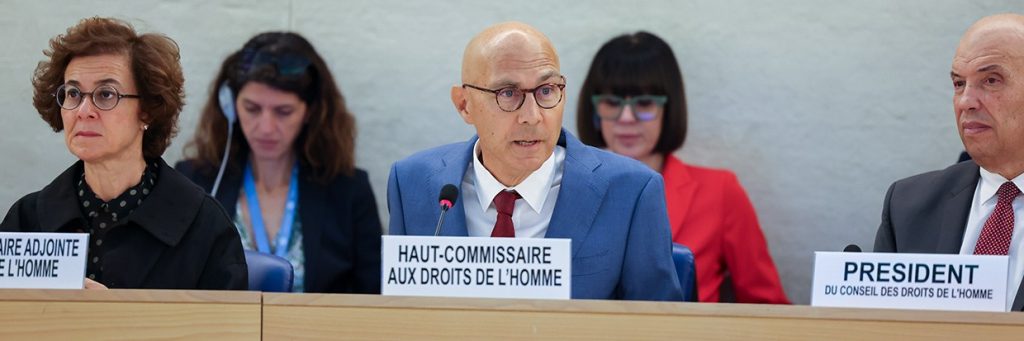
Following China Rights Review, governments must urgently hold Beijing to account for human rights failures in Tibet
Contacts:
Tenzin Jigme, International Tibet Network, +1 (703) 424 0015 [English, Tibetan] Tenzin Dolkar, Students for a Free Tibet, +1 (917) 664-5530 [English, Tibetan] Iona Liddell, Tibet Justice Center, +1 (917) 545 8627 [English] [NEW YORK] Tibetans and supporters were outraged at today’s smooth re-election of China to the UN Human Rights Council, and demand that UN member states use this as an opportunity to hold China accountable for its catastrophic policies in Tibet. A petition launched by Avaaz, supported by over 1 million people, roundly demonstrates that the global community opposed China’s re-election unless its leaders agreed to stop their systematic abuse of the Tibetan people. [1] With no challengers, it was inevitable that China would regain a seat on the Human Rights Council and we applaud the 16 governments who stood up for Tibet and said “No” to China today. [2] However we deeply regret that 176 governments ignored the UN’s own guidance for voting states by voting for China. [3]
“China’s re-election to the UN Human Rights Council is the opposite of what 1 million people worldwide wanted, and denies the realities on the ground in Tibet, where urgent change is needed” said Tenzin Jigme of the International Tibet Network [4]. “In the past 4 years, over 120 people have set themselves on fire in Tibet to protest the conditions there, yet China has been allowed to walk onto the Human Rights Council as if nothing needs to change. Only yesterday the critical importance of urgent action on Tibet was again underlined when yet another Tibetan self-immolated; a young monk named Tsering Gyal. [5]
“China will only be moved on Tibet when world governments clearly speak up in unison”, said Tenzin Dolkar of Students for a Free Tibet. “We will now take the voices of a million people to our capitals, and demand that they ensure China doesn’t turn the Human Rights Council into a puppet show for violators. Our governments must spare no effort in following through with the recommendations made on Tibet during China’s recent Universal Periodic Review.” [6]
In the run-up to today’s vote, Tibet advocates from around the world lobbied Foreign Ministries and New York-based diplomats, and delivered a massive petition from online advocacy organisation Avaaz, signed by over 1 million supporters, to 193 UN Missions. Earlier this morning the Office of the High Commissioner for Human Rights in New York accepted the petition while Tibet activists held a visual demonstration of a Tibetan monk being savagely beaten by Chinese guards in front of the UN headquarters, as a reminder to delegates arriving for the election of the human rights atrocities taking place inside Tibet today. [7] Last month in Geneva, during China’s 2nd Universal Periodic Review, 13 UN member states expressed concern about Tibet, including China’s failure to fulfil a request by High Commissioner for Human Rights Navi Pillay to visit.
“1 million people know this isn’t right – UN General Assembly members should be ashamed of this outcome, which makes a mockery of the Human Rights Council.” said Iona Liddell of Tibet Justice Center. “In order to redress this injustice, UN member states must unite for Tibet and hold China to account for its human rights violations. From now on China must be made to demonstrate its commitment to human rights as a Council member at every opportunity. This should include immediately agreeing dates for an overdue visit by the UN High Commissioner for Human Rights and facilitating early visits by Special Procedures.”
Ben Margetts Avaaz Senior Campaigner, added “Tibetans are a peace-loving inspiration to the world. And the UN Human Rights Council should be, too. It is nuts to give China a prestigious Council seat while their soldiers are beating and shooting terrified Tibetans.”
NOTES
[1] The Avaaz petition ‘Is this Tibet’s big chance?”, https://secure.avaaz.org/en/stand_with_tibet_loc/?aWzMdgb. reads: “As citizens concerned about the sustained and systematic repression inflicted on Tibetans, we call on you to ask China for specific and monitorable commitments as it seeks votes to return to the UN Human Rights Council. These should include: freedom of expression, religion, association and assembly as well as full investigations into disappearances and access for UN investigators. Let’s help China become a human rights leader fit to sit on the Council.”
[2] See webcast at http://webtv.un.org or statement if it already up. China received 176 votes, with 1 abstension out of a possible 192, resulting in 16 GA Members who voted NO for China. The identity of governments that did not vote for China are not known as the vote was a secret ballot. In 2009, China received 167 votes out of 192.
[3] “In accordance with General Assembly resolution A/RES/60/251, when electing members of the Human Rights Council, Member States shall take into account (1) the contribution of candidates to the promotion and protection of human rights and (2) their voluntary pledges and commitments made thereto. http://www.ohchr.org/Documents/HRBodies/HRCouncil/Pledges.pdf.
[4] International Tibet Network is a global coalition of over 185 Tibet campaign groups which are dedicated to advancing the rights of the Tibetan people, see https://www.tibetnetwork.org.
[5] See news report http://www.abc.net.au/news/2013-11-12/an-tibet-monk/5087256 and Tibet movement reports http://www.savetibet.org/tibetans-gather-at-monastery-in-golok-after-self-immolation-of-young-monk/ and http://www.freetibet.org/news-media/na/tibetan-monk-sets-himself-fire
[6] China’s Universal Periodic Review took place in Geneva on 22 October 2013. Tibet Recommendations and Interventions were made by Austria, Canada, Czech Republic, Denmark, France, Germany, Iceland, Japan, New Zealand, Norway, Poland, and Sweden. The Working Group included 7 recommendations in their report, see http://www.upr-info.org/IMG/pdf/a_hrc_wg.6_17_l.3_china.pdf.
[7] Photos and video available from https://www.dropbox.com/sh/oj1zzswcwe6l67n/ne-1s55XrU